What to do about the alternative minimum tax, or AMT, is among the outstanding tax matters that Congress needs to deal with during the lame duck session that began yesterday.
Although this costly parallel tax is complicated, the short-term solution isn't. Lawmakers can simply enact a patch to account for inflation and increase the amount of income (per filing status) that's exempt from the AMT.
Without the patch, more and more taxpayers — most of them what we consider middle-class — could end up owing the greater alternative tax amount.
When the last patch expired, 2010 AMT income exemption amounts dropped to $33,750 for individual taxpayers (single and head of household filers), $45,000 for married couples who file jointly (or qualifying widows/widowers) and $22,500 for husbands and wives who file separate returns.
Folks with incomes that exceed those amounts could face the AMT.
And right now, those lower income levels are what's on the IRS' draft AMT paperwork, Form 6251. The agency does note, however, that Congress "is expected to consider legislation that would increase the AMT exemption amounts."
Overlooked inflation: Why the need for such legislation? Because when the AMT was created in 1969 to ensure that wealthy individuals paid at least some tax, it didn't include a provision to index it to inflation.
That oversight means that Congress must specifically approves such an adjustment, aka the patch, each year — something it's done since 2004 — to increase the amounts of income (per filing status) exempt from the AMT.
The Obama Administration has proposed that Congress make things easier for itself and all potentially affected taxpayers by decreeing that the AMT automatically be indexed for inflation based on the tax's 2009 levels.
Others in Washington (and elsewhere) have called for total repeal of the AMT. That's a harder sell, since even with an annual inflation patch, the tax still brings in a nice chunk of change to the Treasury.
Trust us: So we'll likely get yet another temporary AMT fix for the 2010 tax year in this lame duck session.
That's the plan by Senate Finance Committee chairman Max Baucus (D-Mont.) and ranking minority Finance Committee member Charles Grassley (R-Iowa) and their House Ways and Means counterparts, Michigan Representatives Sander Levin, Democratic committee chair, and GOP ranking member Dave Camp.
The lawmakers even sent a letter to IRS Commissioner Doug Shulman, urging he and his staff to go about their business under the assumption that the minimum tax will be adjusted for inflation.
Déjà vu anyone? Remember back about this time in 2007 when Congress told the IRS, "Trust us. We'll get the AMT patch passed."
Does Congress really think everyone operates as if they're 16-year-old girls? C'mon! "Trust us" hasn't worked for ages.
Even more to the point, Congress is notorious for slipping last-minute provisions into bills. Or, as with the estate tax, simply not doing anything.
So the IRS didn't take a chance on the promise three years ago, noting that if it went ot the expense to make changes that didn't pan out, it would have to spend even more time and money to correct them.
I suspect Shulman and crew will take that same stance this year and not simply take Congress at its word about the AMT.
By the way, the 2007 AMT patch (and other tax legislation) didn't become law that year until the day after Christmas. When the 2008 filing season arrived, the IRS was still updating its computer system with the new info and had to delay processing of returns filed by AMT-affected taxpayers until mid-February.
Unless Congress gets on the stick, we might be looking at a similar situation for 2010 returns filings.
A visual example: Perhaps members of Congress should take a look at this graphic representation from TurboTax Blog of how many taxpayers might face the AMT if they don't act.
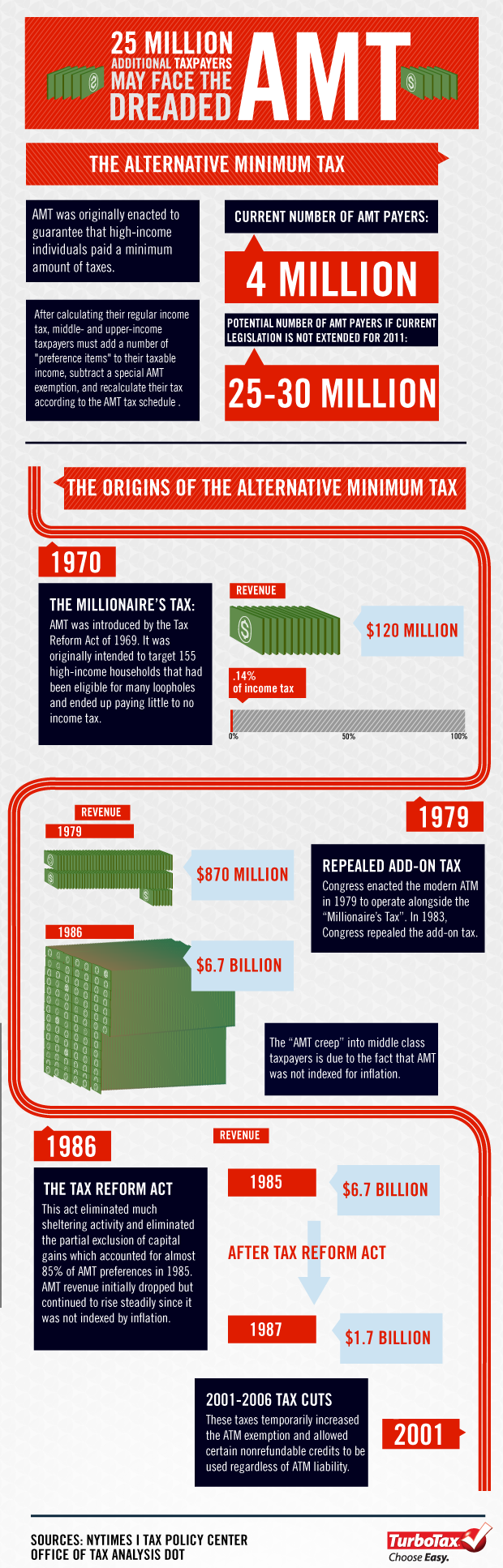
Free Tax Filing, Efile Taxes, Income Tax Returns – TurboTax.com
Get a larger view by clicking on the image.
You might have to click it again once it opens in another window.
While that's a cool looking image, the AMT itself is not a pretty picture for those whom it affects. Here's hoping Congress is true to its word and takes action on this soon.
Related posts:
- 'Trust us on AMT,' Congress says
- AMT winners = 2007 taxpayers
AMT losers = the wieners in Washington - The Advocate and the AMT
- AMT relief: one step forward, two steps back
- Tax extenders, AMT patch welcome Congress back
- AMT, take three
- AMT across the USA
- AMT moves to make — or not make — by Dec. 31
Want to tell your friends about this blog post? Click the Tweet This or Digg This buttons below or use the Share This icon to spread the word via e-mail, Facebook and other popular applications. Thanks!