

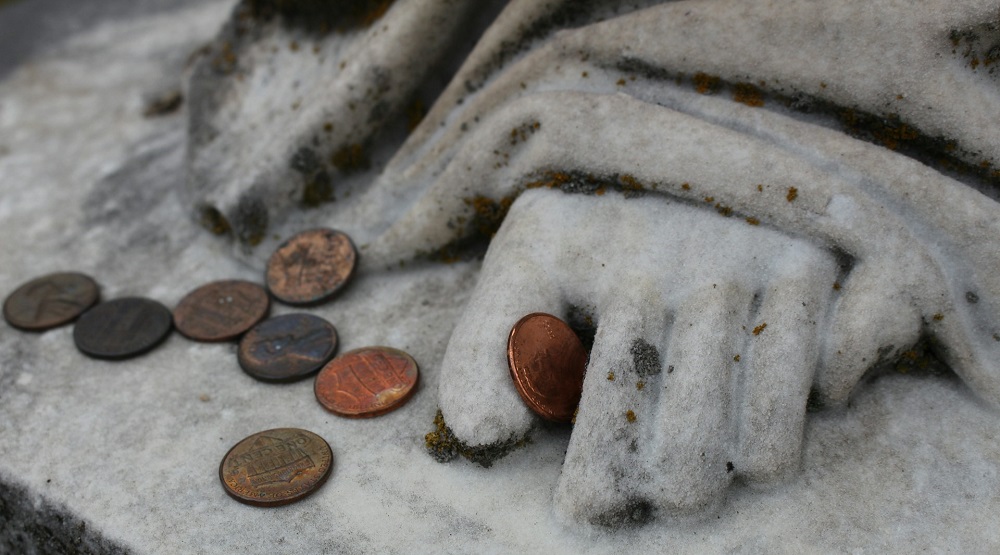
Photo by Haley Owens on Unsplash
The hubby is a patient and tolerant man. I’m glad those traits apply to some of my annoying tendencies.
But one thing I do that drives him crazy is picking up coins on the street. Or, in the case of the penny I found yesterday as I got out of my car at the grocery store, in parking lots.
Lucky for me, he doesn’t see me do this very often. I stick the pennies and other found change in my pocket and dump them in the coin jar when I get home.
And yes, I recite that silly rhyme every time: See a penny, pick it up. All day long, you’ll have good luck. I’m a bit superstitious that way.
But I ignore the adage about avoiding a facedown cent, as it’s supposedly unlucky. Hey, money is money. So, even if Abe Lincoln is eating dirt (or cement or asphalt), I pick it up and add it to the stash.
In the tails-side-up cases, I rely on the advice that Benjamin Franklin actually never offered: A penny saved is a penny earned.
Valuable collectibles: And who knows, maybe one day I’ll chance upon a really valuable penny.
OK, I know it’s a pipe dream. I have a better shot at winning the lottery.
I also know that most numismatists, like collectors of anything, enjoy the search for the items as much as they appreciate their actual collections’ monetary value.
But if they do decide to sell all or part of a valuable collection, in addition to pocketing a nice chunk of change — like the record $26,000 ($29,250 with Buyer’s Fee) paid for the transitional 1983 Lincoln Cent struck on a bronze planchet — they also might get a tax break on the amount.
Capital gains regular and special rules: When you sell a collectible item for any amount more than you paid for it, you’ll owe tax on that profit.
If that sale is completed more than a year after you obtained the item, your profit qualifies for the generally lower capital gains tax treatment.
Most of us are familiar with the three, well-publicized long-term capital gains tax rates that apply to sales of traditional assets. Those are the 0 (yes, zero) percent, 15 percent, and 20 percent rates.
But there also are a couple of other capital gains tax rates that exceed 20 percent for special assets and situations.
The portion of any unrecaptured Internal Revenue Code (IRC) section 1250 gain from selling section 1250 real property is taxed at a maximum 25 percent rate.
The taxable part of a gain from selling IRC section 1202 qualified small business stock is taxed at a maximum 28 percent rate.
And, you knew it was coming, the 28 percent capital gains rate also applies to the profit from selling collectibles, such as coins or art or stamps or other valuables.
Finally, a quick political potential planning note, since Election Day will be here soon. Vice President Kamala Harris, the Democratic nominee for president, has proposed hiking the regular capital gains rate for Americans who make more than $1 million a year from the current top 20 percent to 28 percent.
Capital gains benefits…and limitations: We’ll have to wait, until Nov. 6 and beyond, to see what might happen with capital gains taxes on Capitol Hill. For now, though, here’s a look at why the special, higher rate for collectibles.
First, why the specific designation and increased tax rate? The public policy argument for a different, and less advantageous, tax rate for profit on collectibles is that such sales don’t have any broader economic impact.
True, culturally society benefits from preservation of works of art, antiques and other collectibles.
But, goes the tax argument, there isn’t a larger-scale economic gain on investment in collectibles like we often see from investments that produce innovative techniques, new products, and higher general economic productivity.
So Uncle Sam rewards those more economically focused long-term investments that benefit the country’s gross domestic product with lower capital gains tax rates.
Defining a collectible: So what exactly is a collectible? The short, and some might say smart-ass, answer is simply that it’s an item worth collecting.
The IRS, however, has some guidelines. Here are some items that Internal Revenue Service Publication 17 notes that, for tax purposes, are typically considered collectibles:
- Artworks
- Gems
- Rugs
- Stamps
- Coins
- Precious metals (such as gold, silver, and platinum bullion)
- Antiques
- Fine wines or other alcoholic beverages
- Certain other tangible personal property
OK, that last bullet point makes my previous quip not seem so irreverent. Generally, collectibles are deemed such when the collected items have an additional value based on their rarity and market demand.
All types of collectibles: Essentially, the opinion of other collectors and experts, based on what they are willing to pay for your collection, determines its value and collectability and tax rate.
For example, since we’re heading into Major League Baseball’s post-season and several of its stars are also are within range of breaking league records, let’s consider sports memorabilia. An autographed MLB card of your childhood favorite, a journeyman ball player who happened to autograph your program at a game, is valuable to you on a sentimental basis. But the card or signature won’t net you much on the sports memorabilia market.
If, however, you ever get your hands on one of the only 75 Honus Wagner cards issued in 1909 by the American Tobacco Company, you are set for life. One of those cards was privately sold a few years ago for $1.2 million.
A more modern example is Shohei Ohtani items. The same valuation will apply to the star’s items, especially since this year, his first season as a member of the Los Angeles Dodgers, he’s on pace to become the first player to hit 50 homeruns and steal 50 bases.
Figuring your tax: As with all investments, you’re taxed on the profit. That’s what you sell it for minus its basis.
Basis begins with your acquisition cost, which for collectibles generally include auction and/or broker’s fees along with what you paid for the item.
If you inherited the collectible, your basis is the item’s fair market value at the time of bequeathing owner’s death.
Note, too, that if your collectible item requires special care, for example, added costs to maintain the piece or restore it, those expenses also are part of your basis in the collectible.
What you get when you sell the item, less the accumulated basis, is the amount upon which you’ll owe taxes at 28 percent.
Again, that rate applies if you sell it more than a year after buying or inheriting it. As with all capital gains calculations, if you sell a collectible you’ve owned for a year or less, your profit is taxed at your ordinary income rate.
Also note that you might not owe the 28 percent rate.
If you figure your tax using the maximum capital gain rate and the regular ordinary tax rate for your income level and find that the ordinary tax is lower, then that’s what you pay.
Why you collect: Finally, the approach you take to your collecting also could affect any potential taxes.
Collectors of valuable items do so because they are (1) dealers in the goods, (2) see the items good investments or (3) simply enjoy collecting as a hobby.
The tax treatment for each circumstance is different and discussed in the CPA Journal’s articles Planning and Tax Considerations for Collectibles, and Planning for Collectibles.
You also might find these items of interest:
- Estate gets $14 million tax refund on value of art
- ‘Justin’ Bieber and other collectible baseball cards face a special capital gains tax rate
- Previous Year of the Monkey stamp offers collectors a nice profit, but a higher capital gains tax rate
Advertisements
🌟 Explore Prime for Young Adults 🌟
The text link above is an affiliate ad. If you click through and then buy a product, I receive a commission.
