Photo by Rob Martin on Unsplash
Today marks the 12th day of the current government shutdown. Some of the effects of the partial closure of many federal offices — and, notably, the loss of wages for federal workers — are starting to be felt.
Will that personal inconvenience, or worse, since most Americans don’t have an emergency fund, be enough to get Congress back to the bargaining table?
Don’t count on it.
Donald Trump has pledged to relieve the income pressure on military personnel, a large section of federally compensated employees. That could provide enough leeway for the politically entrenched sides to continue the holdout.
Since we don’t know when this government lockdown might end, this eve of its move into the closure’s second full work week seems like a good time to review the recent history of such closures.
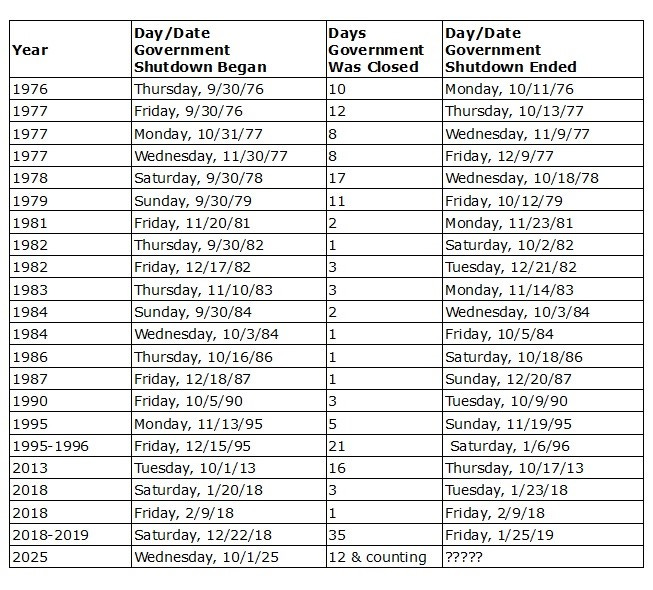
A few notes about the table.
It does not include closures that were settled before a full day are not included. And partial closure days are rounded up to the next full day count.
It’s also a screen shot. When my blog is back online (again, soon, fingers crossed), I’ll post this information with a table that I can update.
Closure length and costs: This is the third federal government closure under Trump. He also holds the records for being in the Oval Office for the longest (35 days) and most costly ($11 billion, including an estimated $3 billion in lost gross domestic product, or GDP) closure back in 2018-2019.
When my blog is back, those two numbers — 35 and $11 billion — will the joint [dis]honorees for this weekend’s By the Numbers recognition. And yes, I’ll get back to the tax inflation series on Monday.
That Trump shutdown was prompted by Democrats’ refusal to meet 45’s demand for money to build a wall along the U.S.-Mexico border.
The standoff was effectively ended when air traffic controllers began calling in sick, forcing travel delays. Some decried the calls as fake, but there’s physical illness and then there’s the sick feeling when you are so overworked you can’t do your job properly. And we all want the folks in charge of landing the planes to be in top shape.
That also caused a break in Republican ranks, with some finally pressuring the White House to agree to a temporary spending deal, without the wall money, to reopen the government.
Potential pressure to force a deal: Will such real-life consequences, and complaints from constituents, produce a similar result this time, before the Uncle Sam shutdown record(s) are broken?
Under the Trump regimes, my crystal ball turns into a Magic 8 Ball, simply repeating, “Reply hazy, try again.”
So, let’s go to the polls. A recent one from Ipsos found most Americans are at least somewhat concerned about the government shutdown, but it’s not very concerning to most.
That could change as the aforementioned missed paychecks and missing federal dollars that support government services start to show up in real-life situations.
Already, air travelers have faced flight delays; there are no telephone hotlines for taxpayers seeking Internal Revenue Service help as the Oct. 15 extended filing deadline nears; and folks looking to spend a break at a national park have been turned away.
Then there’s Nov. 1. That’s when open enrollment starts for Affordable Care Act (ACA, or Obamacare) coverage begins. The federal tax credit that subsidizes coverage for millions of policy holders is the basis for the current government closure.
If the government is still closed at the start of next month, ACA enrollees will see the new premium rates. For many, the amounts could more than double without the expanded Premium Tax Credit.
Political position, real-life harm: I know a lot of people don’t have a lot of empathy or sympathy for the federal government or its workers.
These cut-the-government folks also tend to ignore just how large a role Uncle Sam plays in all our lives, tangentially if not directly.
They don’t fully realize how much they are supported by the federal government because it’s hard to directly connect the dots from taxes to services. Also, government operations are complex. And then we have all the external factors that influence, symbolically if not practically, our social attitudes about government benefits.
My basic belief is that we humans are selfish. If something doesn’t affect us directly, it doesn’t matter. And a lot of us don’t know the very real, average working people who, until the start of this month, were just doing their federal jobs.
Adding insult to injury is that this shutdown, like almost all such closures, was made possible by members of Congress, all of whom are still being paid. Many of those Representatives and Senators are well off enough to not even need their Congressional paychecks.
True, we all are at the whims of our employers, but this too-often repeated Washington, D.C., situation typically happens because of politics. That’s all well and good in the abstract. In reality, some of us now are seeing our relatives, friends, and neighbors worrying about meeting their daily living expenses.
And no, while I tend to support many government programs, I’m not advocating unchecked spending. I understand living within a budget. But a government is not the same as a personal financial spreadsheet. There’s a societal compact to be fulfilled for the greater good of all of us.
Sooner or later, all of us need some — and in some cases, a lot of — help from Uncle Sam.
Capitol Hill needs to work on making such assistance possible within reason, rather than just cutting it all off to prove a point that is pointless to those losing a paycheck and/or necessary services.