
Photo by Sean Lee on Unsplash
…
The Internal Revenue Service wants to add a citizenship and work authorization status question to our tax year 2026 Form 1040. The inquiry, an apparent attempt to further involve the federal tax agency in the Trump administration’s ongoing immigration enforcement efforts, is likely to face legal challenges from tax privacy advocates.
…
When we file our tax returns next year, the Internal Revenue Service might want even more information about us beyond how much we made and what tax breaks we are claiming.
It is proposing that we answer this checkbox question as we begin filling out our Form 1040:
At the time you file your return, are you, and your spouse if filing jointly, a U.S. citizen, U.S. national, or an alien lawfully authorized to work in the U.S.?
That’s an excerpt below of the 2026 tax year draft Form 1040, posted at IRS.gov on Sept. 17. The red arrow was added by me, not the IRS.
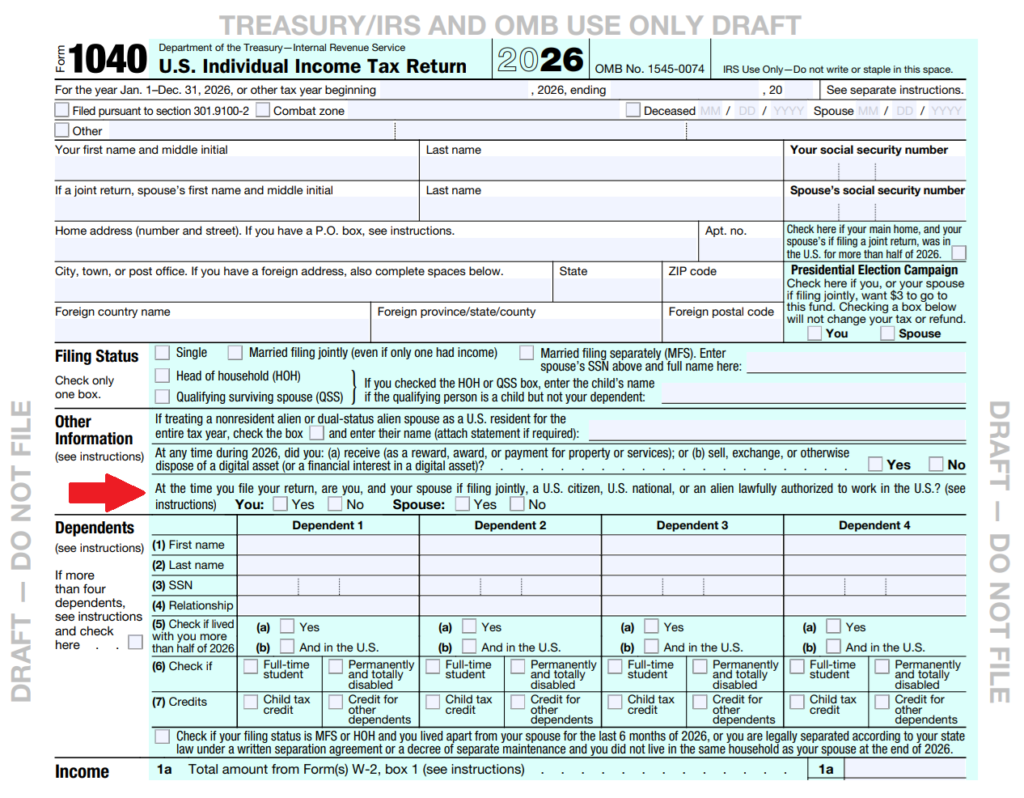
The draft instructions for the 2026 tax year 1040, which the Other Information section header tells us to see for more information, have not yet been posted.
Still just a draft: This is not the first run at such a question the IRS has made. Reuters reported back in May that the IRS was considering a citizenship status checkbox question on Form 1040 as part of the Trump administration’s immigration enforcement push.
If this September draft question does make it onto the form, it would be the first time the primary federal individual income tax return would directly ask taxpayers about their citizenship and work status.
That said, the key thing to note right now is that this is a draft form.
Just because the IRS put the proposed Form 1040 for filing our 2026 returns on its website last week, that does not necessarily mean this will be the individual tax return that we will use when we file next year.
But even without checking Kalshi or Polymarket, odds are good that this or some version of a filer’s citizenship will show up on our tax forms in 2027.
Court challenge likely: Another pretty safe bet (or prediction contract position) is that the tax form’s citizenship question will end up in a federal court.
Since the start of Trump 2.0, this administration has been trying its damnedest to co-opt as many federal agencies and agents as it can to find people it believes don’t belong here. The latest effort is to (again) insert a citizenship inquiry on the upcoming U.S. Census.
That hasn’t worked as well as the White House and its minions had hoped.
As for taxes specifically, a D.C. Circuit Court panel ruled on Sept. 8 — just 10 days before the IRS posted its Form 1040 draft — that a data sharing agreement between the IRS and U.S. Immigration and Customs Enforcement (ICE) that allows the immigration agency to make mass requests for immigrants’ addresses was illegal.
The reason for the court’s decision? The procedure failed to ensure ICE requests satisfied federal requirements governing disclosure of confidential tax information.
This most-recent ruling follows a federal judge’s February determination that the IRS broke the law almost 43,000 times when it turned over immigrants’ addresses even when ICE submitted requests with random numbers as the ZIP code.
The legal question likely to settled by a judge regarding the proposed Form 1040 citizenship question will focus on the intricacies of taxpayers’ guaranteed privacy as far as information we filers directly provide the IRS.
Form change fight ramifications: Will the recent ICE/IRS legal findings prompt the administration and its tax agency officials to walk back the proposed Form 1040 citizenship question?
If not, will the expected federal court debate drag on as the new filing season nears? If so, that could slow the issuance of new tax forms. That, in turn would delay next year’s filings and/or the IRS processing of them.
Again, the question comes down to whether there are legitimate reasons for the IRS to need filers’ citizenship information.
In most cases, when a person has legally issued Social Security number, they are citizens. Where a taxpayer who uses an Individual Tax Identification Number (ITIN) claims a tax break that is restricted to U.S. citizens, can’t the IRS form on which it is filed ask the citizenship question there?
That is happening, too, as least on another draft tax form.
The new Form 1040, Schedule 3-A, Federal Public Benefit, will be required from filers who claim the Earned Income Tax Credit (EITC), additional child tax credit (ACTC), refundable American Opportunity educational credit, or refundable adoption credit. Part II of Schedule 3-A drafts (in both English and Spanish) seek Verification of Eligibility for Federal Public Benefit by asking “Are you or your spouse a U.S. citizen, U.S. national, or qualified alien?”
But apparently those behind the entangling of the IRS and immigration believe in redundancy. And it is much easier just to go with the blanket citizenship inquiry that specifies lawful work authorization from the top, figuratively as well as literally on the draft 2026 tax year Form 1040.
Fiscal costs, too: I know I shouldn’t be surprised by anything, tax or otherwise, this deep into Trump’s second turn in the Oval Office. But I am feeling a little icky with what appears to be Stephen Miller’s anti-immigrant fingerprints showing up on future federal tax forms. This guy just Will. Not. Let. It. Go.
However, his efforts to dramatically reshape (and reduce) the U.S. population could, as has been noted by me and others covering the tax world, backfire spectacularly.
Immigrants, including those who do not have proper paperwork, must by law file taxes. They use the same IRS forms as do taxpayers who are U.S. citizens. Millions of undocumented immigrants have fulfilled this tax obligation because they were told, by the U.S. government no less, that paying taxes is an indicator of reliability and respect for the law that could help them eventually obtain legal status.
That, it seems, is no longer the case. Tax professionals who work with immigrant populations say this policy shift could lead to a substantial, and fiscally costly, reduction of such filers.
The Yale Budget Lab estimated that lower tax compliance rates among immigrant communities could lead to a $313 billion loss in federal revenue over the next decade. That potentially uncollected tax money earns this weekend’s By the Numbers recognition.
So, whether you are or are not a U.S. citizen stay tuned. We all might have some additional information about ourselves to share with the IRS come filing time next year.