
Some ghosts this Halloween are cool trick-or-treaters. But when it comes to taxes, beware of ghost preparers. (Photo by Harun)
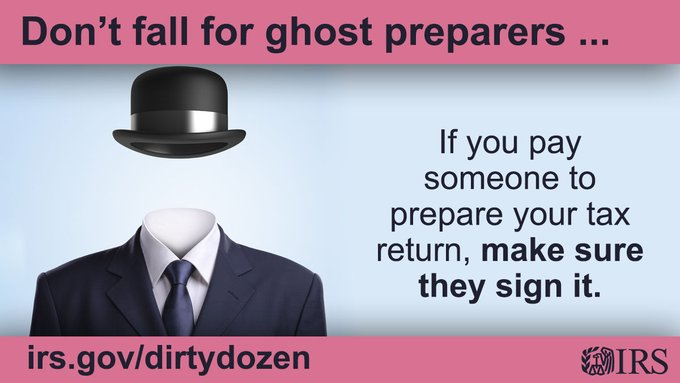
A ghost preparer is not some spectral tax entity. It is a tax preparer who completes a client’s return, but refuses to sign it and/or refuses to include a Preparer Tax Identification Number (PTIN).
But omitting such identifying information, these unscrupulous paid preparers not only file fraudulent income tax returns for clients, but also steal those victims’ tax refunds and identities.
Their hidden tax identities also allow them to escape accountability when client returns invariably are rejected by the Internal Revenue Service or the taxpayers’ refunds are sent directly to the unscrupulous preparers.
That’s why ghost tax preparers are regulars on the IRS’ annual Dirty Dozen tax scams to beware of and avoid.
It’s also why the Government Accountability Office (GAO) recently, and with great spooky season timing, investigated how the IRS can improve its ghost preparer identification and compliance efforts.
IRS efforts to unmask ghost preparers are lacking
Courts have ordered ghost preparers that the IRS and its law-enforcements branch IRS-CI have caught to pay millions of dollars in restitution to the government.
But the IRS acknowledges that the total financial cost of ghost preparers is likely greater, in part, because ghost preparers are difficult to detect.
The IRS maintains some data on identified ghost preparers, notes the GAO study, but the systems it uses is fragmented. The tax agency currently identifies and addresses ghost preparers through data analysis, referrals, taxpayer education, and enforcement actions such as investigations.
However, these anti-ghost preparer efforts are spread across six offices that do not regularly share their separate findings.
Not surprisingly, this fragmentation hinders each office’s usefulness. The lack of information sharing ultimately means that the IRS’ overall enforcement efforts against ghost preparers is not as effective as it could be.
“As a result, IRS does not know how many ghost preparers it has identified, investigated, and addressed,” according to GAO investigators.
Changing this approach, says the GAO, would allow the IRS to better address the risks ghost preparers pose to individuals filers and the U.S. Treasury.
Example of Current Fragmented IRS Activities
Compared to a Comprehensive, Coordinated Strategy
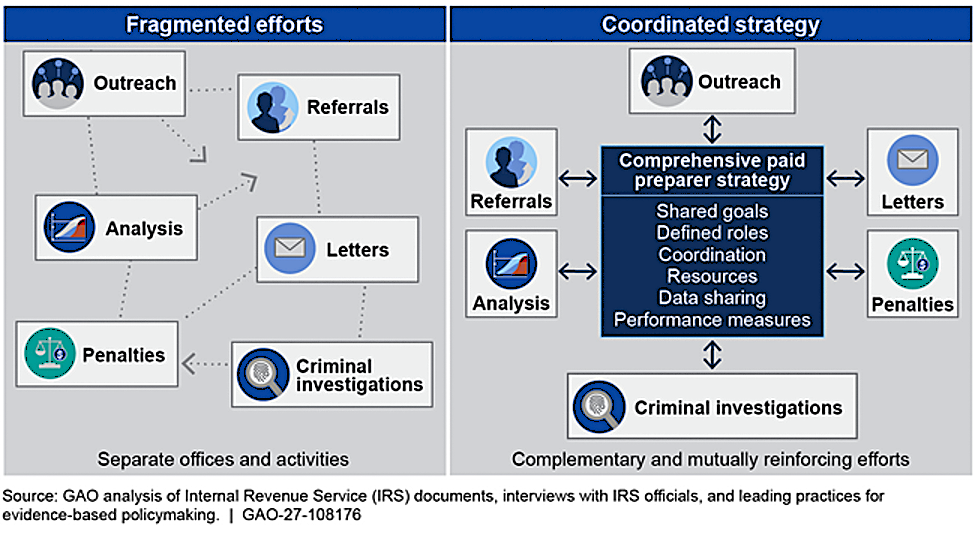
Defining objectives, goals, and performance measures could help IRS reliably assess whether its efforts are reducing ghost preparer activity and adjust its strategy and allocate resources more effectively.
How to spot a ghost tax preparer
The GAO conducted this study because paid tax preparers prepared more than half of all tax returns in fiscal year 2025. These tax professionals, noted the government watchdog, have an enormous effect on IRS’s ability to administer tax laws effectively.
At the other end of the enforcement spectrum, ghost preparers undermine the IRS’ core collection and enforcement efforts. By hiding their identities, ghost preparers escape accountability and leave taxpayers responsible for the inaccurate or fraudulent returns filed by the phantom preparers.
And that’s just the financial cost. Ghost preparers’ targets also must deal with the emotional effects of falling victims to the fraudsters. But there are some warning signs that can help you avoid ghost tax preparers?
First, don’t fall for unsolicited offers to preparer your taxes. This isn’t just advertising. It’s a scheme designed to hook victims by promising large refunds that are paid quickly. That’s horse hockey.
To achieve a refund that’s much bigger than you expected, criminal preparers inflate taxpayer income or falsely claim tax deductions or credits.
Unfortunately, changes to the tax code, like the new ones created by the One Big Beautiful Bill Act, make these pitches easier. If a tax preparer says you are eligible for one of them (or others, like the Earned Income Tax Credit, that have long been in the tax code), make them fully explain how. If the explanation sounds iffy, trust your gut. Walk away.
Also beware of tax preparers whose fee is based on the amount of refund they get you. That’s a signal they likely will do all they can to bump up that amount to put more money in their pockets.
Other tricks ghost preparers use that could metaphorically make your head spin like young Regan MacNeil’s in in the classic 1973 film The Exorcist include requiring payment in cash only and not providing a receipt, and directing refunds into any bank accounts other than the taxpayer’s account.
And if they show you a return that’s ready to go, but doesn’t include the paid preparer’s name, signature, or PTIN, don’t sign off on it either. The preparer probably will tell you that the information will be added before the return if filed. Ask them to show it on the final return they show you for your approval.
The bottom line, both on the tax form where signatures are required and in dealing with a questionable filing, is to never put your John Hancock, by pen or electronically, on a tax return that is blank or incomplete.
If your preparer does or suggests any of these actions, take the advice of one of the best modern scary movies and Get Out!
Don’t let a tax pro mistake haunt you
All the talk about signing your Form 1040 is more than just talk. Even if you pay someone to prepare and file your taxes for you, the ultimate tax responsibility is yours. So, any wrong information filed by a paid preparer could come back to haunt you.
You agree to that when you sign, either by pen to paper or electronically, your Form 1040, as shown in the excerpt below.

Note the sentence before the signature line above, which says, “Under penalties of perjury, I declare that I have examined this return and accompanying schedules and statements, and to the best of my knowledge and belief, they are true, correct, and accurately list all amounts and sources of income I received during the tax year.”
And when it is egregiously incorrect info entered by a criminal preparer who ghosts you by disappearing after getting your preparation payment and/or refund money, the costs could be dramatic.
So, instead of falling for fake filing promises, use a trusted tax professional. You have lots of choices, as discussed in my post Tax law changes highlight the importance of professional tax help. One should be able to meet your personal tax and financial needs.
You can find accredited preparers in the IRS’ public tax professionals directory. The searchable, sortable database includes the name, city, state, and Zip code of those preparers, as well as enrolled retirement plan agents and enrolled actuaries, who have valid PTINs for the current tax season.
You also can use the find-a-tax-pro search options at the National Association of Enrolled Agents and National Association of Tax Professionals websites. If you’re looking for a CPA, your state’s CPA society is a good starting point.
Once you decide on a tax preparer, thoroughly check out that person, making sure some basic vetting tests are passed.
If you just can’t afford to pay for tax help, during filing season IRS-trained and authorized volunteers staff Volunteer Income Tax Assistance (VITA) and Tax Counseling for the Elderly (TCE) sites nationwide. (And if you’re interested in being a VITA or TCE volunteer, the IRS would love to hear from you.)
Finally, if you do find you hired a ghost preparer or other crooked tax pro, let the IRS know about the unscrupulous paid tax assistance. Your report will the IRS track down the bad actors.
I know that these worries are still a few months off. But some folks are starting to look for professional tax help before the end of the year. And the potential scares of bad tax pro choices are definitely worth an early warning this Halloween season.