Photo by Nataliya Vaitkevich
Few things are worse than having to deal with the Internal Revenue Service when it has questions about your tax account.
But there is one thing that can top that. Having the IRS follow-up be prompted by a problem that arose because you fell prey to a tax scam.
I am definitely not judging. Tax criminals have gotten savvier, thanks to all their practice over the years.
Artificial intelligence (AI) advances also help the crooked causes. So do federal lawmakers, whose regular reworking of the tax code creates new avenues for tax deception.
These factors are among the reasons that nearly a quarter of those surveyed earlier this year by computer security company McAfee admitted to losing money to a tax scam. That is scary!
So, this Halloween Eve, here are reminders of some perennial schemes you’ll likely find on the IRS’ annual Dirty Dozen list, a look at a few new (or evolving) ones, and how to avoid falling for any webs of tax deceit.
IRS imposter scam
Uncle Sam’s various tax-related agencies started tracking this fake IRS agent telephone scam in October 2013. Soon, law enforcement and tax officials dubbed it the largest tax scam ever. Four years later, 24 people were convicted of participating in the original scheme that defrauded taxpayers and the U.S. Treasury of millions.
But the template was in place, and it’s still being used.
Con artists still are impersonating IRS agents, telling victims they owe taxes. If you answer, you’re told to settle the false tax debt by paying the calling crooks via pre-paid debit or gift cards, mobile payment apps, or wire transfers.
If you don’t, threaten the crooks, you’ll face a variety of punishments, including possible arrest.
Lottery or inheritance scam
This is a carrot instead of stick impersonation scam. Fraudulent telemarketers from outside the United States call claiming that you have won a sweepstakes or foreign lottery or that you are the recipient of an inheritance.
They may claim to be an attorney or a public official.
These crooks then tell that to get your fake winnings or bequest, you must pay associated fees for shipping, insurance, customs duties, or taxes due on the amount.
Timeshare or real estate sale scam
Scammers, often using public records to find their targets, impersonate real estate agents. They offer to help you sell a timeshare or other property you own for a very attractive price.
To do so, the crooks will ask you for sensitive personal information.
They’ll also try, as in the winnings/inheritance scheme, to get you to send them money to pay fees and taxes associated with fake sale process.
Fake tax credit schemes
The tax code is complex. Changes to it, such as new tax laws included in the recent One Big Beautiful Bill Act, add to taxpayer confusion. Crooks know this. They use real tax credits and IRS forms as a hook to try to steal your money and/or financial and tax identities. Or they create their own false tax breaks that sound similar to existing ones.
Recently, scammers have been promoting and selling non-existent “Tribal Tax Credits” or “Native American Tax Credits.” These are fake, nonexistent tax credits. exist. But promoters are hoping that you don’t know this. They will encourage you to purchase these credits to falsely reduce your tax liability or generate large refunds.
Another bogus credit to watch out for is a broad “self-employment tax credit.” It is true that self-employed individuals may qualify for certain credits, but there is no one, consolidated self-employment tax credit.
And with rising fuel costs on everyone’s minds right now, a tax scam that was popular about a year ago has re-emerged. Crooks are again promoting the misuse of a real fuel tax break.
The Fuel Tax Credit is a legitimate, in the Internal Revenue Code tax break. But it generally is available only to business owners who meet certain requirements, such as non-taxable off-highway business use.
Costly fake filings
Thousands of taxpayers have lost money to tax imposter scams. Those who filed inaccurate returns based on information from scammers who posed as tax experts also paid the crooks for the bad tax advice.
And the scam victims’ tax troubles escalate from there.
When the IRS catches the illegal filings, the taxpayers get the bad news that the lower tax bills or refunds they expected from the scammers’ claims are denied. They owe the real tax dues.
They also face interest due on the unpaid tax, as well as potential fraudulent filing penalties.
Scam red flags
The best way to avoid becoming a tax scam victim is to be skeptical of unsolicited tax advice.
Also know some common warning signs of an abusive tax scheme. They include —
- Promises for larger refunds or tax savings;
- Offers to purchase tax credits for substantially less than their value;
- Claims of only a limited number of credits available or that taxpayers must act fast;
- References to government or interagency agreements that aren’t publicly available;
- Legal opinions that can’t be verified directly with the attorney or law firm identified;
- Requests to sign a nondisclosure agreement before receiving basic information about a tax credit;
- Use of misleading information on social media to promote fake credits or misuse of credit;
- Phishing emails that come from purported official offices, but which are rife with misspellings and/or questionable websites and URLs.
That last bullet point is obvious in the email message below that I got earlier this month. It uses IRS.gov, but as part of the bogus IRS.GOVnoreply address. It also has that ridiculously long URL that would take me to a fake IRS site and/or immediately infect my laptop with malware.
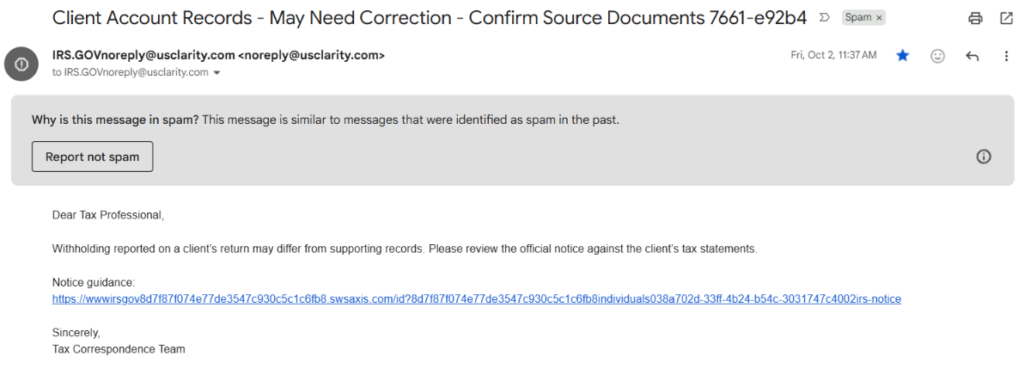
The message automatically went to my spam folder. If a similar IRS scam email makes it into your inbox, don’t click on any attachments or links.
Do let the IRS know of the scam attempt. Forward the scam email to phishing@irs.gov. On the subject line, note “IRS” if it is IRS-related or “Treasury” if Treasury-related.
Then delete the scam attempt.
Report tax scams
Taxpayers with information about tax fraud or other illegal tax-related activity also can submit a tip using the IRS’ consolidated fraud online reporting page.
Your information can help the IRS shut down scams, phishing attacks, and other fraud attempts to trick people into paying or sharing their personal and tax information with tax con artists.
Who knows, your report may be the item that finally breaks the case the IRS, its law-enforcement branch IRS Criminal Investigation (IRS-CI) RS IRS-CI, and federal prosecutors have been working to bring.
When that happens and the tax miscreants are caught, charged, and ultimately convicted, I’ll include it on the ol’ blog’s Tax Felon Friday page.
This post with its list of tax scams has been added to that special page, meaning it’s for now at the top of the list. Just scroll down for more.
And if you’re looking for more tax crime posts, notably those that were published long before I gave them a special end-of-week feature moniker, they’re in the ol’ blog’s tax crimes category.