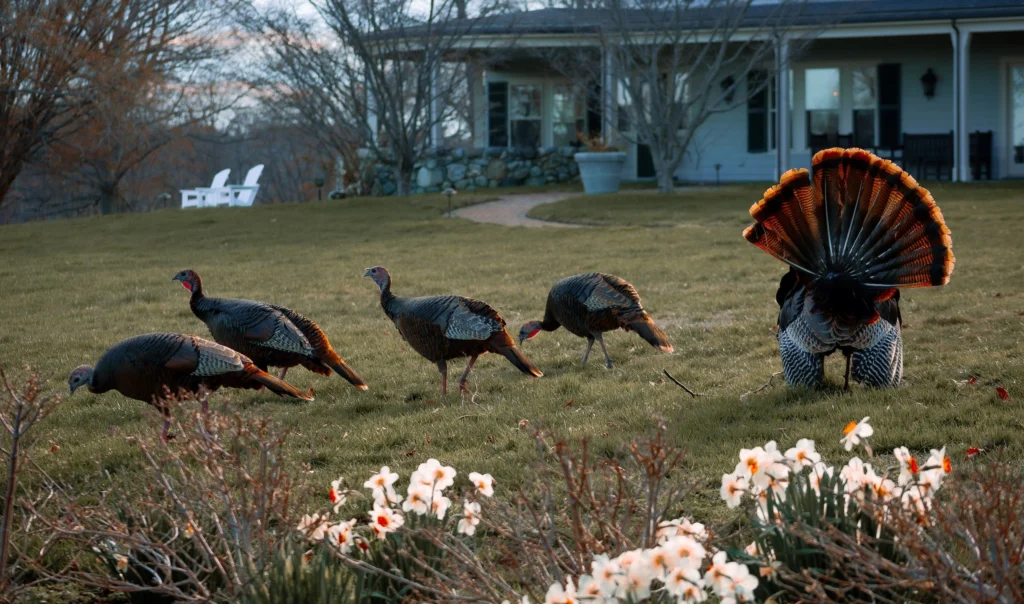
Five turkeys might not technically be enough to be classified as a rafter or gang or death row of turkeys — and yes, all are among the many collective nouns for a gathering of this particular fowl — but these birds do represent today’s fifth and final Tax Turkey to Avoid, a connection of retirement and charity tax laws. (Photo by Chris Henry on Unsplash)
If you have a tax-deferred traditional IRA and are facing a required minimum distribution (RMD) by Dec. 31, there is a way to avoid that taxable withdrawal. You can roll up to $111,000 of your RMD directly over to a qualified charity. Failing to take advantage of the tax-saving RMD-to-QCD option is 2026’s final Tax Turkey to Avoid. And on sad note, it also means no more turkey photos.
🦃 Happy 🥧 Thanksgiving 🏈 Eve! 🦃
I hope your day before Thanksgiving is going well and you’re set for Turkey Day. Family and friends have arrived. You have all your fixings. And the only disagreements are between opposing football fans.
Literally giving in addition to giving thanks also has become a seasonal tradition for many. Some participate in Giving Tuesday, the unofficial holiday for nonprofits on the Tuesday after Thanksgiving. Others make their charitable gifts in December.
The most popular way to give to your favorite charity is with a cash gift. Here the Internal Revenue Service interprets cash as not just currency, but also checks, money orders, and credit card charges.
But there are many ways to give.
Tax Turkey #2 looked at one overlooked option, giving appreciated assets.
And you could commit today’s Tax Turkey #5 if you don’t examine donating your traditional IRA’s required minimum distribution (RMD).
Many RMD ages …
Owners of traditional IRAs must, at some point in their seventies, withdraw at least an IRS-specified amount each year and pay tax on it.
That’s why some, as noted in Tax Turkey #4, explore converting that retirement plan to a tax-free Roth IRA.
Currently, mandated IRA distributions kick in at age 73.
Folks born in 1960 or later won’t face RMDs until they celebrate their 75th birthday.
And those who were taking RMDs before the SECURE changes became law are still making these annual withdrawals.
… One donation option
But one thing the comprehensive retirement legislation didn’t change was the Qualified Charitable Distribution (QCD) opportunity. Here, you can directly transfer a sizeable amount of your RMD to a qualified charity.
When it was created, the allowable QCD amount was set at $100,000. But the law also lets the IRS adjust the gift amount each year for inflation. The 2026 tax year QCD amount is $111,000. It goes to $114,000 in 2027.
This could be a valuable tax-saving move.
The QCD amount that is at least your RMD counts as meeting that annual withdrawal rule. That ensure you don’t face the penalty for not taking the required amount.
Even better, since you don’t take possession of the IRA money, you don’t owe tax on it.
Pre-RMD tax planning
The SECURE legislation also left in place the age requirement to make this charitable retirement account move. It’s available once you reach age 70½.
That lets you give a QCD to a charity, up to the annual limit, before you have to start taking distributions from your IRA.
These early QCDs can’t be carried forward to offset RMDs you must take in the future.
However, whittling down your traditional IRA’s balance before you must take RMDs could be a valuable financial and tax move. The smaller your IRA when RMDs are eventually due means smaller required withdrawals.
The earlier QCD eligibility age gives you two-and-a-half years (or more, if you don’t face mandatory withdrawals until age 75) to do just that.
Follow QCD rules
A QCD used in place of an RMD or before the withdrawal is due can be a valuable tax tool as long as you employ it properly.
The first consideration if you’re thinking of making a QCD is to ensure that you don’t need the retirement money to meet your current living expenses.
Once you clear that financial hurdle, then follow the tax rules.
The first is knowing which retirement accounts can use QCDs.
RMDs are required from a variety of tax-deferred retirement accounts. They are listed in my earlier post on turning your RMD into a QCD. But a QCD must come from a traditional IRA, including traditional rollover and inherited accounts.
Your QCD must go to an IRS-qualified charity. This is a not-for-profit that the IRS has granted 501(c)(3) charitable organization status. The QCD cannot go to donor advised funds (DAFs), private foundations, or supporting organizations.
Your IRA custodian must arrange for the transfer of the IRA funds to the nonprofit. This is accomplished by your retirement account trustee directly issuing the RMD amount as a QCD to the charity, either electronically or by check payable to your chosen nonprofit.
Married couples who file jointly can get double the donation. If each spouse has an RMD-affected IRA, the QCD limit applies to each spouse.
Finally, you cannot claim the QCD amount as a charitable tax deduction. But that’s not a bad trade.
By offsetting your annual RMD, your generosity via a QCD keeps that donated amount out of your taxable income total at tax filing time.
Tax Turkeys are done!
And with this look at failing to turn your RMD into a QCD, the 2026 version of Tax Turkeys to Avoid is done.
If you missed any, here’s the full list of fowl tax fouls —
- Tax Turkey to Avoid #1: Failing to create a tax deduction bunching strategy
- Tax Turkey to Avoid #2: Overlooking appreciated asset charitable gifts
- Tax Turkey to Avoid #3: Wasting your medical FSA funds
- Tax Turkey to Avoid #4: Not exploring a traditional-to-Roth IRA conversion
- Tax Turkey to Avoid #5: Failing to turn your RMD into a QCD
I hope a few apply to you and help you save on your taxes. Or at least, these five tax turkeys give you something to think about when it comes to your tax situation.
After the holiday, of course!
🦃 Happy 🥧 Thanksgiving 🏈 Eve! 🦃