

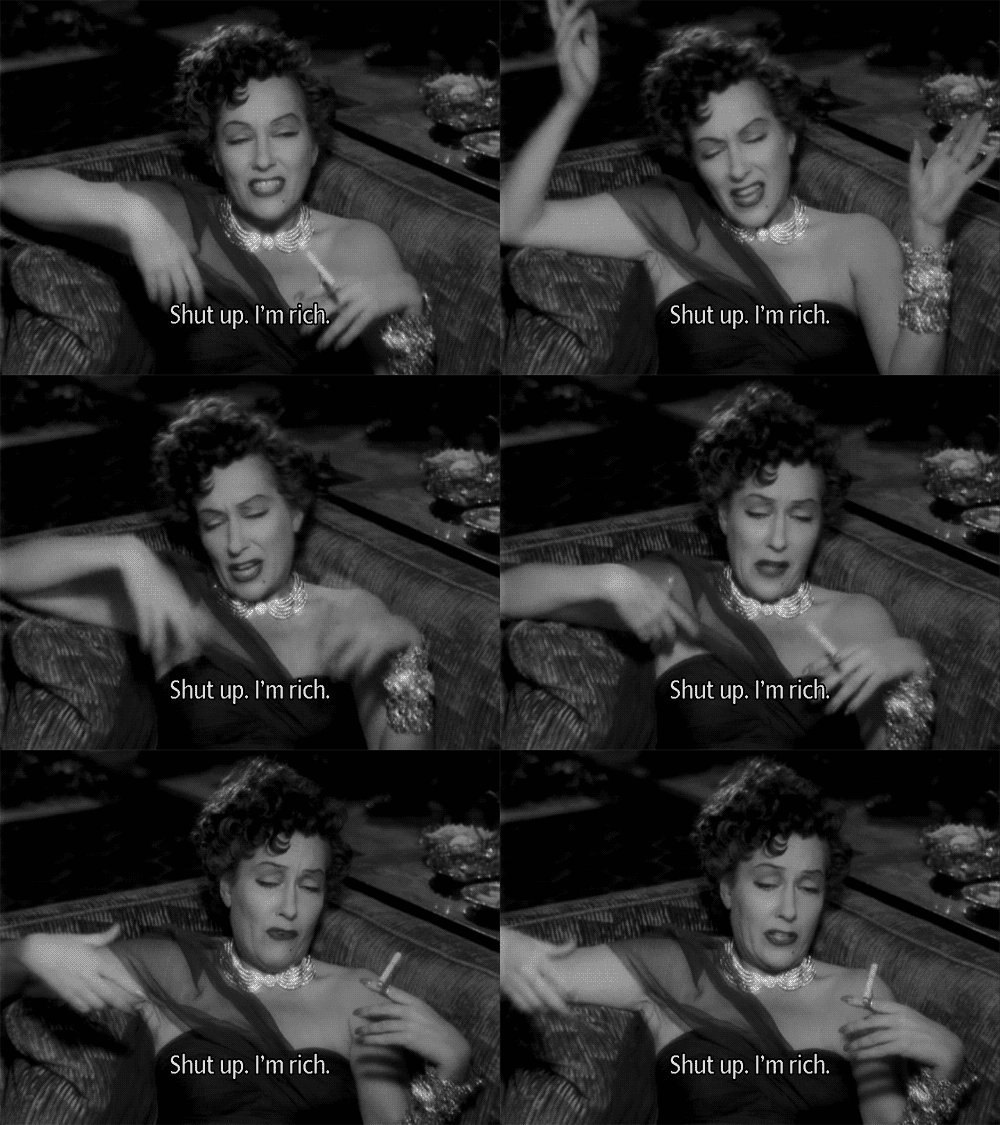
Gloria Swanson in Sunset Boulevard via Giphy
Republican members of Congress returned to their districts this month, but some of their town hall meetings to tout the advantages of the One Big Beautiful Bill (OBBB) Act have not been that successful.
It seems that many Americans don’t really like the bill, despite its continuation of the Tax Cuts and Jobs Act of 2017 individual tax rates and larger standard deduction amounts. Even some of the temporary tax benefits aimed at lower-to-middle-class workers have not been enough to sway the public’s perception.
One of the issues is how the OBBB favors the richest Americans.
That’s not a new tax development. In fact, a recent study found that billionaires paid lower effective tax rates than most of the rest of the United States’ taxpayers.
That’s why today’s Saturday Shout Outs go to articles looking at how the other, richer citizens are taxed.
Let’s start with that study, How Much Tax Do US Billionaires Pay? Evidence from Administrative Data, from UC Berkeley economists Akcan Balkir, Emmanuel Saez, Danny Yagan, and Gabriel Zucman and published by the National Bureau of Economic Research.
The Berkeley economists compared data from the Forbes 400 list with statistics from the Internal Revenue Service on individual, business, estate, and gift tax returns 2010 to 2020 and found total effective tax rate for that wealthy group was lower than the general U.S. population.
“In our benchmark estimate, the total effective tax rate — all taxes paid relative to economic income — of the top 0.0002% (approximately the “top 400″) averaged 24% in 2018–2020 compared with 30% for the full population and 45% for top labor income earners,” according to the report.
Part of the tax rate disparity comes from the types of income taxed. Warren Buffett tipped us off to this back in 2011. And it leads us to the next shout out.
In The Tax That Billionaires Actually Pay, Wall Street Journal reporter Richard Rubin notes that, “One of the most important tools for taxing the wealthiest sliver of Americans is a levy they don’t pay with a personal check to the government: the corporate income tax.”
“The corporate tax is effectively the tax that billionaires pay at source. So it is one that is still a major tax for them,” one of the study’s co-authors Emmanuel Saez told Rubin.
Aaron McDade also took a look at the study for Investopedia and his article Why America’s Richest Pay Less in Taxes: The Surprising Truth Revealed also earns a shout out this weekend.
He notes that the UC Berkeley research confirms what many Americans have long suspected: The ultrawealthy pay proportionally less in taxes than everyone else. Specifically, McDade writes, “While the richest 400 Americans control over 4% of national wealth — double their share from four decades ago — they pay effective tax rates of just 23.8% compared with 30% for typical taxpayers. The 2017 Tax Cuts and Jobs Act widened this gap further, dropping wealthy tax rates from 30% to under 24%.”
But he provides some comparative consolation to us higher taxed non-wealthy.
McDade notes the study’s finding that while rich Americans’ total taxes are lower than those for the general public, they are also higher than the tax rates paid by the wealthiest people in several European countries.
This weekend’s shouts wrap up with one to Annie Lowrey and her article in The Atlantic on How the Richest People in America Avoid Paying Taxes.
“The new study is a technical feat, combining data on corporate earnings, private wealth, and individual tax payments. And it confirms that the country’s tax code is regressive, not progressive, at the very top,” writes Lowrey.
“Every year, America’s richest citizens paper over their earnings with losses and use other creative accounting strategies to shelter their fortunes, as the tax code allows them to do. As a result, the country’s billionaires pay lower tax rates than many of its millionaires do. Indeed, they pay lower tax rates than many middle-class professionals,” she adds.
I know, not really the most fun news for most of us to read over a weekend or any day.
But there’s always Powerball, which has topped the $1 billion mark and could pay a single winner a lump sum of $453.1 million for picking all the correct numbers in tonight’s lottery drawing.
Good luck to all playing. If it happens to be you, I’m including a self-promoting final shout out to myself and my post 6 tax and other money tips for the next lottery millionaire.
Now, I’m off to buy my ticket!
You also might find these items of interest:
- New OBBB tax breaks taking effect in 2025
- Trump’s tariffs will increase U.S. shoppers’ grocery bills
- $3,752 is the average national one big bill tax cut, according to tax group’s calculations
| Blog Changes Ahead!
In case you missed my announcement when you clicked over to the ol’ blog, here it is again. Life is change, regardless of whether we want it. Nov. 14, 2025, would have marked the 20th anniversary of my tax blog Don’t Mess With Taxes. I had planned to scale back my blogging at that point, or at least by the end of the year. But Typepad is shutting its doors on Sept. 30. So, I’m exploring transfer options. Hopefully, the change will be easy and seamless and you’ll never know it happened. Yeah, a blogger can dream! Whatever happens, it’s been a great two decades. Thanks for being a part of it! |
