

 Stereotypes, or traditions if you prefer, tend to be true when it comes to older couples and tax return filing.
When the hubby and I married many (many) years ago, I (we) decided that I would keep my name. I was a writer, and my byline was already known, so it seemed logical. Also, as a young single woman of the 1970s, it was no big deal.
What’s that saying? The more things change, the more they stay the same.
That also applies in many instances to taxes.
Welcome to the 21st century, where Internal Revenue Service return filing data shows that on 1040 forms filed jointly in 2020 by heterosexual couples, men are listed first on the form most of time. In fact, almost all the time. Numerically speaking, 88 percent of the time.
Why?
Is it because, despite the ’70s women’s movement and Barbie’s current fight against the patriarchy, U.S. taxpayers still are more comfortable with outdated traditional male/female perceptions?
Full disclosure. I’ve always done our taxes, but I’ve also listed the hubby’s name first on our 1040. My excuse reason is that on our first joint filing, young feminist proclivity aside, he made the most taxable income. And once that listing was established, I knew better than to fiddle with it.
Names on a joint 1040: That directive comes straight from the IRS. The Form 1040 instructions say to enter the names and Social Security numbers of the taxpayers in the same order as in the previous year.
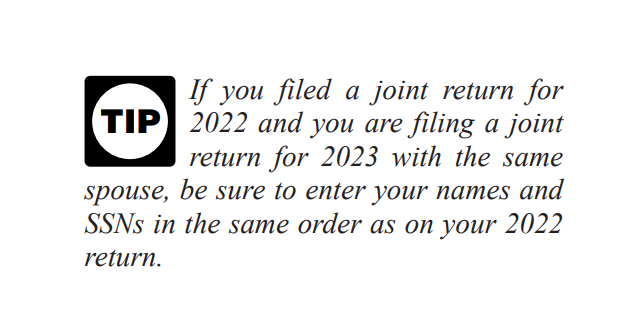
So, as noted in the joint filing tip above from the Form 1040 instructions for the current tax season, if the husband’s name was first on the 2022 return, it should also be listed first on the 2023 return. Or vice versa.
Changing the order could confuse the agency, which already has your tax data shown one way. And that could possibly lead to delays in the IRS’ processing of your joint return.
Therefore, my first initial entry on our first joint 1040 means I’m (we’re) stuck with the hubby’s name listed first. It’s always been that way, even in the years when my earnings were greater.
Who’s first on the 1040: As for others’ reasons, I turn to this weekend’s Saturday Shout Out item. The National Bureau of Economic Research paper Who’s on (the 1040) First? Determinants and Consequences of Spouses’ Name Order on Joint Returns has all the details.
Here are some highlights.
Whose name goes first has absolutely no impact on tax liability, so in one sense it does not matter at all. But the name order by gender is undeniably non-random.
The man’s name is more likely to go first when most of the couple’s income is earned by him.
It’s also seen more among older joint filers.
Based on state averages, putting the man’s name first is strongly associated with conservative political attitudes, religiosity, and a survey-based measure of sexist attitudes.
While the 88 percent total of men’s names listed first on a joint 1040 filing in 2020 is a lot, that trend has been declining. Men were listed as the first filer 97.3 percent in 1996, the first year the first year the NBER authors were able to measure the name listings.
An appendix table, State-Level Male-Name-First Fraction, at the end of the report show that the listing of the man’s name has declined over the 24 years studied across all states and the District of Columbia.
The 2020 tax year data show Iowa filers are the most inclined to list the husband’s name first, with 90.7 percent doing so. Joint husband-wife taxpayers in Washington, D.C., are the most egalitarian, with the man’s name listed first just 79.7 percent of the time. District filers were the only ones to fall below 80 percent.
Female and male study authors: I also must credit by name the NBER study’s authors, in part because it was my own established byline that prompted me to keep my given name after saying “I do.”
The NBER 1040 name filing examination was done by Emily Y. Lin, Joel Slemrod, Evelyn A. Smith, and Alexander Yuskavage. Lin and Yuskavage are with the Treasury Department. Smith and Slemrod are with the University of Michigan
Finally, and this is a spoiler, the study concludes that “name order is associated with decision-making power within the household, and therefore when the man’s name goes first, the household is more likely to take more ‘male’ actions.”
I must note that if that is indeed the case, the hubby and I are the exception that proves the rule.
I also suspect we definitely are not alone in that the man’s name first on a tax return is in no way indicative of which gender’s actions control the household.
You also might find these items of interest:
- Tax to-do’s after you say ‘I Do’
- Married couples filing joint returns share all tax liability, too
- 6 signs married couples should consider separate tax returns
- Married? Filing a joint return? Then make sure both spouses sign the 1040 or prepare to pay tax penalties
Advertisements
🌟 Search Amazon Business and Money Books 🌟
The text link above is an affiliate ad. If you click through and then buy a product, I receive a commission.

Robert D Flach
At one time there was a reason to enter the wife’s name and Social Security number first – when the husband owed back taxes or outstanding child support from before his current marriage. I had been told that when determining if a past debt is deducted from a current refund under the Treasury Offset Program only the first Social Security number on the return is checked. I do not know if this still applies.
Kay
Thanks for that insight, RDF!