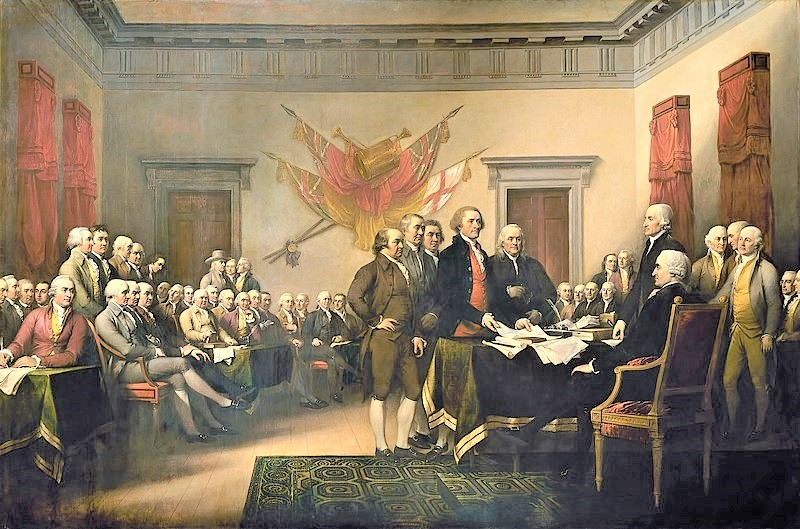
American artist John Trumbull’s painting of the presentation of the draft of the Declaration of Independence, which is the artwork‘s name, to Congress.
(Image from Wikimedia Commons)
…
Happy July 4th everybody! I hope all y’all are having a great and safe 245th birthday party for what became the United States.
Relatively speaking, we’re still a young country. And like most juveniles and young adults, we’re still making mistakes. But we’re learning (I hope) from them as push ahead to reach what our Constitution calls a more perfect union.
To get there, we need to turn to another critical U.S. document, the one that kicked off these annual USA birthday celebrations. A great present to all of us would be the actual delivery of one of the Declaration of Independence’s initial precepts —
We hold these truths to be self-evident, that all men are created equal, that they are endowed by their Creator with certain unalienable Rights, that among these are Life, Liberty and the pursuit of Happiness.
…
We’re still working on that equality thing. And there are almost as many definitions of life, liberty and the pursuit of happiness as there are U.S. residents.
Part of the reason for such disconnects is that, despite all the pontificating about what the Founding Fathers meant, we can’t really even start to know until we better understand the times in which the Declaration of Independence was produced and exactly why it was written and revised.
So, without getting too preachy or teachy, I’m focusing my annual Fourth of July post on this brief — just 1,333 words; most of posts exceed that! — document, starting with a recitation of it.
Hearing freedom’s words: Instead of recording my mellifluous voice, though, I’m turning to National Public Radio. One of NPR’s July 4th traditions is the reading of the Declaration of Independence by its staff.
You can listen via the embedded player below. There’s a brief introduction, with the actual document’s words starting at about the 1 minute, 30 second mark.
Declaration dissing of the King: After that audio interlude, I recommend historian Woody Holton‘s discussion, excerpted for The Conversation from his forthcoming book “Liberty is Sweet: The Hidden History of the American Revolution,” of six surprising Fourth of July facts.
One of them that would have been a surprise to the narcissistic British ruler at the time is that the document’s complaints weren’t actually about King George III.
Jonathan Groff as King George with a message for rebellious colonists in Broadway’s “Hamilton.”
…
Holton says that even though Britain’s king is the subject of 33 verbs in a declaration that never once says “Parliament,” nine of the Continental Congress’ most pressing grievances actually were about parliamentary statutes.
“By targeting only the king – who played a purely symbolic role in the Declaration of Independence, akin to modern America’s Uncle Sam – Congress reinforced its novel argument that Americans did not need to cut ties to Parliament, since they had never had any,” writes Holton.
The professor of history at the University of South Carolina also looks at how America’s independence and the Revolutionary War were influenced by far more — women, Indigenous and enslaved people, religious dissenters — than the men who drafted the Declaration.
We thank all of them today for getting us started on our continuing life, liberty and the pursuit of happiness journey.
Independence from unrepresentative taxation: And since the Declaration of Independence famously notes that one of the reasons for our colonial forebears’ revolt was due to “imposing Taxes on us without our Consent,” I offer these other posts you might find of interest:
- Paying taxes is patriotic, say poll respondents
- Born on the 4th of July & that date’s other tax connections
- America’s Yankee Doodle Boy gives us a tax deduction rule
- Juneteenth added to list of legal holidays, which sometimes affect taxes
- Not yet independence, freedom or justice for all in America on this July 4th
- ‘Taxation without representation is tyranny’ & 12 other tax quotes for the Fourth of July
- Taxes prompted original fireworks. Founding father ensured continuation each July 4th
And also because of the tax and July 4, 1776, connection, the date earns this week’s By the Numbers honor.