Parents want the best schools possible for their kids.
Heck, even child-free folks like the hubby and I want good schools. We’re counting on the kids roaming our neighborhood getting good educations, then good jobs where they pay into the Social Security that we’re planning on collecting in the ever-nearer future.

School is back in session, supported in large part by the property taxes that homeowners pay. (Photo by WoodleyWonderWorks via Flickr)
…
But homeowners also hate property taxes. By some measures, it’s the most hated tax.
So when we get our property tax bills, the largest portion of which tends to go toward funding our local public school district, we’re torn between our frustration with taxes and paying for the best possible education for our kids and/or future federal retirement benefits contributors.
Tracking down big property tax bills: Part of the problem is that our property tax bills tend to be among the largest we get each year.
Even if you don’t pay the tax directly — this is the case when your mortgage payment includes taxes along with interest in your monthly payment, and then your lender uses that money to pay your annual real estate bill — you still get a notice.
And those hundreds or thousands of dollars can freak folks out. I know. I’m right there with you, hating the days that notification of our home’s assessed value and then the actual tax bill arrive.
So who’s most unhappy at property tax time? According to The Tax Foundation, it’s New Jersey homeowners.
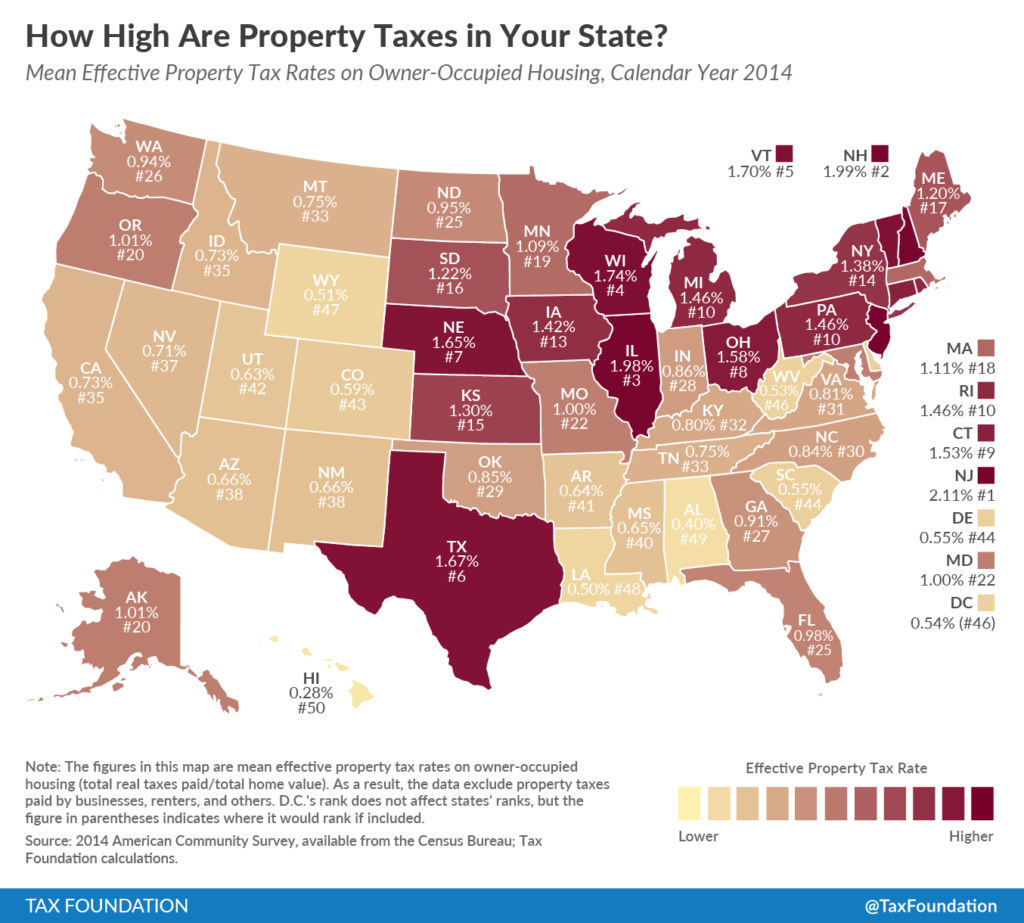
The Washington, D.C. tax policy nonprofit says New Jersey has the highest effective property tax rate at 2.11 percent.
It is followed closely by New Hampshire at 1.99 percent and Illinois at 1.98 percent.
On the other end of the residential real estate tax spectrum, Hawaii has the lowest effective rate at 0.28 percent. Also in the low property tax classification are Alabama at 0.40 percent, Louisiana at 0.50 percent and Wyoming at 0.51 percent.
Keeping an eye on your property and taxes: Regardless of the tax rate where you live, when you get your home’s tax valuation statement, don’t just grumble and then shove it in a drawer. Take a good look at it.
If the tax assessor says your home is worth a lot more than last year, it’s worthwhile questioning how he or she arrived at that number, since in most cases it will be used to calculate your eventual property tax bill.
Maybe the assessor is right. Home values in our neighborhood had been increasing. Or it’s the first reexamination of local property values in several years and the growing real estate worth reflects that.
But nobody’s perfect. And a mistake in your assessment definitely warrants correction so that you get an accurate and fair tax bill. Remember that assessment timing issue? If values in your neighborhood have fallen since then, an earlier valuation is no longer valid.
Appealing your property tax bill: In this case, you should challenge the assessment. You have two options. Do it yourself or hire someone.
DIY is cheaper, but it takes time. And attention to details and deadlines.
If you go it on your own, pay attention to your tax assessment notice or actual bill. It should spell out exactly what you need to do and by when.
Also check your local tax assessor/collector/tax appeals board websites for details on the process. In most cases, you can file the appeal, at least initially, by mail or online.
If you start the process and find it’s taking up more time than you expected, then you can hand it over to a pro. Or you could make the initial appeal yourself and if denied, turn over the subsequent appeals to a firm
Third party property tax appeals companies will file the appeal on your behalf, usually on a contingency basis. Many of the companies have staff, including appraisers, experienced in the process and who are dedicated to spending the research time necessary to fight the tax.
Even after paying for the help, a successful appeal can save a homeowner hundreds of dollars in taxes.
Chances for success: Does appealing a property valuation and/or tax bill work? Yes.
But it’s not a slam dunk, for administrative reasons, such as meeting or missing deadlines of having incomplete data, as well as the actual value/tax issues.
The property tax appeals systems is a lot like a visit to a casino. There’s a chance you’ll win big, but the house, here the local government, holds a lot of the cards.
But don’t let that stop you if you’re sure your assessment and/or property tax bill is too big.
I hope the tax info here is useful. But mainly I hope you don’t spend the Labor Day holiday reading it. Hey, even a hardcore tax geek knows we all need breaks, even from taxes, now and then. So have a great long weekend!
You also might find these items of interest: