

So exactly what is the deal with the health care policy that’s behind the current closure of the federal government?
The contentious component is the federal tax credit available to individuals who buy health care coverage through Affordable Care Act (ACA officially and informally still Obamacare to many) marketplaces.
The law caps how much subsidized enrollees must pay in premiums for their ACA policies at a certain percentage of their income on a sliding scale. The Premium Tax Credit (PTC) covers the remainder.
The PTC typically is claimed during the ACA policy selection process so that insurance buyers won’t have to pay higher premiums. The exact credit amount is reconciled at tax filing time to ensure it was correct, meaning that in some cases taxpayers might have to pay back excess PTC they received early.
Fighting over PTC enhancements: The PTC subsidy was increased in 2021 as part of COVID-19 pandemic relief in the American Rescue Plan, and continued under the Biden administration’s Inflation Reduction Act. The changes are set to expire at the end of this year.
Democrats wanted to continue the ACA tax credit at the enhanced level as part of any plan to keep open, or now reopen, Uncle Sam’s doors. Republicans say they want a clean funding bill, and will deal with the Obamacare tax breaks separately, once the government is open again.
While theoretically the GOP has a point about dealing with different policy concerns in separate legislation, the trust factor on Capitol Hill is not great. Okay, it’s basically nonexistent.
That could fill up another blog post, but now I’m more interested in what might actually help end the shutdown. And yes, in addition to a tax credit being at the heart of the matter, there’s another tax implication. If a deal isn’t reached to end the shutdown by next Tuesday, the Internal Revenue Service’s five-day fiscal grace period will expire.
So, I’ve been reading a lot about this third government closure under a Donald Trump presidency, and some of those health policy, political and tax items are part of this weekend’s Saturday Shout Out post.
First off is Selena Simmons-Duffin’s piece “What’s behind the health care fight that led to the government shutdown,” that aired on a recent NPR All Things Considered broadcast.
While this year’s ACA enrollment hit a record 24 million, that’s only about 7 percent of the U.S. population, but the people who rely on these plans are an influential group, reports Simmons-Duffin. She talked with the director of the Program on the ACA at the nonpartisan health research organization KFF, who pointed out the subsidy-affected group includes small business owners, farmers, and ranchers, all of whom could face premium payment increases, on average, of 114 percent.
So naturally, the next shout out goes to the KFF analysis. “ACA Marketplace Premium Payments Would More than Double on Average Next Year if Enhanced Premium Tax Credits Expire.”
The study by KFF’s Justin Lo, Larry Levitt, Jared Ortaliza, and Cynthia Cox found that while many ACA marketplace enrollees would continue to qualify for a smaller tax credit if the enhanced version expires, others would lose eligibility altogether and be hit by a “double whammy” of losing their entire tax credit and being on the hook for rising premiums.
Then there are the politics: The Wall Street Journal article “The Health Insurance Subsidies at the Center of the Government Shutdown Fight,” by Jasmine Li and Anna Wilde Mathews takes a closer look at the political fights at the heart of the subsidy, and shutdown, fight. The main issue here is health care for undocumented immigrants.
The Democrats’ proposal, “which they cast as a starting point in talks, would reverse all health-policy changes enacted by the GOP’s tax law, including provisions that limited federal funding for healthcare for unauthorized and ‘lawfully present’ immigrants,” according to Li and Mathews.
The One Big Beautiful Bill (OBBB) Act signed into law on July 4, revoked eligibility from immigrants such as refugees, asylum seekers, and visa holders who are deemed “lawfully present.” The Democrats’ proposal, which they cast as a starting point in talks, would reverse that and other GOP health-policy changes.
But other demographics also raise some potentially serious political concerns.
“ACA subsidies are used heavily in politically important states such as Georgia, Alaska and Texas, where Republicans and Democrats hope to flip or defend Senate seats next year, and Republicans are leery of voters suddenly seeing much higher bills,” notes the WSJ article. “Among the states with the fastest growth in ACA enrollment are Republican-leaning ones such as Texas, Mississippi and Tennessee.”
The possible adverse financial effect on GOP voters who rely on ACA coverage also was noted in the next shout out, the Bloomberg piece “Why Obamacare Haunts Republicans in Shutdown Fight.”
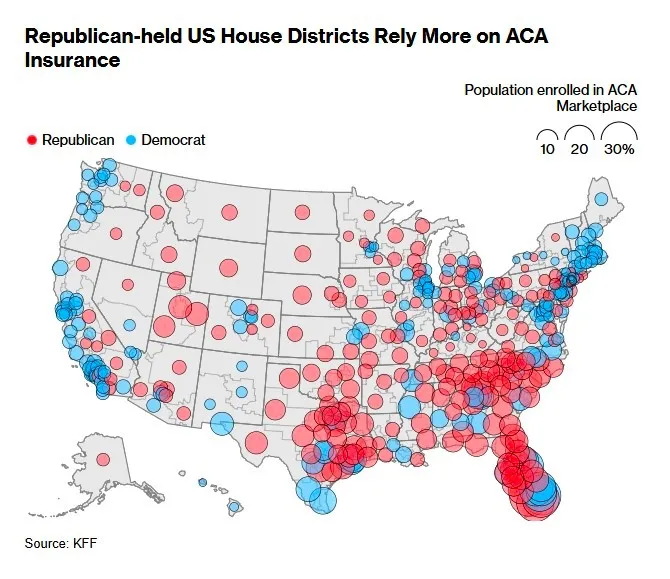
David Rovella notes in the item for Bloomberg Evening Briefing Americas Newsletter that the health insurance subsidies “disproportionately benefit areas of the country represented by Republican lawmakers, posing a potential vulnerability for President Donald Trump’s party in next year’s midterm congressional elections.”
The map, reproduced in a static version below but interactive on the Bloomberg web page, offers a great visual display of the political dispersion of ACA policy holders.
And that politically tinted map leads to a shout out to a public opinion poll, because why not?
“A majority of Trump supporters back extending Obamacare subsidies, poll finds,” reports NBC News.
“Most of President Donald Trump’s supporters back keeping enhanced subsidies for Affordable Care Act plans, the central obstacle in ending the government shutdown,” reports Berkeley Lovelace Jr.
The poll, “Despite Budget Concerns, Three-Quarters of Public Say Congress Should Extend the Enhanced ACA Tax Credits Set to Expire Next Year, Including Most Republicans and MAGA Supporters,” was by KFF and conducted Sept. 23 through Sept. 29, just days before Congressional efforts to stave off the shutdown failed. Yes, the health care group already has a lot of citations in this post, but it gets another shout out for this, too.
Will this mix of medical, political, and financial concerns, both for individuals who pay for health care and Uncle Sam’s operating budget, eventually lead to a relatively quick resolution of the current federal government shutdown?
Or will ideologies harden and extend the closure?
My crystal ball is broken, but this weekend’s final Saturday Shout Out goes to a group that’s willing to go out on a limb with a shutdown prediction.
“Morgan Stanley Says Treasury Options See 10- to 29-Day Shutdown,” writes Elizabeth Stanton for ThinkAdvisor.
I’m hoping the end comes at the shorter end of the financial experts’ time frame projection. However, it looks like it won’t be as quick as I and others want.
House Speaker Mike Johnson (R-Louisiana) has called off next week’s votes in that chamber.

