
Most tax returns now are completed electronically, either by individual taxpayers or the tax pros they hire. That’s helped cut down on a lot of annual filing errors.
But taxes being, well, taxes, and taxpayers (and tax preparers) being error-prone humans, Form 1040 mistakes still happen.
Filing slip-ups could, at best, slow down the Internal Revenue Service’s processing of your return. If you’re expecting a refund, that means you’ll be waiting longer for it.
At worst, tax filing errors could literally cost you. Sometimes a lot, if the mistake attracts the attention of an examiner who wants to take an even closer look at your return.
Your best defense against these unwanted tax outcomes is to file a mistake-free return. And you especially don’t want to make an error that’s avoidable.
Here are 11 common tax mistakes that happen on tax returns every year. This list comes from my personal experience (like I said, we all mess up sometimes), talks with tax professionals, and the IRS.
1. Not reporting all your income: It’s called an income tax, and to the U.S. Treasury, that means almost all types of money you bring home throughout the year. When you’re only income is from a job, all you have to worry about is entering your W-2 data.
But lots of full-time workers supplement their salaries with side hustles. In some of these side jobs, you’ll get a 1099 form with details of these gig earnings. But even if you didn’t get a 1099-NEC because you didn’t make enough to require the reporting forms to be issued, you still need to include those amounts on your tax return.
Likewise, don’t forget any other payments not subject to withholding, such as investment earnings (on 1099-DIV and INT forms), certain gambling and prize winnings, and even unemployment benefits shown on a Form 1099-G.
Where a 1099 form or acceptable substitute statement is issued to you, the IRS will get a copy, too. So the tax agency will know if your earnings total doesn’t match its math. And it definitely will let you know of the discrepancy.
So, double check the tax statements you got earlier this year, and enter all that info, correctly, on your Form 1040.
2. Making math miscalculations: This is the most common mistake made on tax returns year after year. Even when you have the documents in front of you, it’s easy to enter the amounts incorrectly on your Form 1040. The math errors range from transposed numerals to simple addition and subtraction errors to more complex tax item calculations, like figuring credits and deductions.
So pay very close attention when you enter your numerical data into your tax return. One wrong digit will lead to a math miscalculation that can really screw up your filing’s final result.
And no, tax software can’t help you here. In fact, it can make things worse. Once you enter a wrong amount on one tax form line, the program repeats or transfers as required that number to another form, meaning a lone innocent numerical error can quickly compound, and not in the good financial way.
3. Omitting or entering inaccurate Social Security numbers: This nine-digit number was not intended to be our universal identifier, but, for better and in this age of identity theft often for worse, that’s what the Social Security number (SSN) has become.
If you don’t enter your Social Security number and that of each individual who’s included on your Form 1040, from spouse to all dependents, as they are shown on your and others’ Social Security cards, the IRS won’t process your return.
A Social Security number also is critical when claiming several tax credits, such as the Child Tax Credit and Additional Child Tax Credit, as well as ones for educational expenses and dependent care costs.
4. Misspelling or using different names: Most of the information on your tax return is numerical, but words — specifically names — are important, too. Spell all names listed on a tax return exactly as listed on Social Security cards. That’s yours, your spouse’s if you’re filing jointly, and those of any dependents.
What’s the big deal if you’ve gone by a middle or nickname all your life and enter that on your Form 1040? Plenty. When the names of a taxpayer or a spouse or their children don’t match the number that the Social Security Administration (SSA) has on record, the IRS processing machine likely will kick out or slow down the tax return.
Name issues often are a problem for the newly married. Many folks still change their surnames when they marry. In these cases, if you didn’t alert the SSA of your name change after your wedding, your new name on your 1040 or other tax statements could cause a problem when you file your first joint tax return. Get in touch with the SSA ASAP to reconcile this.
The same issue also arises when marital bliss doesn’t last and ex-spouses change names after a divorce. Again, make sure Uncle Sam’s appropriate agencies know that, too.
5. Improperly claiming a dependent: Having a dependent’s tax ID number, as noted in common tax-filing mistake #3, generally means that you know that person can be claimed on your return. Or maybe not.
Sometimes determining just who is your tax dependent, be it a child or qualifying relative, can be messy. There are lots of rules about relationships and support earned or provided and who lives for how long in your house. Such considerations also can be complicated by personal circumstances, such as divorce and shared custody of children.
The confusion often leads to an innocent mistake about who qualifies to be listed as your tax dependent. Other times, though, folks knowingly claim an ineligible dependent to get the added exemption amount or to claim the refundable Earned Income Tax Credit (EITC).
Faking dependents is not a good idea. This is willful disregard of the tax laws and your responsibility to meet them. Such intentional tax violations could lead to tough penalties, sometimes of a criminal nature, on top of the unpaid tax and interest added to the correct tax amount you must pay.
6. Using the wrong filing status: Dependents also affect your filing status. So does divorce or marriage. All these life changes mean that every year, filing status selection that can be different. And an innocent error could be costly.
Take, for example, your first tax return filing since your divorce. You might think you should file as a single taxpayer. But since you have primary custody of your dependent children, your more advantageous filing status is head of household. In fact, you could be a head of household taxpayer even if you’ve never married and don’t have kids, but are providing the bulk of support for someone else.
Check out all five filing status options. If you’re unsure about which you should select, use the IRS’ Interactive Tax Assistant. This online tool can help you sort out your correct current filing status.
7. Overlooking or miscalculating tax breaks: Here’s a non-news flash. The tax code is complicated, despite (or, say code critics, because of) continual tweaks made by Congress.
That’s the case this filing season since the tax section of the One Big Beautiful Bill Act (OBBBA) enacted last July 4 included retroactive changes that affect millions of taxpayers’ 2025 returns. And while the new tax breaks will help lots of filers, they also could contribute to return completion errors.
Then there are the tax deductions and credits that simply are overlooked year after year. One of them is the EITC mentioned in mistake #5. Ignoring the EITC is particularly notable, since the tax credit can net eligible families a sizeable amount.
The EITC could provide qualifying large families with an $8,046 tax benefit on their 2025 tax return. Even better, the EITC is a refundable tax credit. In addition to producing a dollar-for-dollar reduction of any tax owed, when the EITC amount is more than the taxpayer’s liability, the filer gets the excess as a refund. If you’re unsure as to whether you qualify, check out the IRS’ online interactive EITC Assistant.
8. Omitting your IP PIN: The IRS has made major strides in combating tax identity theft. The agency’s Identity Protection Personal Identification Number, or IP PIN, is one of the best ways to stop crooks from using stolen Social Security or Individual Taxpayer Identification Number (ITIN) numbers to file fake returns claiming fraudulent refunds.
Any taxpayer can get an IP PIN. Once issued, the IRS won’t accept a return unless the return includes this unique six-digit number tied to the real taxpayer’s Social Security number or ITIN.
So, if you got an IP PIN, be sure to include it on your return. And don’t assume that your tax software will ask for it.
This year, the hubby and I got IP PINs. When I reviewed the forms before electronically filing them, I noticed that the IP PIN entry area, shown in the Form 1040 excerpt below, was blank.
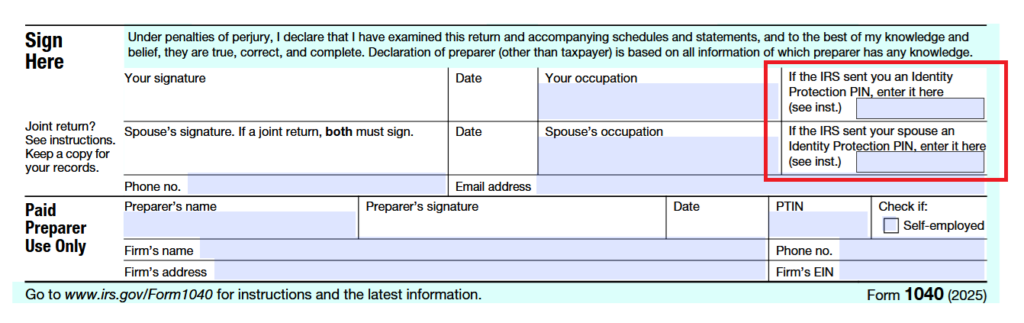
The software’s step-by-step process had neglected to ask if we had IP PINs. I had to go back and manually enter the numbers before I hit send.
9. Entering incorrect bank account numbers: The IRS has for years encouraged us to file electronically and have our refunds directly deposited into a financial account. That process is easy for taxpayers and the IRS, unless you enter the wrong account number and accompanying routing number.
In addition to carefully entering the digits on your return, make sure they are the ones your bank wants you to use. As financial institutions expand their digital options, routing numbers could be different. Our bank uses a routing sequence for electronic transactions that is different from the numerals on the handful of paper checks we have. Contact your financial institution for the correct routing numbers to use.
The Taxpayer First Act required the Treasury Department to establish a mechanism to deal with errant IRS direct deposits. But that still means a delay in getting your tax cash. So, your best move is to double check your account numbers so that your refund goes to your correct account.
10. Missing the filing deadline: Tax Day isn’t until April 15, so you have plenty of time to fill out your tax return correctly. But if you’re a tax procrastinator, be careful. You don’t want to push your filing task to the very last minute.
Not only will a rush to the deadline make you more prone to make some, or many, of these mistakes, you also run the risk of missing the deadline altogether.
Don’t do that. If you miss the filing deadline and owe Uncle Sam, penalties and interest will start accruing on that unfiled return and unpaid amount as soon as the clock ticks past midnight April 16.
If you just can’t complete your return Tax Day, then file Form 4868. It will get you an automatic six-month extension, during which you can finish and send your return to the IRS. Note, however, that this is only an extension to file your return. You must pay any tax you owe when you submit your Form 4868. By April 15.
11. Ignoring tax record keeping: Sloppy or nonexistent tax records could pose a problem if the Internal Revenue Service has questions about your return. The burden to prove your claims are correct falls totally on you.
This includes evidence of credit claims, such as the amount spent on child care costs and self-employment expenses like business mileage and home office costs. Itemizing taxpayers in particular need the documentation to back up deductions for charitable contributions and medical expenditures.
Your guesstimates aren’t going to cut it when an IRS examiner wants answers. And reconstructing the evidence isn’t always easy, or convincing even when you’ve done your best. So, if your tax record keeping has been a bit sketchy, correct that right now.
Start by making a copy of your return and all the associated worksheets. Then put it in your new record keeping system, which can be an old-school paper system with folders and filing cabinets or an electronic method.
Add to the filing system contemporaneously throughout the year as you collect receipts and substantiation for various tax claims you will make on your 2026 return next year.
When 2027 arrives, be sure to drop the 1099s, W-2s, and all other tax statements you’ll get (mostly in January) into the proper files, too. Your complete and accurate record keeping will make next year’s tax filing task a breeze.
And it could help ensure you don’t make any of the other 10 mistakes on this list.
Advertisements
🌟 Search Amazon Tax Products 🌟
The text link above is an affiliate ad. If you click through and then buy a product, I receive a commission.