

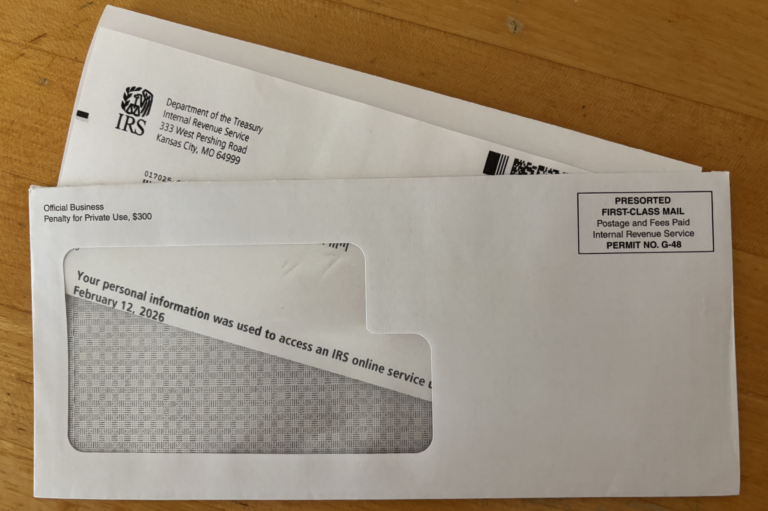
I know it’s 2026, but I still look forward to getting snail mail. It’s a throwback to the olden days when I lived alone and the material stuffed in my apartment’s small U.S. Postal Service box might contain a letter from home or some other welcome missive.
But sometimes, unwanted mail also shows up. Like today. I — actually the hubby — got a letter from the Internal Revenue Service.
Yes, my pulse jumped a bit, even though my brain was saying there’s nothing to worry about. My brain, this time, was right.
The notice, shown at the top of this post, was a CP303. That’s simply an alert from the IRS that my/the hubby’s personal information was used to access an IRS online service. Specifically, it was the new online account I/he created so we could more easily make online estimated (and usually annual filing season) tax payments.
But that information wasn’t available until I opened the letter. Hence, the momentary bump in my blood pressure.
At least I followed my top three tips on how to handle any IRS notice. I’m not counting the brief freakout before opening the envelope! Below is the full 10-point list.
1. Don’t panic. While hearing from the tax collector about your return is always a little unnerving, it doesn’t necessarily mean you’re in for a major audit. Sometimes the agency just wants more information from you. Other times, the IRS has found what it believes is a mistake on your return and wants your help in clearing up the issue.
2. Don’t ignore it. If the IRS says you didn’t pay enough tax, penalties and interest on the due amount will add to any tax liability. If you ignore the matter, the amount you owe will keep growing. Notices also often have deadlines for responding. If you miss them, you’ll find yourself facing more tax troubles.
3. Read the notice thoroughly. Each notice has specific instructions, so read it carefully. It will tell you what you need to do, such as provide more information. Or it could explain changes the IRS made to your filing, and how that affects any tax due or refund you were expecting.
4. Know the notices. Even the IRS admits that some of its notices are confusing. It’s working on changing that. If you have trouble deciphering exactly what the IRS wants, call the telephone number that’s usually found in the document’s upper right-hand corner. You also can familiarize yourself with the many types of notices that the IRS sends.
5. Double check the numbers. When a notice includes changes by the IRS to your tax account, review the information and compare it with your original return. Nobody’s perfect. The IRS does sometimes make mistakes, so you want to catch them as quickly as possible.
6. If you agree, you’re done. In instances where you agree that the IRS notice information and subsequent tax action is correct, you usually don’t need to do anything else. There’s no need to reply unless the IRS document asks you to, or gives you other instructions, or you need to make a payment.
In the case of today’s CP303, the IRS notes, “If you did access this service, then you don’t need to do anything.” The notice also provided a toll-free number to call if I/the hubby weren’t the ones who used the IRS online service.
I’ve also had to deal with the third situation, where the IRS asks you to follow up in some way. That happened the year I overlooked a 1099-DIV.
The IRS definitely didn’t ignore its copy of the form. Uncle Sam’s tax collector calculated the tax (and interest and penalty) I owed, and sent me a notice telling me where to send the money. I quickly complied.
7. If you disagree, speak up. If, however, you don’t agree with the notice, it’s important for you to respond. Your reply not only will let the IRS know you got the notice (and have an issue with the agency’s position), it also will preserve your appeal rights. The notice will tell you how to respond (see tip #6), which could be via mail, FAX, or digitally through the IRS’ Documentation Upload Tool, which is available now in some tax circumstances.
Whichever method applies, explain why you think the agency is wrong. Include any information and documents you want the IRS to consider. And be sure you send your concerns by the response date cited in the notice.
8. Keep good records. Keeping good records, both of your official forms and substantiating material, is a solid piece of advice even if you never hear from the IRS. But when it comes to IRS notices, you’ll also want to make sure you keep copies of any notices and all follow-up communications and documents.
9. Know when you need help. Many notices are routine and relatively easy for taxpayers to take care of on their own. Some, though, are more complicated or confusing, despite the IRS’ aforementioned efforts to make the mailings more understandable.
Or maybe you just don’t want to deal with the IRS yourself.
In any of these or other tax and tax notice situations, then getting professional tax help is a good move. A reputable tax professional with experience dealing with the IRS can help you through the process in the lease painful and costly way. Plus, you’ll have the peace of mind knowing you have a capable tax pro on your side.
10. Be alert for scams. Most tax scammers tend to show up online or as phone callers, while the IRS primarily communicates with taxpayers by letters and notices sent via the U.S. Postal Service. Sometimes, though, crooks also take the paper route (like here, here, and here).
If you suspect the tax notice you received is fake, call 1-800-829-1040 or visit a local IRS Taxpayer Assistance Center. You also can sign up to access your taxpayer account online and check there for any issues. Just be prepared to get a CP303 notice!
And if you do get a call or e-mail after receiving an official IRS notice, don’t be conned into believing it’s a follow-up to your legitimate interaction with the IRS.
Again, if you get a notice, don’t freak out. Just deal with it, as quickly as possible and by following the guidance you get from the notice or your tax pro.
The more quickly and thoroughly you respond to a tax notice, the less additional time you have to spend with the IRS.
