


Holiday shopping online is easy, for shoppers and scammers. Be careful in your online deal searches, as crooks can use the personal info they steal now to file false tax returns claiming fraudulent tax refunds.
The annual holiday shopping season is here. If you’re like most consumers, you’re doing much of your gift selection online.
That’s definitely convenient for you. Unfortunately, it also makes things easier for crooks. Over the years, they’ve refined their schemes to attract and trap shoppers, with their presents being shoppers’ stolen money and identities.
These threats, however, don’t end after Santa completes his rounds.
The pilfered personal data can lead to additional financial problems early in the coming year, when crooks use the purloined information to file fake tax returns claiming fraudulent tax refunds.
That holiday/tax connection is the focus this week of the 10th National Tax Security Awareness Week.
Scams link two successive seasons: The annual event is sponsored by the Internal Revenue Service and its Security Summit partners in state tax offices, tax software companies, the tax professional community, and others in the larger tax community.
Over the last decade, the coalition has worked to combat tax-related identity theft through its public-private sector partnership that has strengthened internal protections and raised awareness about security threats.
“With the holiday shopping season underway and tax season quickly approaching, we are urging taxpayers and tax professionals to take extra steps to protect their financial and tax information,” said IRS CEO Frank Bisignano in announcing this year’s National Tax Security Awareness Week.
“During this holiday season, people face the heightened risk of identity theft as criminals ramp up efforts to trick people into sharing sensitive personal information: identity thieves might use this information to try filing false tax returns and stealing refunds,” added Bisignano.
The end-of-year seasonal attacks are an annual focus. So, as in previous Decembers, the IRS and Security Summit members are highlighting five areas where taxpayers, tax professionals, and businesses need to be extra vigilant.
Social media scams: The internet has opened a lot of doors. Unfortunately, a lot of bad tax actors have walked through them.
Sometimes it is simply bad tax advice on social media that misleads taxpayers about credit or refund eligibility. In the worst cases, online tax “experts” urge taxpayers to lie on tax forms or suggest the IRS is keeping a tax credit secret from filers. Social media posts also may put taxpayers in touch with scammers.
Whether it is from incorrect information or blatant scams, it is the conned taxpayers who literally pay the price. The IRS says social media tax scammers have cost duped taxpayers $162 million in IRS penalties.
So be careful about taking online advice. Check out the tax recommendations before using them on your own return by researching reputable tax sites and IRS.gov, or consulting a tax professional.
Phishing and smishing: Is there anyone out there who hasn’t received a malicious tax email or text? I doubt it. Still, these phishing and smishing crooks keep sending out their scam missives, and people still fall for them.
There’s also spearphishing, a tailored phishing attempt that targets a specific individual or group. Tax professionals need to be very careful about spearphishing because of the risk of a data breach.
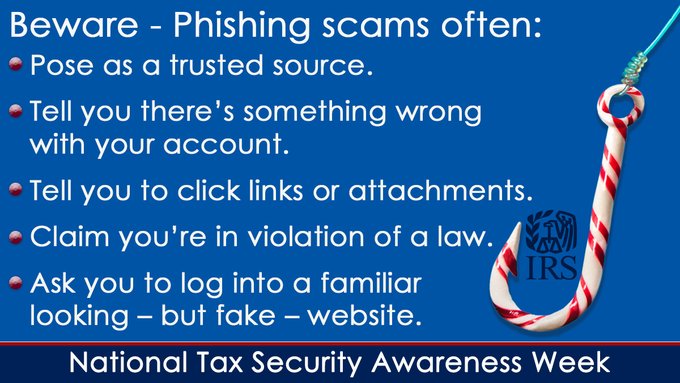
Taxpayers and tax professionals also should be alert to fake communications posing as legitimate organizations in the tax and financial community, including the IRS and state tax departments. These messages arrive in the form of an unsolicited text or email to lure victims into providing valuable personal and financial information that can lead to identity theft.
If you receive a suspicious tax-related communication —
- Don’t reply to the sender.
- Don’t click, save, or open any attachments. They probably — okay, they do — contain malicious code that will infect your computer, phone, or other mobile device.
- Don’t click on any links. These also will unleash dangerous code or allow the criminal sender access to your online info.
If you do accidentally click on any links or attachments and entered confidential information, visit the IRS’ identity protection page for the next steps to take.
Protection for seniors: With every passing day, I subscribe more to playwright and filmmaker David Mamet’s observation that “Old age and treachery will always beat youth and exuberance.” But the wisdom of years doesn’t always beat tax scammers.
Crooks often target people age 65 or nearing retirement for personal or financial information or money. The consensus is that they are more trusting, or less tech savvy.
Again, as I age, I’m not sure that’s true, but we can’t overlook this scam tendency. And recently, a Nigerian national was sentenced to 8 years in a U.S. federal prison for his part in an international scheme to defraud elderly individuals.
The Security Summit notes that in many senior-skewed scams, once the older targets give crooks money, the scammers keep coming up with reasons to ask for more. When the withdrawals are from tax-advantaged retirement accounts, the distributions could create subsequent, and substantial, tax troubles for the con artists’ targets.
Protections for businesses and tax professionals: While plenty of tax crooks target individual taxpayers, those looking for the biggest bang for their criminal efforts go after tax professionals. Getting access to a tax pro’s database will give them information on hundreds, perhaps thousands, of clients. These more efficient tax crooks also target tax pros’ databases year-round, not just during tax season.
To guard against breaches any time of year, the IRS reminds tax professionals of their legal obligation to have a Written Information Security Plan (WISP). Tax preparers also should use multi-factor authentication in connection with their records.
And, of course, all businesses, not just those in the tax industry, are advised to update their security measures and remain vigilant against cyberattacks.
Identity Protection PIN: An Identity Protection Personal Identification Number, or IP PIN, is a six-digit number that prevents someone else from filing a tax return using a taxpayer’s Social Security number (SSN) or Individual Taxpayer Identification Number (ITIN).
If you have an IP PIN, a crook who has your other personal information can’t file a federal tax return in your name without also having the special identifying digits.
More than 10 million taxpayers, including U.S. taxpayers living abroad, already use this added layer of tax-filing protection. If you have a SSN or an ITIN, you can join this protected group by first creating your IRS Online Account. Once that’s set up, getting an IP PIN is quick and easy.
More tax security resources: You can find more on these five Security Summit areas of concern this holiday season (and beyond) at IRS.gov’s special Security Summit page.
Victims of identity theft can visit Identity Theft Central.
Additional general scam information is at the IRS’ Tax Scams page. It has more on scam indicators, how to report a tax scam, and the latest tax scams that the IRS is tracking.
Finally, you can follow the IRS on social media, visit an IRS walk-in Taxpayer Assistance Center, and, of course, talk to a trusted tax professional.
Tax Felon Friday: Today’s post is the latest step in getting the ol’ blog back in shape here at its new site. Specifically, it is a resumption of Tax Felon Friday.
I know, it’s not the usual John Doe of Anywhere USA was sentenced to 40 years at Club Fed for being a scammy tax crook. But since all these IRS Security Summit concerns involve criminals, it earns its place in this list of dishonor.
If you want to catch up on other tax miscreants, from those just charged and/or indicted to those convicted and/or confessed and sentenced, check out the ol’ blogs’ special Tax Felon Friday page.
And if you want more tax crime posts, notably those that were published long before I gave them a special end-of-week feature, you can peruse, what else, the tax crimes category. You’ll find this post at the top of that collection right now, so just scroll down for more.
Advertisement
*** Search Amazon Electronics ***
The text link above is an affiliate ad.
If you click through and then buy a product, I receive a commission.

