
One of the family-friendly individual tax changes in the One Big Beautiful Bill (OBBB) Act is an expansion of the federal adoption tax credit.
Starting this tax year, when you adopt children younger than 18 or who can’t take care of themselves, Uncle Sam does more at tax filing time to help you add to your family.
The tax credit of up to $17,280 for each adoptee remains the same in 2025, but now up to $5,000 in qualifying adoption expenses are refundable.
That means that five grand in claimed adoption expenses can potentially come back to you as a tax refund. Before the OBBB, if you had more in the adoption tax credit than you owed in tax, that excess dollar-for-dollar tax relief amount was wasted.
Now all the Internal Revenue Service has to do is get the word out about the adoption changes to in the OBBB Act.
That’s something the tax agency hasn’t been very good at, according to a new Government Accountability Office (GAO) report.
Adoption tax help too often hidden: Each year, more than 100,000 children are adopted in the United States. These youngsters’ new parents can pay thousands of dollars in expenses to complete the process.
The tax credit’s help to cover some adoption costs obviously is welcome.
Or it would be welcome if more adopting families knew it was available, according to GAO report 25-107429, published Aug. 11. To accomplish this, the government watchdog agency says the IRS needs to develop and implement a comprehensive educational outreach plan in connection with the adoption credit.
The government watchdog found that the IRS has taken some, but not enough, steps to inform and educate taxpayers who could benefit from the adoption tax credit.
For example, GAO notes that the IRS has created adoption tax credit materials. However, the GAO also found the tax agency has not consistently provided this information to key adoption stakeholders, such as state agencies.
Some stakeholders told GAO that having these materials would help them in assisting adoptive families.
Clearer information needed: Additionally, some IRS materials did not provide clear, consistent messages on how to accurately claim the adoption tax credit.
Examples of Qualified and Non-qualified Adoption Expenses
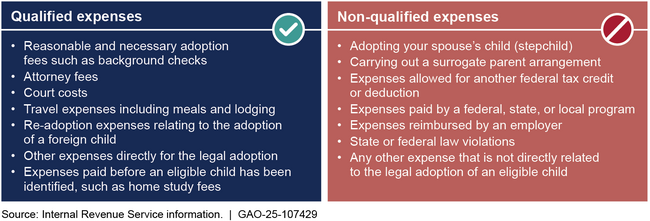
GAO also found that the IRS’ list of approved documentation taxpayers should retain when claiming the credit is not easily accessible.
And while the IRS does communicate with taxpayers about the adoption tax credit through various avenues, such as a dedicated adoption tax credit web page, tax tips, and social media, these efforts are scattershot and, in some cases, lacking.
For example, GAO found that the IRS.gov online Interactive Tax Assistant tool to help taxpayers determine their eligibility for the adoption tax credit is inconsistent, as the example below from the GAO report shows.
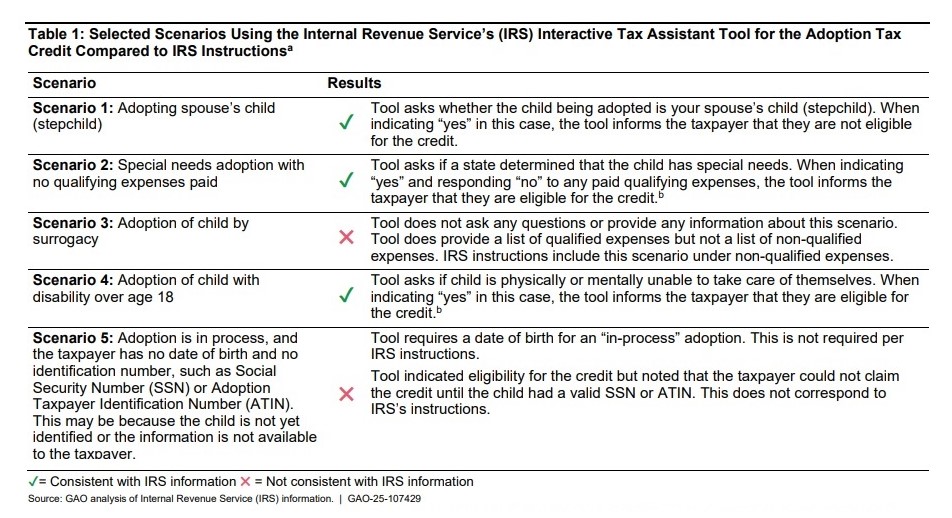
Costs to taxpayers and IRS: Such imprecise and vague direction typically produces three results that are not good for potential adoption tax credit claimants. The GAO report says taxpayers too often —
- Don’t know they are eligible for the credit, or
- Inaccurately claim the credit, or
- Claim the credit, but are unprepared to answer IRS questions if they are audited.
In fact, in reviewing tax returns that claimed the adoption tax credit and were audited in tax years 2012 through 2021, 41 percent of the credit claims were adjusted by IRS.
These IRS examination efforts in that time frame produced an average adoption tax credit increase of approximately $6,000 and an average tax break decrease of around $7,000.
IRS officials could not easily provide the GAO an explanation for these changes.
Educational outreach imperative: The GAO, however, has an explanation it says could change things for the better for taxpayers who adopt.
“An educational outreach plan for the adoption tax credit would help IRS ensure that adoptive families know about the credit, their eligibility, and other requirements. Such a plan is particularly important in light of changes [in the One Big Beautiful Bill Act] to the credit that were enacted in July 2025,” states the GAO report.
The GAO added that improved IRS adoption tax credit education and guidance for taxpayers, along with more involvement with adoption stakeholders such as the Department of Health and Human Services’ Administration for Children and Families, would help taxpayers avoid costly mistakes in either failing to claim the credit or doing so inappropriately.
More focused IRS adoption tax credit action also would benefit the tax agency.
“Improved understanding of the credit could also save IRS resources by reducing the need for expensive audits,” according to the GAO report.
You also might find these items of interest:
- Uncle Sam’s tax break gifts for fathers
- Problems with Trump Savings for children
- New OBBB tax breaks taking effect in 2025
Advertisements
🌟 Search Amazon Tax Products 🌟
The text link above is an affiliate ad. If you click through and then buy a product, I receive a commission.