

Reviewed and revised Feb. 23, 2024
 You don’t have to have this many candles on your birthday cake to use Form 1040-SR. Hitting age 65 qualifies you to use file this new form.
If there’s one Internal Tax Service constant, it’s that its myriad tax forms are always seem to change. Sometimes a lot. Sometimes just a smidge.
That happened en masse in the wake of the wake of the Tax Cuts and Jobs Act (TCJA) of 2017. Back then, Uncle Sam’s tax collector that year proposed tweaks to the Form 1040 and elimination of three of the six schedules created to go with a redesigned Form 1040. Additional changes to the 1040 for the 2020 tax year produced a longer form that now resembles its predecessor, the long Form 1040.
The IRS also added in 2019 a separate 1040 for older taxpayers. The Form 1040-SR, with the appended two letters standing for seniors, has proven to be popular, with both filers and the IRS.
Budget, not tax bill mandate: The genesis of the new 1040-SR that would be used by taxpayers age 65 or older was not the TCJA, but the Bipartisan Budget Act (BBA) of 2018.
While the TCJA actually complicated, rather than simplified, many tax situations, the BBA that became law about a month later provided for simplified tax filing for senior citizens.
Eligible filers won’t be required to use it, but if the find it is a good tax fit, they can when filing season starts next year.
Long tax form road: While the 1040-SR didn’t appear until the 2020 filing season, the form has been in the works for a while.
It was first proposed in 2013 as part of the Seniors Tax Reconciliation Act. The AARP, the National Taxpayers Union, and the Association of Mature Americans all supported the bill.
That measure, however, was never able to clear Congress, getting hung up in the Senate.
It was fashioned on the prior 1040EZ, but is a more bulked up version, allowing some tax moves that weren’t allowed on that now defunct document.
Here’s a look at part of Form 1040-SR, 2020 version, below. That’s just the top section of page 1. In total, there are four pages.
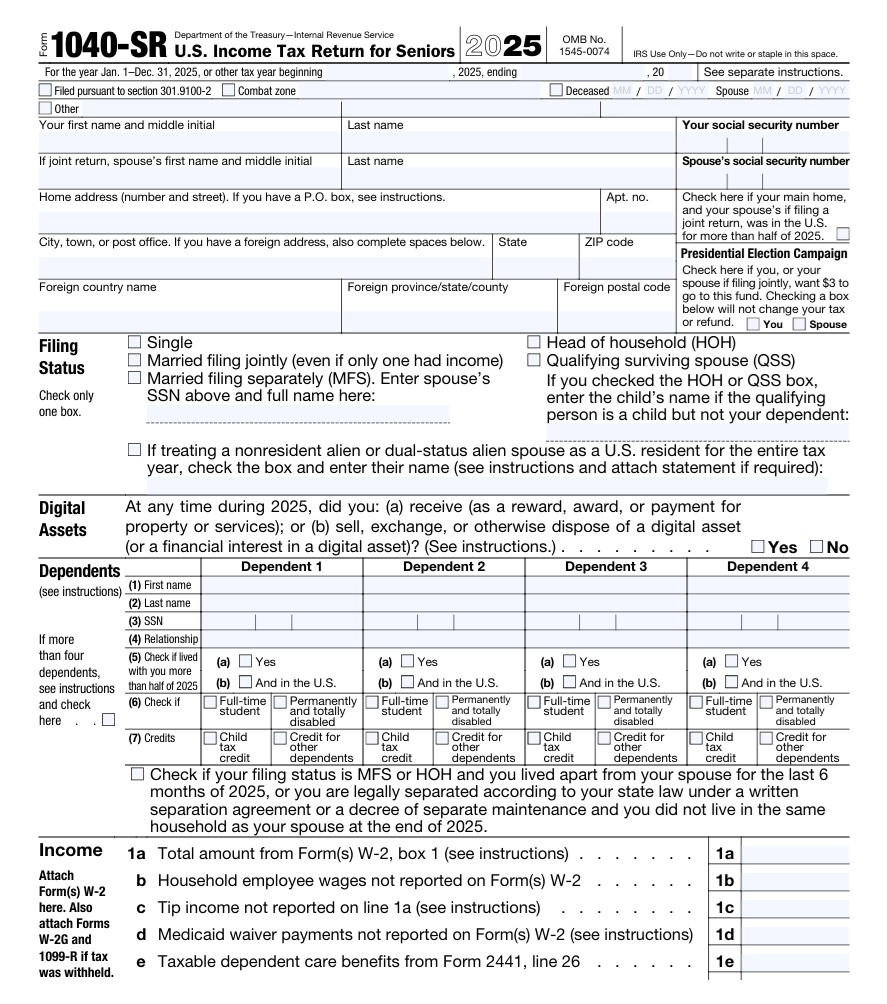
And here’s a look at the 1040-SR’s requirements and options.
Age obviously counts: Senior taxpayers, in the eyes of the IRS, are those who are 65 or older.
That age threshold applies to the 1040-SR. Taxpayers who were 65 or older last year can use the form. If you were born on Jan. 1, 1961, the IRS considers you to be age 65 at the end of 2025.
When a married couple files jointly, only one spouse needs to meet the age requirement.
Dependents are OK: Today’s families take many forms. There are many parents who are supporting adult children, as well as grandparents responsible for their grandkids.
The 1040-SR takes this into account.

Where the old 1040EZ couldn’t be used by filers who claimed dependents, it’s OK for 1040-SR taxpayers.
Dependent information, including the always critical Social Security numbers for each person claimed, is entered at the top of the 1040-SR.
Income, earned or from retirement plans: You don’t have to be retired to use the form. Age allowing, you can still be working and report those earnings on 1040-SR.
If, however, you have decided to call it quits from the cube farm, then you can report your retirement benefits and investment income you might be tapping on 1040-SR.
Self-employment earnings also are reported on this form. For example, money from gig work you’ve done since leaving your traditional office space can be entered on 1040-SR after you detail the income on Schedule 1.
Standard, but larger, claims: Many older taxpayers find that as they’ve simplified their lives, both practical and financial, they no longer need to itemize. But the tax code has found a way to make the standard deduction amount even more appealing to older filers. The standard amounts allowed on 1040-SR could be substantially larger based on the filer’s (or filers’, if married) age and eyesight.
When the Form 1040-SR debuted for the 2019 tax year, those deduction amounts were $12,200 for single filers; $18,350 for heads of households; and $24,400 for joint filers. For the 2020 tax year, those amounts were increased to $12,400 for single taxpayers; $18,650 for head-of-household filers; and $24,800 for married jointly filing couples. (You can find the increases for the 2025 and coming 2026 tax years in this post on the latest inflation adjustments.)
The bumps for senior taxpayers when 1040-SR was introduced for tax year 2019 pushed the standard deductions up even more. They continue to do so.
For the 2025 tax year, single taxpayers 65 or older get to add an additional $1,600 to the standard amount. The add-on for married joint filers is $1,200. For the 2026 tax year, inflation adjustments mean filers age 65 or older (or legally blind taxpayers of any age) get an additional standard deduction amount of $1,650 for each qualifying circumstance.
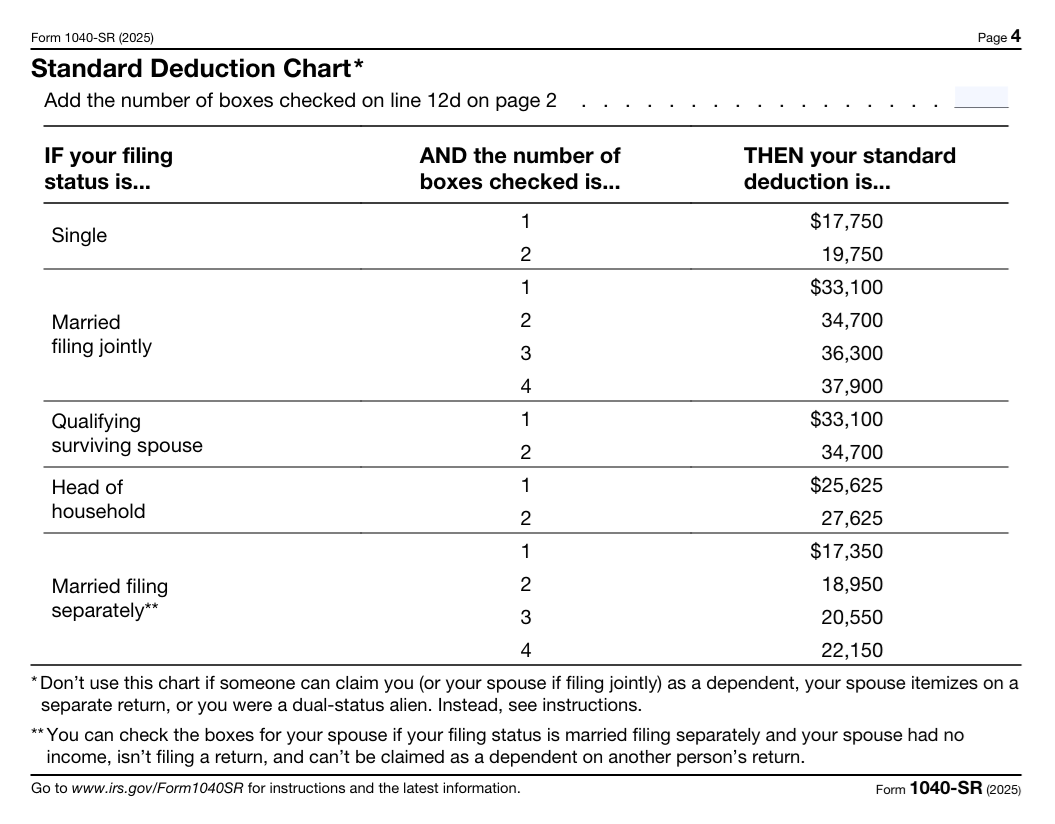
To claim these added amounts, taxpayers must continue to check boxes on the 1040-SR that they and/or their spouse qualify for the added age and/or blindness deduction amounts for their filing status. The situations, shown on the return’s second page, are counted separately for each taxpayer.
The table below from page 4 of this year’s 1040-SR shows how the checks could add up for an older couple.
If after checking those numbers, you find you have more deductions by itemizing, that’s fine. You still can do that with the 1040-SR. And regardless of your age, you should always choose the deduction method that produces a better tax result for you.
Tax credits, too: Your deduction amount choice goes on page 2 of the 1040-SR, which is the back of the form. This is also where you’ll figure your tax amount.
This include the amounts due on other things, like self-employment on those aforementioned gigs, and which are detailed on Schedule 2.
In arriving at your final tax liability, you’ll also get on 1040-SR some chances to reduce the final amount by claiming some tax credits.
The child tax credit or credit for other dependents, the Earned Income Tax Credit (EITC), additional child tax credit, and the America Opportunity tax credit are all listed directly on 1040-SR. Any other credits for which you qualify also can be claimed by filling out Schedule 3 and then transferring that amount to 1040-SR.
And, of course, thanks to the One Big Beautiful Bill Act, taxpayers age 65 or older might be able to get the Senior Bonus. For qualifying filers, it could be as much as $6,000 per taxpayer. You claim it on the new for 2025 Schedule 1-A.
Finally, on page 3 of the 1040-SE you’ll calculate the tax you owe or any refund you’re due. As with all tax return forms, you can have that refund directly deposited to a bank account.
If you’ve been doing your taxes for a while, starting as a young taxpayer, then 1040-SR shouldn’t pose any problems as you age into it.
You also might find these items of interest:
- When Social Security benefits are taxed
- Tax help to take care of aging (and injury prone) parents
- The IRS isn’t fooling around. April 1 is RMD deadline for some
Advertisements
🌟 Search Amazon Tax Products 🌟
The text link above is an affiliate ad. If you click through and then buy a product, I receive a commission.

Eva Rosenberg
Doncha just love the combat pay notation on the second page?