


Image by Pexels / Pixabay
Hello, December. I’m back!
I wish I could say I essentially disappeared from the blogosphere for the month of November because I was deep into personal holiday planning. The frustrating reality is that I’ve been grappling for a month now with a stubbornly painful and annoying medical issue.
I’m feeling better, and seeing another specialist today. Hopefully, this will be the final step in solving the mystery of my own real-life version as a guest patient on a “House” episode.
But the medical mess has at least provided one positive as far as the ol’ blog is concerned. It prompted today’s December Tax Move, which is to bunch your medical expenses to claim them on the return you file next year.
If you’re close to being able to itemize more deductions than your standard amount, pulling all these medical and dental costs into this tax year could be the best move. The tax-deductible health costs could be enough to make filling out a Schedule A worthwhile this coming filing season.
Picking the bigger deduction amount: The bottom line, of course, is that you have more itemized deductions than your standard amount.
For 2025 returns, the One Big Beautiful Bill Act (OBBBA) increased standard deduction to $15,750 for single filers; $23,625 for heads of households; and $31,500 for jointly filing married couples. This change likely will prompt even more filers to claim the standard deduction next tax season.
But the OBBBA also upped the cap on state and local tax (SALT) itemized deductions.
For 2025 through 2029, most filers with adjusted gross income up to $500,000 can claim up to $40,000 in SALT on Schedule A, a jump from the Tax Cuts and Jobs Act’s (TCJA) $10,000 limit. This is expected to produce a short-term boost in itemizing. The Tax Policy Center estimates that there will be five million more itemizers of 2025 returns than previously expected, reversing the TCJA’s standard deduction trend.
Of course, itemizing takes more time, both in filing and gathering the supporting documentation for filling out Schedule A. But it’s worth it if you get a bigger tax deduction.
So, as promised, here’s a look at ways to maximize those medical expenses for tax purposes.
Legitimate medical reason required: Being sick sucks. Having to pay a lot of out-of-pocket medical expenses is a pain, too. But if you have a lot of medical and dental costs, you might be able to put them to tax deduction use in the first section of Schedule A.
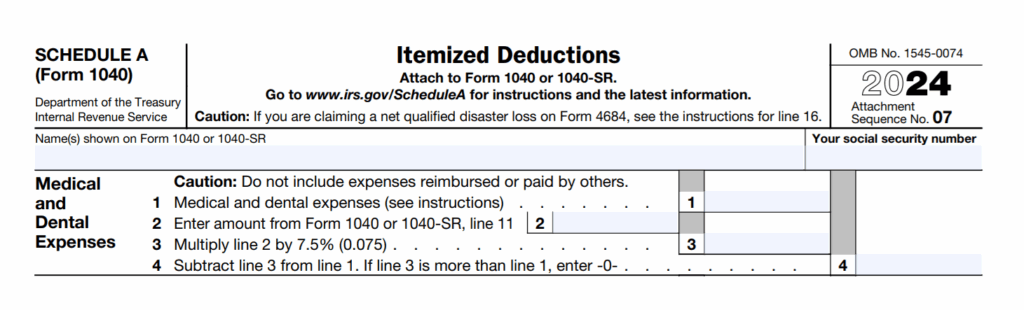
The goal here is to account for enough medical costs that exceed 7.5 percent of your adjusted gross income (AGI). That means, for example, if your AGI is $100,000, you must have medical expenses that total more than $7,500. And then only the amount over that, counts. Total medical expenses of $8,000 in this example mean a Schedule A claim of $500.
If you’re close or just slightly over your percentage threshold, make sure you don’t miss any allowable medical costs that could help increase your deduction here.
You also must make sure that all the costs you claim in this Schedule A section are on the Internal Revenue Service’s approved list of qualified medical expenditures.
The official word from Uncle Sam’s tax collector is that allowable medical care expenses are those for the diagnosis, cure, mitigation, treatment, or prevention of disease, or payments for treatments affecting any structure or function of the body.
This means that there must be a real medical reason for the treatment. And that usually means you must get a sign off from your doctor.
Many medical and dental costs: The good news is that there are many medical expenses that can make you feel better at tax time. This includes the obvious costs, such as copays for physician visits and prescription medications.
Don’t forget the travel to the doctor’s office or to pick up your Rx. Those miles are deductible. And if your medical trip requires extraordinary transport, be sure to also add in those ambulance service fees.
But wait, there’s more. Specialist treatments, which tend to cost more, are added here. This includes, for example, fertility treatments.
Under certain circumstances, expenses for medical weight loss efforts, smoking cessation programs, and even some structural changes to your home can be claimed on this part of Schedule A.
Income adjustment instead of tax deduction: Self-employed taxpayers also have another medical tax break option.
If you’re self-employed and have a net profit for the year, you may be eligible to claim the self-employed health insurance deduction. This is an adjustment to income, rather than an itemized deduction, for premiums you paid on a health insurance policy covering medical care, including a qualified long-term care insurance policy for yourself, your spouse, and dependents.
The policy can also cover your child who is under the age of 27 at the end of the year even if the child wasn’t your dependent.
You can find more details in the instructions for IRS Form 7206.
And if you don’t claim 100 percent of your paid premiums, you can include the remainder with your other medical expenses as an itemized deduction on Form 1040 Schedule A.
More medical claims: You can find the full, official list of tax-deductible medical claims in IRS Publication 502, Medical and Dental Expenses. IRS.gov also has an interactive tool to help you determine whether you can deduct your medical and dental expenses.
More December tax moves on the way: Long-time readers of the ol’ blog know that my monthly tax moves post usually is a collection of a few steps to take in the relevant month.
This year, however, I’m diverging a bit.
First, this medically-focused post was plenty long on its own. And second, since I’ve slacked off (with good reason) a bit as far as blogging, I’m going to use these last 31 days of 2025 to do separate posts on end-of-year tax moves you should consider.
Until the next tax move, take care of yourself. Now, I’m off to take a nap. Doctor’s orders, of course!

Kay Bell
Sorry about the glitch. The transfer of copy from Typepad did not include photos. So I’m going back and adding as quickly as I can. Thanks for your patience and especially for reading. Kay
web page
Hmm is anyone else experiencing problems with the images on this blog loading?
I’m trying to determine if its a problem on my end or if it’s the blog.
Any feedback would be greatly appreciated.