

As I type, the 27th tropical system of the year is meandering south of Puerto Rico.
Twenty-seven … an amazing, terrifying, distressing number, and one that makes me feel a bit guilty.
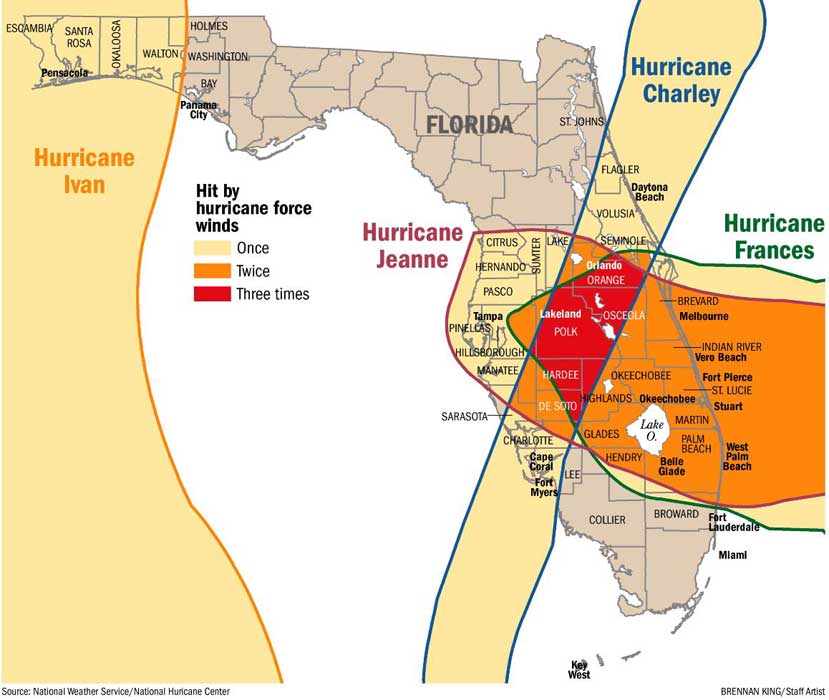
This time last year, my husband and I, along with family and friends in Florida, were still dealing with the aftermath of the one-two punch of Frances and Jeanne. Two ’canes three weeks apart. They were two of four major hurricanes to strike the Sunshine State that year, and why we moved back home to Texas.
Living in hurricane country means learning a new acronym vocabulary (ERC, SAL, GOM, GFDL, etc.), figuring out how to convert ZULU time to local time, and finally appreciating your grandparents’ stories of how they survived without electricity. But this year, with potential tropical storm 27 out there in November, we realize that we were only inconvenienced; we went through nothing.
Watching Katrina and the subsequent Keystone Kops chaos of FEMA, then the insistent Wilma, we are saddened, angry, thankful and yes, that word again, feeling guilty for ever whining about our plight. We and everyone close to us came through the 2004 storms safely, our insurance paid up quickly and completely, and we were able to move away from hurricanes that might continue to land at latitude/longitude 27N/80W to the Texas Hill Country at 30N/98W.
But it doesn’t matter where we are or what kind of weather we might face, there is a national truth: We all gripe about our local weather forecasters. That griping should stop, however, when it comes to the big meteorological guns: the men and women at the National Weather Service and its National Hurricane Center. This year especially they deserve kudos and respect. These folks nailed this remarkable tropical season and helped save many lives by getting the word out.
While Brownie decidedly didn’t do a heck of job, it wasn’t (despite pale protestations to the contrary) because he wasn’t warned. Check out the Katrina alerts archive; beginning with #22 at 7 a.m. CDT, Aug. 28, the word “catastrophic” shows up and is used repeatedly in subsequent NHC advisories.
The NWS New Orleans released an even more chilling special urgent weather message three hours later, warning in part, of: …DEVASTATING DAMAGE EXPECTED … HURRICANE KATRINA … A MOST POWERFUL HURRICANE WITH UNPRECEDENTED STRENGTH … MOST OF THE AREA WILL BE UNINHABITABLE FOR WEEKS … PERHAPS LONGER. AT LEAST ONE HALF OF WELL CONSTRUCTED HOMES WILL HAVE ROOF AND WALL FAILURE. ALL GABLED ROOFS WILL FAIL…LEAVING THOSE HOMES SEVERELY DAMAGED OR DESTROYED. … PERSONS … PETS … AND LIVESTOCK EXPOSED TO THE WINDS WILL FACE CERTAIN DEATH IF STRUCK. POWER OUTAGES WILL LAST FOR WEEKS. … WATER SHORTAGES WILL MAKE HUMAN SUFFERING INCREDIBLE BY MODERN STANDARDS.
The National Weather Service is a federal agency that I’m proud my federal taxes help support. And I agree with those who say the Service deserves more tax dollars to upgrade its equipment and capabilities so that it can improve and expand its weather tracking and public preparedness services. Anyone who’s ever lived in a hurricane-prone area reads NHC advisories religiously and they almost always, particularly early in a storm’s formation, note that “the intensity forecast remains highly uncertain.” This forecasting challenge was discussed in testimony by Max Mayfield, director of the Tropical Prediction Center/NHC, before the U.S. Senate Subcommittee on Disaster Prevention and Prediction. Let’s just hope that Congress appreciates the work of Mayfield and his crew, pay attention to his words, and send him and his forecasters the financial support they require.
Until that happens, the NWS will continue to do the best with what they’ve got. I sure think that we all deserve better, and it appears that many other taxpayers tend to agree. Voters last week in several states reassessed the public good served by tax-supported services and questioned some broadly applied tax cut proposals. In light of voter rejection of tax-cap measures in Colorado, Washington state and California, an article in today’s New York Times asks, “Has the American voter’s ardor for cutting taxes and shrinking government cooled?”
While three states are far from a trend, it is a start and the Gulf Coast hurricane tragedy might have helped point out the need to spend relatively little tax dollars up front for prevention in order to avoid spending a lot more later for reclamation.
