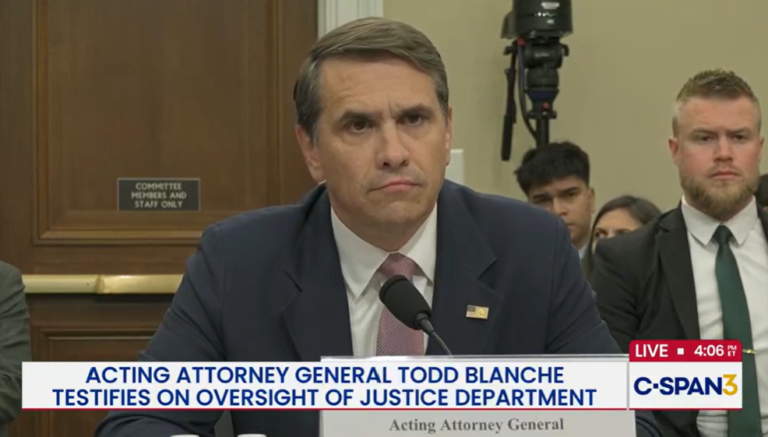
Acting Attorney General Todd Blanche updates U.S. Representatives on status of compensation fund and Donald Trump tax amnesty.
(Screen shot from C-SPAN broadcast)
…
Today is a good news, bad news day for U.S. taxpayers.
On the good news front, our tax dollars won’t be used to fund $1.776 billion Anti-Weaponization Fund (AWF) that was part of a deal to settle Donald Trump’s lawsuit against the Internal Revenue Service.
On the bad news front, the IRS’ agreement not to audit Trump, his family members, or his businesses in connection with the dismissal of said lawsuit remains in place.
‘Slush’ fund scrapped: Let’s start with the end of the controversial AWF.
Acting Attorney General Todd Blanche today said the Department of Justice (DoJ) would abandon plans for the fund.
The decision was made after Republicans on Capitol Hill finally found a line they wouldn’t cross. They joined their Democratic colleagues in denouncing the AWF.
The White House had characterized the account as a way to compensate people who claim they were unfairly investigated by the government. Opponents called it a slush fund that could be used to pay the administration’s allies.
Potential payments to J6ers, individuals who participated in over-running the Capitol Building on Jan. 6, 2021, to prevent President Joe Biden’s election from being certified by Congress, was the breaking point.
Concerns about such payments prompted the Republican-led Senate last week to leave for the Memorial Day holiday without funding immigration enforcement agencies. That rare bipartisan pushback from Capitol Hill apparently was what forced the administration’s retreat.
“We are not moving forward with the fund, period,” Blanche told Representatives during a hearing of the House Appropriations Committee panel overseeing the Justice Department.
“Not moving forward with the fund ever?” Rep. Grace Meng (D-New York) asked him asked him. “Correct,” Blanche replied.
Trump tax amnesty remains: Things aren’t so good for us taxpayers, however, when it comes to taxes that the IRS previously had argued were due from 47 and his businesses.
Blanche also today confirmed during the House hearing that the DoJ is standing by a wide-ranging Trump tax amnesty deal brokered in connection with the dismissal of Trump’s $10 billion lawsuit against the IRS.
Trump filed the suit on Jan. 29, seeking compensation for what he argued was the agency’s failure to prevent a contractor from sharing in 2019 Trump’s and other wealthy taxpayers’ returns with the media.
But on May 19, the DoJ posted on its website a one-page fund document stating that in return for Trump dropping his legal action, the IRS is “FOREVER BARRED AND PRECLUDED” (yes, it is in 47’s customary all capital letters) from pursuing examinations (which readers of the ol’ blog know is tax speak for audits) of Trump, “related or affiliated individuals (including, without limitation, family or others filing jointly),” and Trump-connected trusts and businesses.
Essentially, the agreement sanctioned by United States’ law enforcement arm gives Trump et al expansive protection from Uncle Sam’s tax agency. Tax experts say it also likely saves Trump and his family from not just due tax, but also massive penalties.
Just the one IRS investigation into claimed losses on Trump tower in Chicago, they note, could have exceeded $100 million if the IRS audit had been successful.
No audits, no money, no fairness: But Trump’s tax savings will literally cost the rest of us.
When the U.S. Treasury doesn’t collect all that it is legally owed, Uncle Sam has to find other ways to pay for his federal programs. That generally means more taxes from other taxpayers (you and me), or the ending of the services upon which millions rely.
Trump’s no-audit deal also undercuts the IRS’ core mission to collect taxes in a disinterested, nonpartisan way.
And that, in turn, underscores the dissatisfaction that many have with taxes, notably that the rich get special, less invasive treatment that lets them off the hook for taxes that we regular taxpayers cannot escape.
“It’s just completely contrary to the notion that you’re supposed to comply with the law and the IRS is there to make sure you do that,” George Yin, a tax law professor and former chief of staff at the congressional Joint Committee on Taxation, told the New York Times shortly after the deal was announced.
“The idea that you can get a free pass from the IRS or anyone can get a free pass from the IRS is just completely ridiculous,” added Yin.
Conveniently separate documents: Who could have seen this coming? Maybe skeptics (me raising my hand) who questioned why, when the lawsuit dismissal deal was announced, it was done in two parts.
First, there was the nine-page agreement detailing the formation of the AWF. That was followed by the no-audit addendum.
How fortunate for Trump (and his family and his businesses) that they were independent announcements. Coincidence or….
I’ll let you fill in your own description of whether this was planned or just serendipity.
You also might find these items of interest:
- Trump and Shakira get good tax news
- GOP joins backlash against Trump government weaponization ‘slush’ fund
- Former IRS consultant pleads guilty to stealing and sharing Trump (and others) tax data
…
Advertisements
🌟 Search Amazon Tax Products 🌟
The text link above is an affiliate ad. If you click through and then buy a product, I receive a commission.