

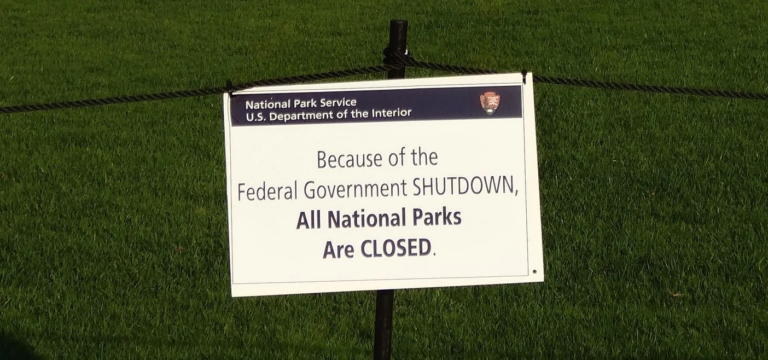
It’s official. The Internal Revenue Service today notified its employees of what they, and we, already knew was coming.
“Due to the lapse in appropriations, most IRS operations are closed.”
The agency-wide furlough began today for IRS personnel not already-identified excepted and exempt employees. That’s 47 percent of its workforce, or around 34,000 of the 74,299 staff listed in the agency’s more comprehensive, updated contingency plan.
The furloughed IRS employees now are in a “non-pay and non-duty status until further notice.”
Furlough financial concerns: While we taxpayers will be affected by the greatly reduced IRS access and services, the tax agency staff now join the 620,000+ of their colleagues in facing a potential financial emergency.
To help with the impending money crunch, IRS employees were given a letter they can use in seeking financial help, i.e., loans, to cover short-term expenses.
It says, in part, “It is in the long term best interests of both financial institutions and their customers to work out a set of feasible payment terms during this temporary situation, which is beyond our employees’ control.”
That could help some folks get enough funds to make it through a shutdown, especially if it’s not long.
And the furloughed workers will, per the U.S. Office of Personnel Management’s Guidance for Shutdown Furloughs, get retroactive pay under the requirements of the Government Employee Fair Treatment Act of 2019, signed into Public Law 116-1 on Jan. 16, 2019, by Donald Trump during his first term.
But if the government closure is a long one, that promised pay — which now also is under threat by officials in the second Trump administration who say they “would take a novel interpretation of the back pay law and argue it applied only to the 2019 shutdown” — could come too late.
Such fiscal worries are not new, and don’t apply to just federal workers. Too many people rely on regular paychecks are not equipped to deal with any kind of emergency.
Here are some tips to help you cope with unexpected financial upheaval, as well as get ready before one arrives.
Open an emergency fund: Let’s begin by being proactive. If at all possible start putting some cash into an emergency fund.
It could be as little as $5 a pay period. Anything is a good start to this account that can help if your car unexpectedly breaks down or, like federal workers now, you suddenly find you’re not getting any income.
An emergency fund can help you avoid a situation that many cash-strapped workers use, which leads to the next section on using retirement money to cover unexpected expenses.
Rules on tapping retirement funds: Taking money from a retirement account, often as a distribution or loan from a tax-deferred workplace retirement, to pay current costs, is not an ideal move, but we all do what we must. I get it. We all have to eat, and I am particularly fond of electricity.
Note, though, that when you take money from a tax-deferred retirement account before you reach retirement age, generally 65, you’ll likely face an additional tax of 10 percent on the amount you withdraw. That’s in addition to the tax on the distribution itself.
You might be able to avoid the penalty if the early withdrawal meets hardship distribution requirements. This generally is when the account owner is facing an immediate and heavy financial need. But the withdrawn hardship money is still taxed, and is limited to the amount necessary to satisfy the qualifying financial need.
There also is some tax relief if the emergency retirement withdrawal is small. Under the Setting Every Community Up for Retirement Enhancement (SECURE) Act 2.0, the 10 percent penalty is waived if the amount taken from employer-sponsored and traditional IRA plans is no more than $1,000 to cover personal or family emergencies.
If you repay this one grand distribution within three, you can get a refund on the income taxes you paid. But if you don’t, you can’t make any other emergency withdrawals in those following three years.
Also note that your employer isn’t required to offer any emergency withdrawal options. Check with your boss and benefits office before making decisions based on this potential money.
Adjust your withholding: Finally, one easy way to avoid tapping retirement funds is to review your payroll withholding. If you’re overpaying your eventual tax bill every pay period, change that and get the money yourself each pay period.
Yes, I know a lot of folks intentionally overwithhold so that they’ll get a refund at tax-filing time. It’s an easy forced savings account.
But the Bank of Uncle Sam pays no interest. And things like a government closure or IRS staffing issues thanks to agency cutbacks could mean you might have to wait longer than expected for your tax refund.
Adjusting your withholding amount will get you that cash in each paycheck. If you’re afraid you’ll just spend it, set up an automatic deposit of that money that used to go to the IRS into a savings account, aka your new emergency fund. Most payroll administrators and banks or credit unions will work with you here.
You can change your withholding any time by giving your payroll administrator a new Form W-4, Employee’s Withholding Certificate. And the IRS can help.
Even though the tax agency is in shutdown mode as far as its workforce, IRS.gov’s Tax Withholding Estimator is still available online. While the web page notes that the online tool hasn’t been updated to account for some of the One Big Beautiful Bill (OBBB) Act tax provisions that apply in the 2025 tax year, it still can give you an idea of where your withholding should be.
And if those new tax situations — overtime pay, tip income, auto loan interest, or the Senior Bonus — don’t apply to you, it still can give you a pretty good idea of where your withholding should be.
That recaptured withholding could be, as noted, the basis of your emergency fund. And that cash will be readily accessible any time you need it, not just when the IRS gets around to processing your return and issuing your tax refund.

