
Photo by Mikhail Nilov
…
Last year, the White House directed federal agencies to modernize payment systems. So, how is the Internal Revenue Service doing in going paperless? A recent Treasury Inspector General for Tax Administration (TIGTA) report details the tax agency’s digital-first successes, and where it is lagging.
…
If you paid estimated taxes this week, you probably did so electronically.
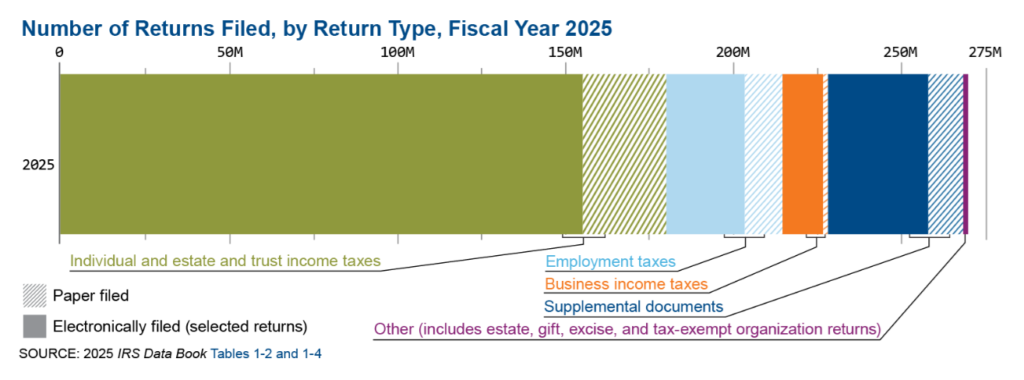
The Internal Revenue Service’s 2025 Data Book, which breaks out the tax numbers for fiscal year 2025, shows that most taxpayers are amenable to the agency’s urging that we go electronic with our filing and paying of taxes.
Electronic filings accounted for almost 94 percent of the nearly 163 million individual income tax returns sent to the IRS from Oct. 1, 2024, through Sept. 30, 2025.
…
…
While the Data Book, doesn’t detail how the more than $5.3 trillion the IRS collected last fiscal year was paid, it’s safe to assume that a whole lot of the e-filers who owed also e-paid their due tax.
Additional data digging by the Treasury Inspector General for Tax Administration (TIGTA) supports that assumption. The independent tax watchdog says that 81 percent of individual payments and 85 percent of individual refunds were electronic.
That is good news for the IRS. The agency, like other federal offices that handle financial transactions, has been working to comply with the Trump administration’s March 2025 Executive Order (EO) 14247 requiring most federal payments and receipts to be made electronically.
TIGTA recently took a closer look at how e-transactions are going at the tax agency, and what challenges it still faces to get even more of us on the e-train.
Electronic differences in individuals and business taxpayers: TIGTA’s “Snapshot Report: The IRS’s Paperless Transition Efforts as of July 2026” found that even before the White House’s paperless directive, taxpayers were embracing the technology.
During tax processing years 2024 and 2025, data show that 88 percent of total tax transactions were made electronically. Numerically, that was 654 million e-tax tasks out of 743 million overall filings and payments.
Individual taxpayers lead the way when it comes to electronically paying tax and getting refunds. Eighty-five percent of taxpayers got paperless refunds, while 81 percent of individual tax payments were electronic.
Business taxpayers were more active when it came to e-payments. Ninety-seven percent of these transactions were e-paid. Of course, this impressive business e-payment rate can be attributed in large part to the long-standing IRS requirement that companies make federal tax deposits such as employment and withholding taxes electronically.
But businesses lag individuals filers when it comes to refunds. Only 0.7 percent of them received electronically-delivered businesses tax refunds.
Current e-tax progress: The EO required full compliance within six months of its issuance. TIGTA found the IRS is making progress helping more individual and business taxpayers conduct their transactions electronically.
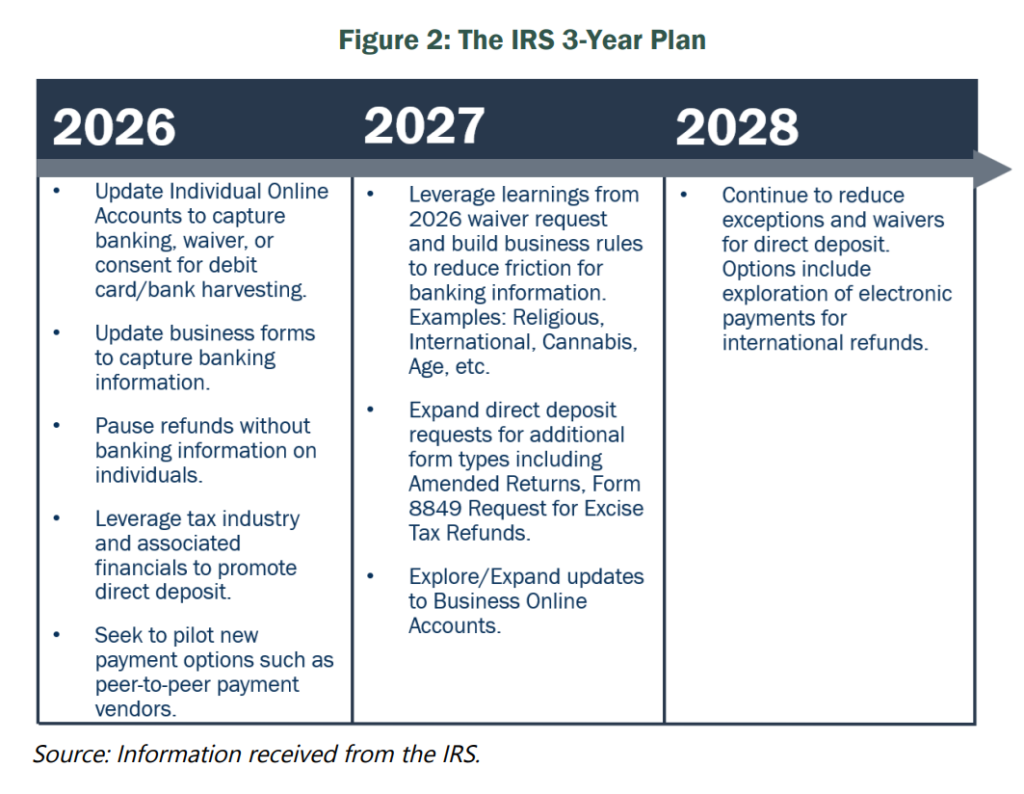
IRS officials told the oversight examiners that the agency’s compliance with the EO is part of a three-year plan, shown below, that was aligned with the start of the filing season in January 2026.
…
…
According to Treasury’s implementation plan, the IRS will prioritize form updates, conduct a media campaign, update notices and online accounts, and establish procedures for processing exceptions.
The IRS also has redesigned several relevant business tax forms to enable taxpayers to input their bank account information. As for individuals filers, it has updated notices and online services to help these taxpayers understand the new paperless shift and how to comply.
Unbanked challenges: However, there are several hurdles the IRS must overcome as it works towards implementing its self-proclaimed zero paper initiative.
One of the key areas of concern are taxpayers who do not have bank accounts. These so-called unbanked individuals may object to such financial activity due to certain religious beliefs. Others have limited access to technology. And around 830,000 of them had trouble getting their tax refunds this year as paper Treasury checks.
The EO acknowledged these situations, as well as other exceptions where certain taxpayers would face undue hardship using electronic fund transfers, or EFTs. Treasury and the IRS can grant exceptions to taxpayers when electronic payment and collection methods are not feasible.
The Taxpayer Advocate Service also weighed in here, noting that Treasury’s authority to approve limited exceptions must be used “proactively, compassionately, and with stakeholder input.”
The TIGTA report is informational only, so it does not make any recommendations to the IRS regarding its paperless transformation efforts.
However, one thing is clear and generally accepted by all parties. Additional public awareness and input will be key for the IRS to successfully reach its goal of becoming a digital-first agency.
Without taxpayer buy-in, both from the individual and business sectors, efforts to force filers into electronic tax transactions may work, but that so-called success will come with increased filer frustration.…
You also might find these items of interest:
- IRS received $3.2 billion in unidentified tax payments in FY2022-24
- Open a bank account to get your tax refund sooner via direct deposit
- Congress still seeking answers about 3.4 million delayed paper tax refund checks
…
Advertisements
🌟 Search Amazon Tax Products 🌟
The text link above is an affiliate ad. If you click through and then buy a product, I receive a commission.