


An Internal Revenue Service watchdog found the agency recently received billions in unidentified tax payments. The IRS is working on modernizing its operations, which will go a long way in more effectively resolving unaccounted-for amounts. Taxpayers can help, too, by taking advantage of the IRS’ various electronic transaction options.
…
Collecting taxes obviously is the Internal Revenue Service’s main job. Once it gets those tax dollars, it then needs to make sure it properly accounts for the money.
But sometimes that doesn’t happen. For example, take some tax payments made from fiscal years 2022 through 2024. The Treasury Inspector General for Tax Administration (TIGTA) found that during that time period the IRS received approximately $3.2 billion in unidentified payments.
Those billions, as long-time readers of the ol’ blog already have guessed, are this weekend’s By the Numbers figure.
Old-fashioned payment problems: In its report on the mystery money, TIGTA noted this happens when tax payment information is missing or incomplete.
That’s the case when a taxpayer’s check or money order doesn’t include the payer’s name or identification number, or it doesn’t note the form type or tax period to which the amount should be credited.
The good news is that the IRS ultimately identified the sources for most of the unknown tax payments. But $218 million was left unresolved, according to TIGTA’s report.
And that document’s title spells out what TIGTA says the agency needs to do: IRS Programs That Resolve Billions of Dollars in Unidentified Taxpayer Payments Need to Be Improved and Modernized.
The key here is the IRS’ ongoing modernization effort.
Problems for IRS: Unaccounted for tax payments obviously present a problem for Uncle Sam.
From the government’s standpoint, it adds layers of work to an already overburdened system.
TIGTA found that the IRS’ unidentified payment inventory is not centrally managed in a case management system. Rather, the agency handles unidentified payments as three separate inventories through each Tax Processing Center’s accounting system.
These unidentified payments also are assigned and monitored manually, compounding the problem. The multi follow-up systems doesn’t allow the IRS to efficiently evaluate program results, such as the timeliness of case resolution, notes TIGTA.
And, according to the report, the IRS does not distribute the inventory of work at its Tax Processing Centers based on available resources.
TIGTA points out that the Unidentified Remittance unit in the Ogden, Utah, Tax Processing Center had the same number of staff as the Kansas City, Missouri, Tax Processing Center. However, Ogden accounted for 40 percent of unidentified payment inventory compared to 11 percent in Kansas City.
TIGTA’s data also shows that the IRS’ Austin, Texas, processing center, the third facility that handles unidentified payment inventory, was the most successful in applying payments to taxpayer accounts.
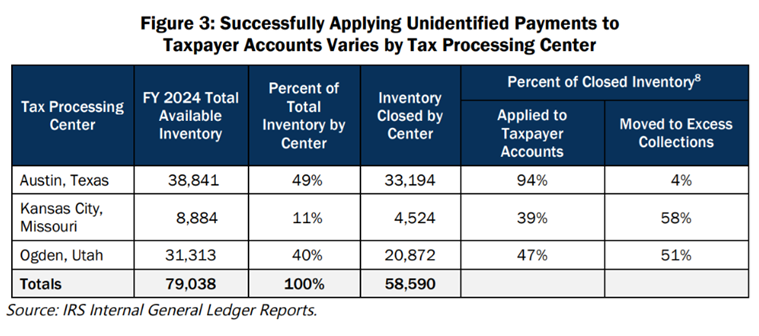
The Austin campus closed 94 percent of its inventory, compared to 47 percent and 39 percent, respectively, at the agency’s Ogden and Kansas City operations.
Some of the Texas center’s success in applying payments may be because the Austin facility also processes Individual Taxpayer Identification Number (ITIN) applications, notes the report.
“Payments attached to an ITIN application are routed to Austin’s Unidentified Remittance unit and added to the Unidentified Remittance File pending issuance of the ITIN. Once the identification number is assigned, the payment can be credited to the taxpayer’s account,” TIGTA noted.
Problems for taxpayers, too: As for taxpayers, they are inconvenienced when they contact about a missing payment.
If the IRS employee receiving their inquiry cannot locate the payment, the taxpayer’s case will be sent to one of the three Accounting Operations within the IRS Tax Processing Centers.
However, TIGTA found that the IRS is not able to assess the effectiveness of this so-called hardcore payment tracer referral program. Again, the primary problem is that the unidentified payment inventory is not centrally managed in one case management system.
Such inefficiencies in resolving unidentified tax payments can increase the burden on taxpayers, resulting in additional calls, letters, and visits to the IRS.
Electronic solutions suggested: TIGTA recommended that the IRS develop an electronic case management system and associated internal controls to collectively manage inventory streams across the agency’s accounting operations.
TIGTA says an e-management system would enable the IRS to —
- Oversee and evaluate unidentified payment and hardcore payment tracer inventories.
- Create consistency and reduce employee error in case documentation.
- Enable the IRS to work electronic case files.
Until the IRS has an electronic case management system in place, TIGTA suggests the agency develop an interim process to track hardcore payment tracers. It also recommends the IRS establish evaluative metrics to help it assess the efficiency and effectiveness of its current methods to identify and address unidentified payments and hardcore payment tracers.
Increasing taxpayers’ electronic transactions: The IRS agreed with all of the TIGTA recommendations.
The tax oversight report also noted that the agency has implemented the interim process for tracking hardcore payment tracers tracking process.
Another way to reduce unidentified tax payments is to get more taxpayers using electronic options.
Kenneth Corbin, IRS Chief of the Taxpayer Services Division, addressed this effort in his reply to TIGTA’s analysis.
“In accordance with Executive Order 14247, Modernizing Payment To and From America’s Bank Account, we will be transitioning away from paper-based payments and expanding electronic payment options, including payments from taxpayers,” wrote Corbin.
This move, he added, will reduce the number errors and improve the agency’s ability to apply payments to the correct taxpayer accounts.
Taxpayer tips on current IRS e-options: The IRS has been promoting its online individual taxpayer account option.
With an account, you can access your current tax account information, including balance due, payments you’ve made, tax records and more.
It also is a good way to avoid the IRS’ telephone help line delays.
If you discover you do owe more tax than you can pay in one fell swoop, the IRS has another electronic option you should check out.
The IRS introduced its Tax Debt Tool this spring. You’ll find it atop IRS.gov’s special Get Help With Tax Debt page.
You don’t have to enter personal data, such as your name or Social Security number, to explore the agency’s various tax debt payment options. The online search option is available 27/7.
Finally, the IRS continues to encourage taxpayers who can pay their tax bills in full to do so electronically. Doing so via your online taxpayer account is one method. And millions already use credit or debit cards every filing season, as well as to pay estimated taxes throughout the year.
You can find more e-pay options in my post 6 ways to electronically pay your tax bill.
When you’re getting a tax refund, going electronic also is better for both taxpayers and the IRS. Refunds that are directly deposited are delivered much sooner, and more securely, than those sent as old-school U.S. Treasury paper checks.
And this year, due to the White House Executive Order that the IRS’ Corbin cited in his response to TIGTA’s study, around 3.4 million taxpayers have had their refund checks delayed.
So, if you don’t have a bank account into which the IRS can electronically remit your tax refund, look into opening one.
I know that many people have plenty of valid reasons, including costs, for not having a financial account. However, there are some affordable options if you want a bank account for, if nothing else, getting quicker access to your tax refund.
…
Advertisements
🌟 Search Amazon Tax Products 🌟
The text link above is an affiliate ad. If you click through and then buy a product, I receive a commission.

