
Photo by Stas Knop
Bummed because today’s return to Standard Time means earlier sunsets? Here’s a look at a couple of standard tax deductions that might brighten your tax filing attitude, if not literally your days.
Daylight Saving Time officially ended at 2 a.m. today. If you’re a morning person, you appreciated seeing the sun an hour earlier this morning.
But if you enjoy more daylight after you get home from school or work, things are probably looking pretty gloomy right now.
I get it. We lived on the East Coast for 25 years. Short winter days are the worst. Even here in the Central Time Zone, I turned on lamps earlier than 24 hours ago.
So, how about some tax talk to brighten your mood, if not your skies?
In conjunction with today’s return of Standard Time (and the one hour adjustment to our timepieces that earns this week’s By the Numbers honor), here’s a look at a couple of tax standards, the standard tax deduction claim and standard optional deductible mileage rates.
Standard deduction annual increase
Most taxpayers have always claimed the standard deduction every filing season. One of the main reasons for the standard deduction’s popularity is its convenience.
It is easier to enter that set amount on your Form 1040 than to track expenditures and collect receipts throughout the year to document itemized amounts on Schedule A.
Major tax reform in 2017 and 2025 also made the standard deduction amounts for the five filing status more financially appealing.
The Tax Cuts and Jobs Act of 2017 (TCJA) basically doubled the standard deduction amounts. The tax provisions in the One Big Beautiful Bill Act (OBBBA) made the individuals TCJA changes permanent, and even bumped up the 2025 standard deduction amounts.
That increase was notable since it was used as the basis for the Internal Revenue Service’s inflation adjustments for the 2026 tax year. Those amounts, shown in the table below, will be what standard filers can claim when they file this year’s tax returns in 2027
| Filing Status | 2026 Standard Deductions For use in filing 2026 tax returns in 2027 |
| Single | $16,100 |
| Head of Household | $24,150 |
| Married Filing Jointly | $32,200 |
| Qualifying Widow or Widower (Surviving Spouse) | $32,200 |
| Married Filing Separately | $16,100 |
You can bookmark this post, or jot those deduction amounts down. Or you also can just wait until tax-filing time.
Another benefit of the standard deduction is that the amounts are always listing directly on Form 1040, as shown in the except from the draft 2026 tax year version below.
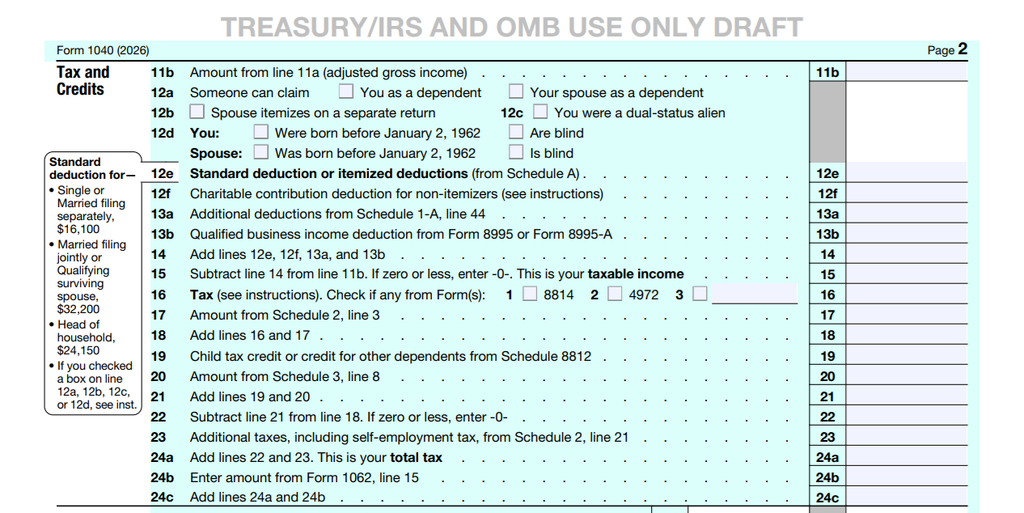
And for my tax-planning readers already thinking about 2027 taxes, those 2026 standard deduction amounts will be the basis for the inflation adjustments for next tax year.
Preview: The IRS should announce those 2027 amounts any day now. When it does, they will be Part 2 (a la this year’s version) of the ol’ blog’s annual 10-part tax inflation series.
Measuring business mileage. Twice.
One of those tax matters annually affected tangentially by inflation is how much you can deduct if you use your auto for various IRS-sanctioned tasks.
The most common mileage deduction is for folks who use their vehicles for business.
This isn’t used to claim miles driven to do your job if you’re an employee. Reimbursement for that work-related travel is now between just you and your company, as the 2017 tax law eliminated the option to claim it as a miscellaneous itemized expense.
But it you are self-employed, this transportation write-off is a valuable way to reduce your taxes.
As the boss behind the wheel, you have a choice as to how to claim your work-related automotive expenses. You can write off all your actual work-related vehicle expenses or you can claim the standard options mileage deduction.
Which is better? As with most things tax, the answer is “it depends.” You can find the intricacies of both options and what you should consider before making a business mileage deduction decision in my earlier post on which auto expenses deduction method might cut your business tax bill more.
If you do decide to use the standard optional mileage rate when you file your 2026 taxes, you will have to double up on your tally. That’s because the IRS made two separate mileage rate changes for 2026 business driving.
The first was at the end of 2025, when it hiked the business mileage tax deduction rate for 2026, but lowered two other mileage rates.
Then, this July as drivers were dealing with what at the time seemed like outrageous gasoline prices, the IRS made an interim adjustment. It increased the tax-deductible standard mileage rates for the last half of 2026.
The deductible dollar amount for miles driven during the first have of 2026, from Jan. 1 through June 30, will be based on the first inflation-related figures from last year. Those from July 1 through Dec. 31 will be calculated using the summer increase to the cents-per-mile (cpm) rates.
So, when eligible business drivers claim the optional standard mileage rate for their travel on their 2026 returns next year, they’ll have to make two computations. As the table below shows, that same double mileage duty also applies to taxpayers who can claim qualifying medical and relocation miles, which also were bumped up a bit.
| 2026 Tax Year | Business | Medical | Moving | Charity |
| Jan. 1 – June 30 | 72.5 | 20.5 | 20.5 | 14 |
| July 1 – Dec. 31 | 76.0 | 23.5 | 23.5 | 14 |
The mileage rates also will be revised later this year. Given the pain at the pump we’ve all been experiencing since the start of the U.S.-Iran war, they could go up substantially for 2027.
These standard tax rates should help many taxpayers cut their tax bills. Here’s hoping the tax savings will help make a dent in higher utility bills we’re likely to face this winter.