Photo by George Pak
Military service is difficult. Veterans also face challenges. But there is some tax help for our armed forces, both while they are on active duty and when they return to civilian life. Here’s an overview on this Veterans Day.
Veterans Day is always emotional. It’s even more difficult for families whose loved ones are still active and engaged in an active war.
We are thinking of all y’all this Nov. 11, and hoping you are home soon.
Nov. 11 is one of the few federal holidays that doesn’t shift to a Monday. The reason is solemn and symbolic origin.
What we now call Memorial Day began as Armistice Day to honor the 4.7 million Americans who served — and the 116,500 who died — in World War I, then known as the Great War.
The Great War’s fighting between Allied forces and Germany on the Western Front at precisely 11 a.m. on Nov. 11, 1918.
Remembering Flanders Fields sacrifices
Perhaps the best-known commemoration of the lives lost during WWI is the poppy.

The flower, now seen on lapels worldwide every November, was adopted as the official memorial flower of the Veterans of Foreign Wars in 1922. The floral choice first was immortalized in John McCrae’s poem “In Flanders Fields.”
In addition to expressing the immeasurable grief over the “row on row” of graves of soldiers who had died on Flanders’ battlefields, the poem also notes our global commitment to peace through sacrifice in its closing stanza:
“To you from failing hands we throw
The torch; be yours to hold it high!
If ye break faith with us who die
We shall not sleep, though poppies grow
In Flanders fields.”
Armistice Day kept its name and focus until 1954, when the Nov. 11 tribute was changed in the United States to Veterans Day. The day’s scope also was widened to honor veterans from all eras.
Transitioning to the private sector
There were 15.7 million military veterans in the United States in 2025, according to the U.S. Census Bureau’s American Community Survey for that year. They represented nearly 6 percent of the total civilian population age 18 and over.
Veterans age 75 and older in 2025 accounted for 30.5 percent of the U.S. population.
At the other end of the spectrum, 8.4 percent of veterans were under age 35 last year.
Veterans of all ages continue to contribute after completing their military service. Many make use of their armed service training and skills upon returning to civilian life.
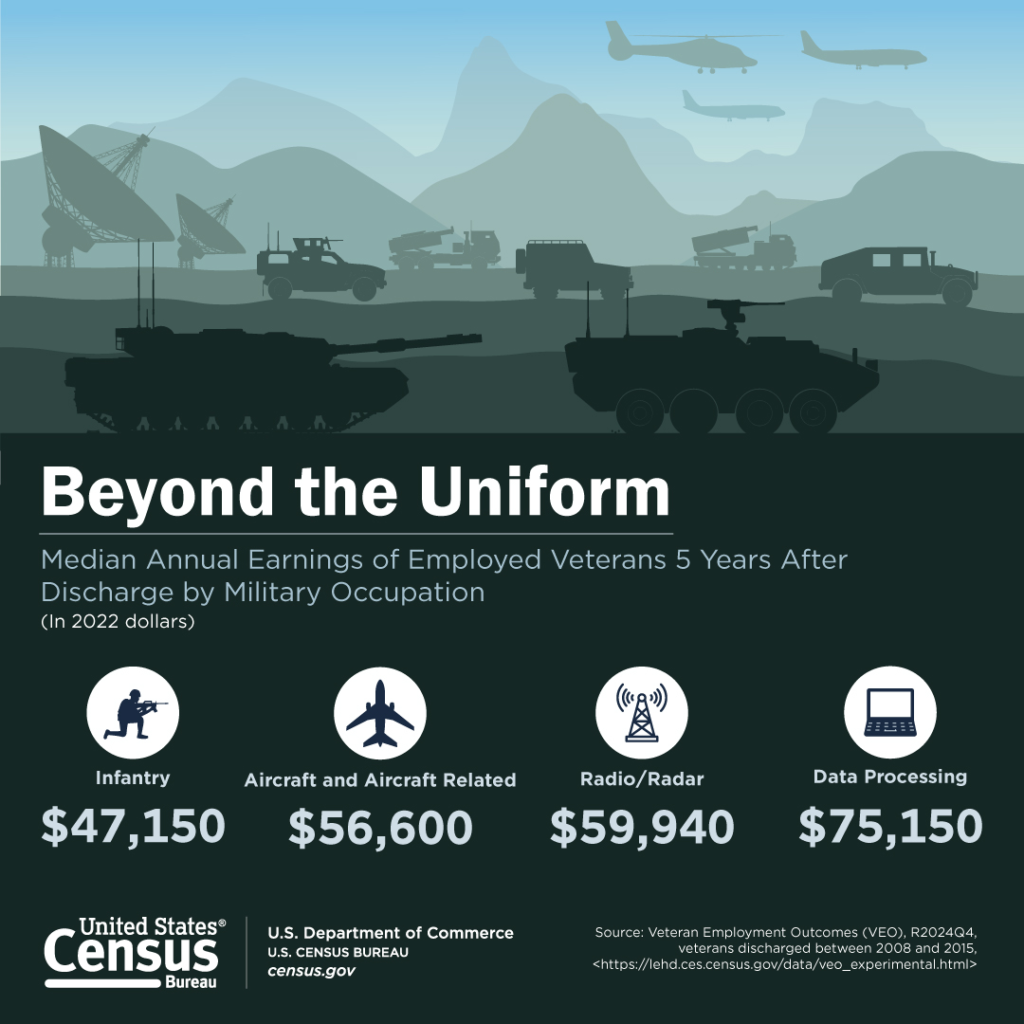
The Census Bureau graphic below shows that the earnings for former military personnel based on their roles while serving Uncle Sam. It’s no surprise that those with data processing roles while in uniform did quite well after leaving the military.
Like all workers, their incomes, both while in uniform and afterwards, are subject to taxes.
But service members also get some veteran-specific tax considerations.
Tax benefits for veterans
Certain benefits from the Department of Veterans Affairs (VA) may not be taxable. Military veterans do not have to include the following amounts as taxable income.
- VA disability benefits, including
- Disability compensation and pension payments to veterans and their families,
- Grants for designing a wheelchair accessible home,
- Grants for motor vehicles for loss of sight or use of limbs, and
- Benefits under a dependent-care assistance program;
- VA education benefits; and
- One-time lump-sum disability severance payments received from the Defense Department is the service personnel separated from the military because of combat-related injuries.
Veterans who erroneously paid taxes on these amounts can file an amended return (IRS Form 1040-X) to get a refund.
When it comes to VA disability income, veterans definitely should explore the amended filing option if they received —
- An increased VA disability rating, including retroactive determinations, or
- Combat-related special compensation while receiving both military retirement pay and disability compensation.
Don’t overlook the EITC
Veterans and their brethren still in uniform should explore whether they qualify for the Earned Income Tax Credit (EITC). This is a refundable tax credit, meaning that if the credit amount is more than the filer owes, the taxpayer will get the excess back as a refund.
Active military members looking to claim the EITC have two other rules to consider if they —
- Get nontaxable military pay, such as combat pay or a housing or subsistence allowance; or
- Were stationed outside the United States
Service members do not have to include the nontaxable amounts when filing returns. However, some find that including it in taxable earned income for EITC claiming purposes may produce a smaller tax liability or larger tax refund.
As for veterans, their tax-exempt VA disability payments, disability retirement pay, and Combat-Related Special Compensation do not count as earned income for the EITC. However, long-term disability benefits received before the minimum retirement age can count as earned income.
Also, veterans who now hold civilian jobs or who are self-employed can use those earnings to claim the EITC.
Active military and veterans should take advantage of IRS.gov’s online interactive EITC Qualification Assistant. It can help you determine whether you qualify for the tax credit.
You also can use it to calculate your taxes using your nontaxable military income as well as without counting it. Then choose the filing method one that works the best for you.
Military personnel and veterans can find more on how their service affects this tax credit in the Nontaxable Combat Pay section of in IRS Publication 596, Earned Income Credit.
More service-related tax information also is available at the IRS’ Veterans tax information and services and Tax information for members of the military web pages.
Thanks to all for their service
I hope these tax tips help veterans, active duty service members, and their families.
But mostly, before closing this Nov. 11 post, I want to take a moment to remember those, to borrow McCrae’s words, who loved and were loved, but whom we lost.
My father was a veteran, serving in the Navy and Navy Reserve. Unfortunately, he’s no longer around for me to personally salute on this Veterans Day.
But if your veterans are still part of your life, give them a huge hug of thanks for all of us.