


Photo by Investment Zen via Flickr
Deductions are an easy way to lower your tax bill. Most taxpayers take the standard route. It’s easy and the deduction amounts (they differ based on your filing status) are increased annually to account for inflation. Here’s a look at the standard deduction hikes for the 2027 tax year.
Deductions can help reduce your taxable income. The less money subject to taxes, the less you owe the U.S. Treasury.
Some people get the most advantageous deduction amount by itemizing. Most of us, however, claim the standard deduction.
That’s especially true now that the One Big Beautiful Bill Act (OBBBA) of 2025 made permanent the standard deduction amounts that essentially were doubled eight years earlier by the Tax Cuts and Jobs Act.
Whichever deduction method you use, it is yours to choose each year. You can claim the standard amount for three years, then itemize the next. Or vice versa.
Or alternate between years, which is common for filers who bunch deductions (an option noted in my November Tax Moves post).
The Internal Revenue Service also annually reviews the standard deduction amounts and usually bumps each one up at least a bit based on inflation. And yes, the plural “amounts” was intentional. There are three that apply based on which tax filing status you use.
The tax agency released its latest inflation review last week. Now, those 2027 increases to the standard deduction are the focus of this Part 2 of the ol’ blog’s annual 10-part inflation series.
Inflation finally pays off a bit at tax time.
Inflation has been created a ton of financial problems for consumers this year. But when it comes to taxes, it provides at least a little relief. The increased cost of living is reflected in larger standard tax deduction amounts.
For tax year 2027, the standard deduction amounts will be —
- $16,600 for single taxpayers and married individuals who file separate returns, a bump of $500;
- $24,925 for head of household filers, an increase of $775; and
- $33,200 for married filing jointly couples and surviving spouses, an increase of $1,000 more than this year’s standard claim.
At the risk of being repetitive (and because I like tables), below is a comparison of this year’s 2026 standard deduction amounts and those that will be available in 2027. Again, note the dates, that is the tax years, to which these amounts apply.
Filing Status | 2026 Standard Deductions Use these amounts to file 2026 taxes in 2027 | 2027 Standard Deductions Use these amounts to file 2027 taxes in 2028 |
| Single | $16,100 | $16,600 |
| Head of Household | $24,150 | $24,925 |
| Married Filing Jointly | $32,200 | $33,200 |
| Qualifying Widow or Widower (Surviving Spouse) | $32,200 | $33,200 |
| Married Filing Separately | $16,100 | $16,600 |
Age and tax dependency status affect standard deductions.
The standard deduction amounts shown above apply to most taxpayers younger than 65.
The age distinction is important because the tax code allows older filers and those who are visually impaired to claim additional standard deduction amounts. And you can do so simply by ticking a checkbox on your tax return.
Each added standard deduction amount option is separate for each filer, meaning that an older married couple could check up to four boxes on their joint return. The total number of boxes checked then is used to determine the filer(s) standard deduction amount.
For the 2027 tax year, filers age 65 or older and/or legally blind taxpayers get an additional standard deduction amount. It will be $1,700 for each qualifying circumstance. That’s $50 more than the $1,650 allowed on 2026 returns.
The additional standard deduction amount in age/vision situations increases next year to $2,100 if the individual is also unmarried and not a surviving spouse. That’s also a $50 increase of the $2,050 allowed this tax year.
These additional standard deduction amount are separate from the Senior Bonus created by the OBBBA. This potential $6,000 per person tax break is available to eligible older taxpayers regardless of whether they itemize or claim the standard deduction.
So, be sure to claim all the added checkbox standard deduction add-on amounts, as well as the Senior Bonus if you qualify for it, too.
And if you are a tax filer who also can be claimed as a dependent on another taxpayer’s return, in 2027 your standard deduction amount could be limited. It cannot be more than the greater of either $1,400 or the sum of $500 and the dependent filer’s earned income. Those amounts are each $50 more than what applies to this 2026 tax year.
Standard deduction amounts are easy to find.
You can bookmark this post, or jot down these standard deduction 2027 amounts for use when that tax filing season finally arrives in 2028.
Or you also can just wait until then and check your Form 1040. The standard deduction amounts are always listing directly on the annual personal tax return.
It will be a while before the 2027 tax year version is ready; like, more than a year from now. But you can see where the future inflation adjusted amounts discussed in this post will show up in the 2026 tax year draft Form 1040 version below.
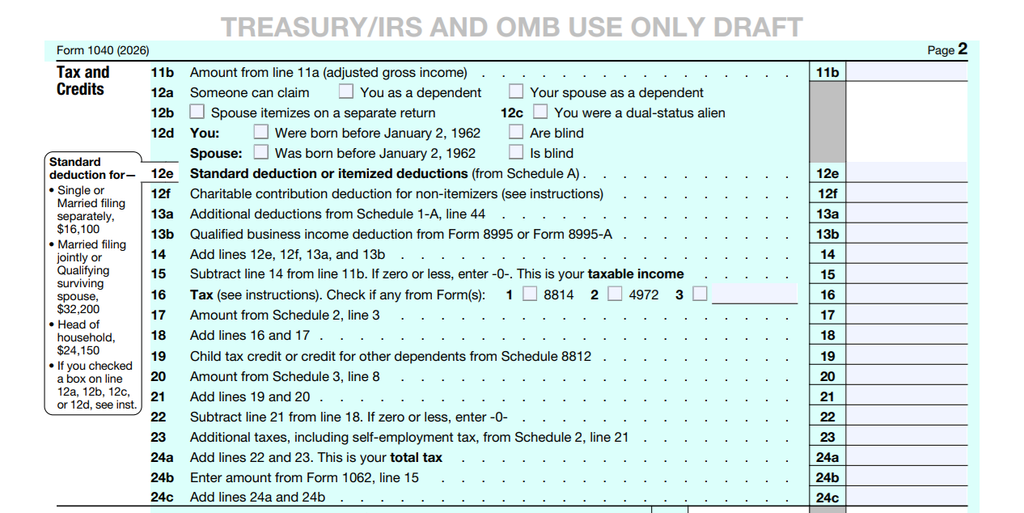
And yes, the 2026 Form 1040 is still in draft form. The IRS is still working on it and other material we’ll use in next year’s filing season. So maybe you do want to bookmark this page for 2027 filing season preparation.
Don’t automatically discount itemizing.
While most of us claim the standard deduction, you can choose every year which deduction method to use. And you definitely should at least take a look at both options.
Don’t just assume that taking the standard route is the best tax deduction map to follow. You know that old tax saying: Assuming can get your a$$ kicked by the IRS in the form of a higher tax bill.
OK, maybe that’s just my personal old tax saying, but you get the idea.
So, double check your deduction choice so that you don’t cheat yourself at filing time. Changes in your financial and/or life might mean itemizing might give you the better tax result.
Even the IRS endorses such actions, noting that taxpayers always want to use the deduction method that gives them the larger amount to offset your income. If that’s itemizing, then you should do the extra work to get a better tax deduction result.
I also want to reiterate, for a third time if you’re counting, my reminder about choosing deduction method every year. Things change. One year, itemizing might be better. The next year, it’s wiser to take the standard deduction.
Tax laws changes, too. For example, some OBBBA additions, such as the increase in the state and local taxes (SALT) deduction, as well as long-time Schedule A claims for medical expenses, could mean your total itemized deduction amount will be more than your standard deduction. If that’s your situation, then by all means itemize.
Knowing what’s available on the standard side gives you a baseline to use in measuring your potential itemized expenses.
Tracking 2027’s tax inflation changes.
Long-time readers are familiar with the ol’ blog’s annual 10-part inflation series. Returning or new, the table of contents below will keep you up to date on the official IRS inflation adjustments to a plethora of tax provisions (almost 70 per the IRS’ count) that will apply to the 2027 tax year.
That said, if you click on most of the links past this post (#2 below) you will find they go to the Don’t Mess With Taxes tax brackets and inflation category page. The only others that are updated are the HSA reference in #4 and the wage base increase announced last month and cited in #6.
I’m still working on the rest of the main IRS 2027 inflation revision posts that are make up the ol’ blog’s other eight parts of this annual series. As I do publish them, I’ll come back to the table of contents and update the links.
- 2027 tax rates and income brackets
- Standard deduction amounts and itemized deduction considerations (This post!)
- Credits and deductions, including adoption costs and assistance, Lifetime Learning Credit, Earned Income Tax Credit, educators’ expenses, interest on education loans and transportation fringe benefits
- Medical-related tax provisions, including contributions to a flexible spending account (FSA), health savings account (HSA), medical savings account (MSA), and eligible and eligible long-term care premiums
- Capital gains tax income brackets, estate and gift tax limits, kiddie tax, kiddie tax, and nanny tax
- Alternative Minimum Tax exemption amounts, along with the Social Security wage base increase amount and other pay-related taxes
- International worker tax issues, including foreign income and housing exclusions (including for higher cost residential areas abroad)
- Retirement (e.g., IRA etc.) and pension plan contribution limits
- Penalties, for both individuals and tax pros, for things such as failure to file a timely 1040 or certain information returns
- Standard mileage deduction rates (This is the final component, since the IRS issues these adjustments and later in the year.)
Again, I know all y’all fellow tax geeks want as much tax information as soon as possible. I get it. So, I really appreciate your patience when comes to my extended presentation of the 2027 tax inflation info.

