This summer, the Internal Revenue Service and its Security Summit partners conducted their annual “Protect Your Clients, Protect Yourself” awareness campaign for tax professionals.
The goal of the summer series is to update tax pros on the latest threats to their businesses and clients. Among the warnings are scams designed to steal crucial taxpayer data that can be used, among other things, to file fraudulent tax returns.
The importance of the program was underscored recently by a recent Treasury Inspector General for Tax Administration (TIGTA) report that found the IRS last year did not adequately verify the identity of callers to its Business Specialty Tax and the Practitioner Priority Service telephone lines.
“This allowed the unauthorized disclosure of tax information, the fraudulent filing of Forms 941, and the issuance of fraudulent tax refund checks,” according to the report issued Aug. 12.
By the time TIGTA alerted the IRS in October 2024 of the fake business filings, 20 different businesses had received more than $93 million in fraudulent tax refund checks.
Ultimately, most of the fraudulent refunds were stopped and the IRS added another safeguard layer. But the scheme still resulted in millions in tax losses.
And it emphasizes that everyone — individual and business taxpayers, tax pros, and the IRS — must constantly be on alert for new and evolving tax schemes.
Larger fraud loss reduced: The good news is that TIGTA’s Office of Investigations successfully stopped payment on most of the fraudulent Form 941 refund checks.
“However, the federal government incurred at least $2.7 million in losses,” notes the TIGTA report.
The bad news is that further TIGTA analysis revealed that approximately $55.6 million in refund checks were issued to 150 Employer Identification Numbers (EINs) from January 2023 through July 2024.
The worse news, according to the report, was that “IRS management was aware of the risk of erroneous refunds being issued based on fraudulent Form 941 filings, but did not take action to prevent the scheme.”
The worst news is that the initial Form 941 concerns that the IRS ignored were raised by the IRS’ own Customer Account Services in June 2024 and August 2024.
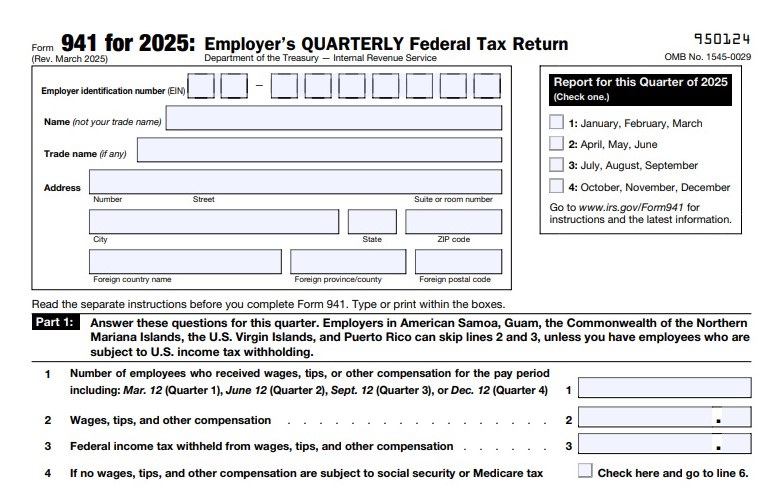
Process not followed: Employers use Form 941, Employer’s Quarterly Federal Tax Return (excerpt below), to report wages and tips their employees have earned. Form 941 is also used to report employment taxes, including federal income, Social Security, and Medicare taxes withheld from employees, as well as the employer’s matching contributions to the federal retirement and retiree health care programs.
See more tax forms and more about them at Tax Forms 2025.
TIGTA says that the IRS didn’t adequately verify the identity of callers to its Business Specialty Tax and the Practitioner Priority Service telephone lines even though there is a process to do so in place. That failure allowed fraudsters to get enough tax information to launch their fraudulent Form 941 scheme.
IRS procedures state that prior to releasing any tax account information over the telephone, agency employees are required to review the Integrated Automation Technology (IAT) Disclosure tool. This alerts IRS representatives to certain tax account conditions when identity theft is suspected or documented.
TIGTA also noted in the report that when identity theft is suspected on a tax account, IRS employees are required to conduct additional research, including reviewing history notes on the account.
“Our review of the history notes showed that IRS employees had documented fraudsters’ initial requests for tax information. If subsequent IRS employees had reviewed those notes, they may not have provided the information needed to further the fraud scheme,” according to TIGTA.
New security in place: As a result of TIGTA’s review, the IRS ultimately did implement additional authentication controls.
Now, IRS representatives answering practitioner telephone line calls get access to the Secure Access Digital Identity dashboard. This dashboard provides IRS representatives access to an additional tool to verify the identity of an authorized representative while the person is on the telephone.
This occurs before any tax return information is released.
In addition, TIGTA notes that a move by the U.S. federal government to end where possible the issuance of paper Treasury checks and digitize all federal disbursements and payments should help prevent similar tax fraud schemes.
“However, strengthening the authentication process is still needed to further eliminate the fraudulent issuance of tax refunds,” said TIGTA.
You also might find these items of interest:
- How to report tax scams and fraud
- Tariff and other tax scams on IRS Small Business Week radar
- IRS implements filing season changes to detect tax scams and return fraud
Advertisements
🌟 Search Amazon Tax Products 🌟
The text link above is an affiliate ad. If you click through and then buy a product, I receive a commission.