


Photo by Leeloo The First
.
I know I nagged reminded folks who face estimated tax payments of the June 16 deadline just last week in my monthly tax moves post.
Well, I’m back nagging reminding all y’all again. Sorry, not sorry.
As the hubby knows, my penchant for nagging repeating myself is because I care. It’s also because we also make estimated tax payments four times a year, so the process is on my mind.
June 16 payment date: The June estimated tax due date is officially the 15th, but since that’s on a Sunday — Father’s Day, just in case you need a reminder about that, too 😊 — the second estimated tax payment is due Monday, June 16.
The amount due technically covers income earned in April and May that wasn’t subject to withholding.
For most estimated taxpayers, that will be the same amount as your first 1040-ES payment back in April.
That’s because most estimated taxpayers make a good estimate of this year’s earnings that aren’t subject to withholding, figure the tax due, and divide it by four.
They then send those amounts to the Internal Revenue Service to meet the mid-month due dates each April, June, September, and January of the next year.
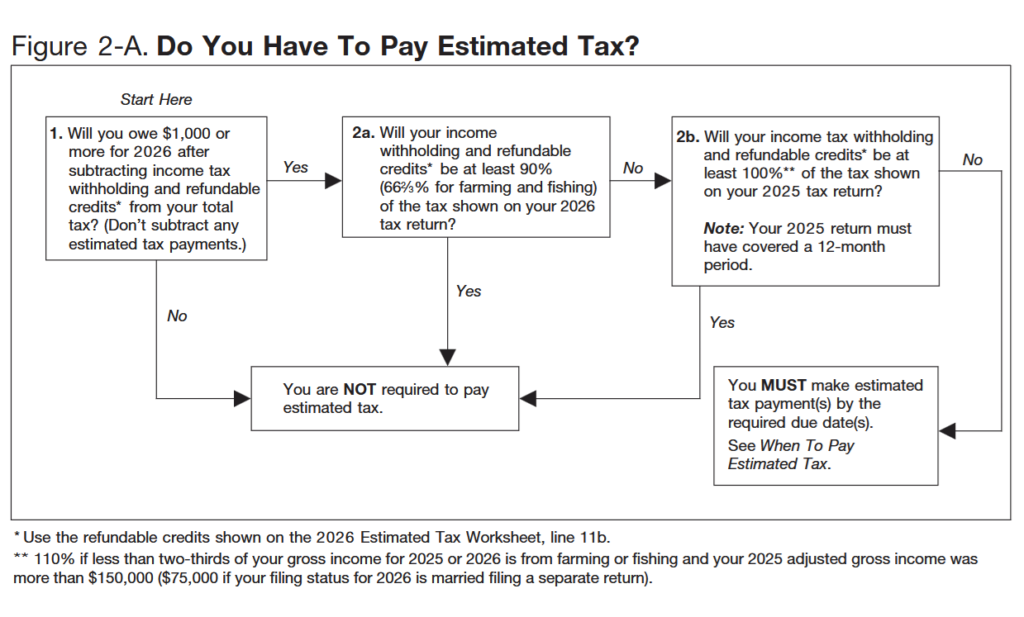
The flow chart below from IRS Publication 505, Tax Withholding and Estimated Tax, offers a visual depiction of when you need to make estimated tax payments.
Safe harbors to avoiding penalties: Making the correct estimated tax payment amounts and on time is critical. Mess up either and you’ll face penalties.
To avoid that unwanted circumstance, your total estimated tax paid must be at least 90 percent of the tax you’ll ultimately owe when you file next year.
If your non-withheld earnings are uneven throughout the year, you can use the annualized income installment method to precisely figure your estimated tax amounts for each quarter. This method helps with cash flow, but does take more work and record keeping.
Then there are those of us who avoid penalty charges by taking the easiest estimated tax payment route. We sidestep tax guesstimating or continual monthly figuring by simply paying our prior year’s full tax liability in four equal estimated tax amounts.
Meeting this safe harbor of paying 100 percent of last year’s tax liability in four equal payments means, regardless of what your eventual 2025 tax bill is, you won’t face any estimated tax underpayment penalties.
Total tax, not remaining tax due: Note that this is 100 percent your total tax bill last year, found on line 24 of your Form 1040.
It is not simply what you ended up owing Uncle Sam when your filled out your return with all your tax payments, withholding or otherwise, considered.
Note, too, that your safe harbor percentage is larger is you make more money. It goes to 110 percent of your prior year’s total tax if your adjusted gross income in 2024 was more than $150,000 ($75,000 if your filing status for 2025 is married filing a separate return).
Ways to paying estimated taxes: Once you know what you need to pay on June 16, the easiest way to do that, for both you and the IRS, is electronically.
The IRS offers a variety of options.
- Use your IRS Online Account.
- If you have a checking or savings account, remit via Direct Pay.
- Use a credit/debit card or digital wallet.
- Send your payment using the Electronic Federal Tax Payment System (EFTPS).
- On-the-go taxpayers can sue the IRS2Go app.
If, however, you prefer paper, the IRS still accepts checks and money orders. Make the estimated tax amount payable to the “United States Treasury.” You also need to download and send Form 1040-ES with your check or money order.
You also might find these items of interest:
- The scoop on estimated taxes
- Estimated taxes: Why, when, and how to pay them
- A quick estimated tax Q&A in advance of the deadline
- NTA urges Congress to change estimated tax deadlines (and more)
Advertisements
🌟 Search Amazon Tax Products 🌟
The text link above is an affiliate ad. If you click through and then buy a product, I receive a commission.
