


It’s Thanksgiving Week! The end-of-year holidays are officially here. So is scam and identity theft season.
So it’s no surprise that this time of year, the Internal Revenue Service and its Security Summit partners spend a week focusing on ways taxpayers and tax professionals can protect their and clients’ sensitive financial information from tax scammers.
Yes, in addition to trying to steal your identity and cash and holiday cheer, tax crooks are preparing for the upcoming filing season. They can use the information they stole to file fake tax returns claiming fraudulent tax refunds.
Almost a decade of tax security weeks: The 9th annual National Tax Security Awareness Week runs this year from Dec. 2 through Dec. 6.
During those five work days, the IRS and its security partners from state tax departments, tax software companies, the tax professional community, and others in the larger tax community will offer
Those dates also are this weekend’s By the Numbers figure.
As mentioned earlier, the security week is timed to take advantage of people’s already heightened concerns about identity theft as most of us do at least part of our holiday shopping online.
“We are entering into a critical period where taxpayers need to be extra careful protecting their valuable information,” said IRS Commissioner Danny Werfel. “Scams and schemes are quickly evolving. Extra caution by people during the holiday season and the upcoming filing season will be essential to avoid being a victim.”
And while we taxpayers aren’t technically members of the IRS Security Summit, Werfel noted that “vigilant taxpayers are on the front lines of the larger efforts by the Security Summit partners to strengthen the tax system against identity theft and tax scams.”
New security focus every day: During National Tax Security Awareness Week, a series of educational efforts will be highlighted, with a new one each of the five days.
On Cyber Monday, Dec. 2, the focus will be on online commerce, with special attention paid to phishing attempts. Scammers also are shopping for their next victim’s personal information. Identity thieves also send out fake delivery notifications during the busy holiday season looking to “confirm” orders.
Some basic safety tips, especially during the holiday season, include:
- Shop at sites with web addresses that begin with the letters “https:” indicating secure communications. Also look for a padlock icon in the browser window.
- Don’t shop on unsecured public Wi-Fi in places like a mall or restaurant.
- Ensure security software is updated on computers, tablets, and mobile phones. Use a software that includes a feature to stop malware, as well as a firewall enabled to prevent intrusions.
- Protect the devices of family members, including young children, older adults, and all who are less technologically savvy.
- Use strong, unique passwords for online accounts.
- Use multi-factor authentication whenever possible.
My personal tip, use a credit card that lets you create a virtual card number for each purchase. That way, you can make online purchases without sharing your actual credit card number with online retailers.
Most card issuers also let you lock or unlock virtual cards at any time without affecting your ability to make other purchases with your actual card number. Some virtual cards may even allow you to set a custom expiration date or spending limits.
Tuesday, Dec. 3, will focus on schemes and misinformation spread on social media. Topics often provide inaccurate and potentially fraudulent information. Many of these share a common theme of people trying to use legitimate tax forms for the wrong reason.
For real tax information, follow the IRS accounts on X (formerly Twitter), Facebook, Instagram, and YouTube. The agency says you can get the latest tax updates on X by following @IRSTaxSecurity and @IRSnews, as well as hashtags #TaxSecurity.
A quick word to the IRS social media coordinator: Bluesky. A decidedly unofficial person is using IRS there.
And for your information, I’m @taxtweet at still-Twitter-to-me and Bluesky.
Wednesday, Dec. 4, looks at the advantages of using an IP PIN and IRS Online Account. An IP PIN, the acronym for an Identity Protection Personal Identification Number, is a unique six-digit number used to verify a taxpayer’s identity when filing a return. More than 10.4 million taxpayers already have their IP PIN.
If you have an IP PIN, a crook who has your other personal information can’t file a federal tax return without also having the special identifying digits.
An (IP PIN) program at the start of the 2025 tax season. They can do so after creating an IRS Online Account also is an online tool that allows taxpayers to securely access their tax and return information from prior years.
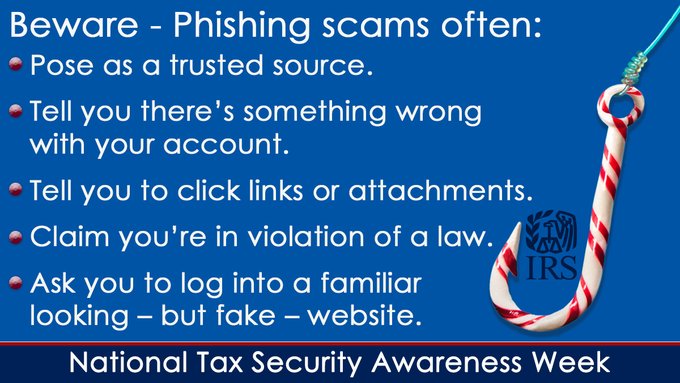
Thursday, Dec. 5, will feature ways taxpayers can guard against identity thieves. Fraudsters are relentless in sending emails, texts, and direct messages made to look like they come from a legitimate source, like the IRS, state tax agencies, a bank, or a trusted tax professional. Taxpayers need to watch for such solicitations and the dangerous links, attachments and contact information they contain. Never click, call, or reply on these without first independently verifying the source.
National Tax Security Awareness Week wraps up on Friday, Dec. 6, with tips for tax professionals. Tax pros are prime targets since they receive and hold large amounts of sensitive taxpayer data.
To help guard against loss, the IRS and Security Summit partners this year released an updated Written Information Security Plan (WISP). Tax pros can use these as a roadmap to protect their practice. The IRS also recommends signing up for a Tax Pro Account.
More tax security information: For more on the upcoming tax security highlights, check out IRS.gov’s National Tax Security Awareness Week 2024 for additional information, as well as the special Security Summit webpage.
Victims of identity theft can visit Identity Theft Central. You also can visit an IRS Taxpayer Assistance Center walk-in center. And, of course, talk to a trusted tax professional.
You also might find these items of interest:
- Latest identity theft and scams blog posts (this one is at top; scroll down)
- Crooks target tax pros’ databases long after tax season ends
- IRS updates guide to help tax pros create a written information security plan
- IP PIN adds taxpayer security, and in 2025 will help processing duplicate dependent claims
Advertisements
🌟 Search Amazon Electronics 🌟
The text link above is an affiliate ad. If you click through and then buy a product, I receive a commission.
