Welcome back from your holiday festivities. I hope you got everything you asked of Santa.
Not to run the Jan. 1, 2013, deadline into the ground, but since we avoided the Mayan end of days, the possible coming U.S. financial calamity has totally taken center stage.
So now we get to wait to see if there will be a post-Christmas miracle in the form of a fiscal cliff deal.
Senators and the President are expected back in their offices on Thursday, Dec. 27. Representatives are awaiting word to return to Capitol Hill.
Right now it's looking more and more likely that at best a partial deal will be reached to keep tax rates at the Bush tax cuts level for most taxpayers. Other details then must be worked out when the new Congress convenes in 2013.
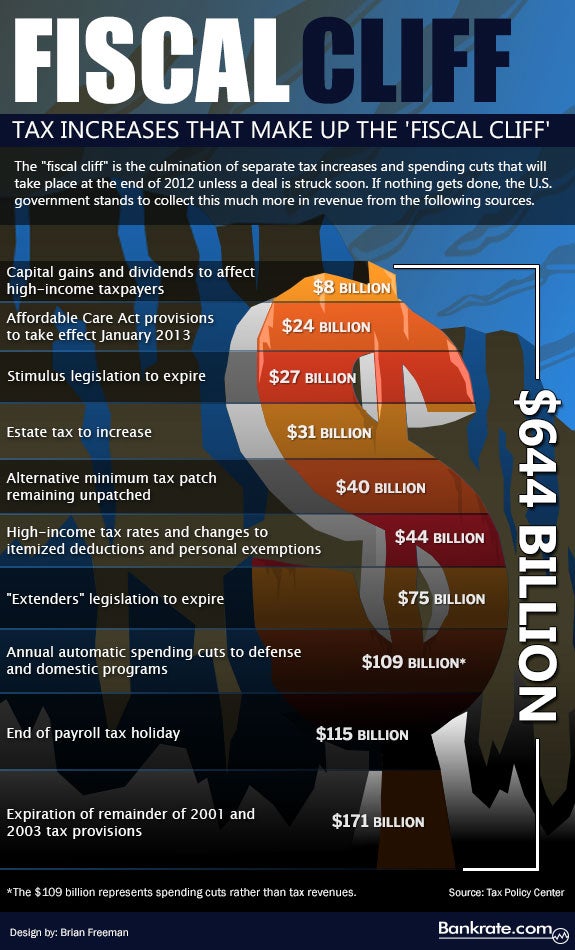
In case you forgot in the wake of holiday merry making, the infographic below provides a quick look at the tax matters that matter in the fiscal cliff debate.
Among the things most folks are hoping will be done in the next few days are a patch to the alternative
minimum tax, or AMT, so that they aren't among the estimated 60 million
who'll owe this more expensive parallel tax, and approval of the extenders,
technically temporary tax provisions that expire every year or so and are renewed.
House Speaker John Boehner included an AMT fix in his Plan B that his Republican colleagues rejected just before going on holiday breaks. But at least he created a framework — and one that includes proposed 2012 AMT exclusions of $78,750 for joint filers and $50,600 for single taxpayers and which would be indexed for inflation so we wouldn't find ourselves in this predicament year after year after year — from which to start in these hectic closing days of 2013.
Similarly, the Senate Finance Committee gave its stamp of approval to most of the extenders in a bill it moved through that tax-writing committee last summer. It, too, is a good foundation to use for approving these tax provisions, which include such popular tax provisions as:
Educators above-the-line $250 deduction for certain out-of-pocket classroom supplies.
Tuition and fees for higher education tax break, also an above-the-line claim, worth up to $4,000.
Private mortgage insurance (PMI) premium
deduction as itemized mortgage interest for tax years 2012 and
2013.State and local sales taxes
continuation as Schedule A itemized deductions, benefiting taxpayers who live in one of the seven no-income-tax states or who find that the sales tax write-off is worth
more to them than the state and local income tax itemized deduction.Roll over of an IRA required minimum distribution (RMD) to charity so the taxpayer can meet the withdrawal requirement but avoid including the retirement fund money as a taxable
distribution.
The Senate Finance members also OK'ed AMT relief
with exemption numbers for 2012 identical to Boehner's proposal. But
instead of indexing after that, the Senate tax writers propose AMT
exemptions of $51,150 for individuals and $79,850 for married filing
jointly spouses
in 2013.
Here's hoping that we all get a few after-the-fact tax presents in the next few days. I'm leaving my Christmas tree up for a while just in case.
You also might find these items of interest: