

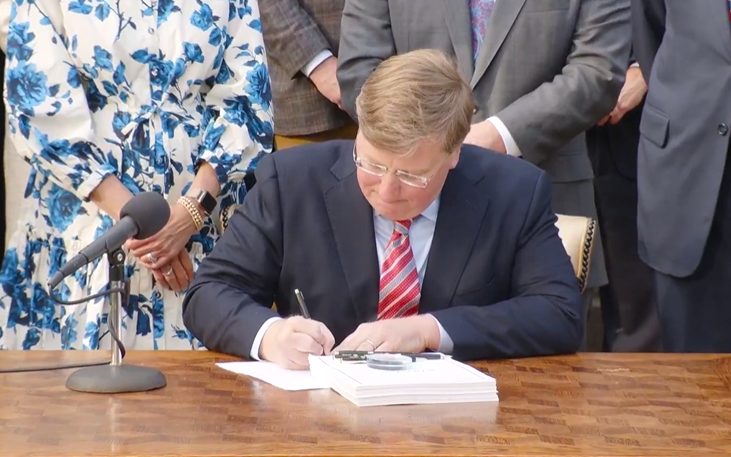
Mississippi Gov. Tate Reeves on March 27 signed into law a tax bill that, among other things, will phase out the Magnolia State’s income tax. (Photo courtesy Reeves’ Facebook page)
.
One day, April 15 Tax Day in Mississippi will be less work for many residents.
That’s because last week, the Magnolia State set in place a plan to phase out its income tax.
It still will take while, though, before Mississippians feel the full no-tax benefit. Like into the next decade.
After some specific phasing down of the tax rates, which is 4.7 percent on 2024 tax year returns now being filed, the final cuts to an end of the state tax rate will be determined by growth triggers starting in 2031.
In addition to the future phaseout of the income tax, the measure, known as the Build Up Mississippi Act, also cuts Mississippi’s state sales tax on groceries from 7 percent to 5 percent.
But the new law also has an excise tax hike. It bumps the state’s gas tax by 9 cents to 27.4 cents per gallon.
Income tax on way out: The other components of the new law got little attention during the signing ceremony. Instead, no-income-tax advocates were celebrating what they already are calling elimination of the levy.
“The elimination of the income tax is not just a win for our economy, it’s a win for freedom, a win for families, a win for the idea that Mississippi can lead and that we will lead in the century to come,” Reeves said during the March 27 ceremony in which he signed the tax bill into law. “I believe with all my heart that we will look back on this day as a turning point, a generational victory and a proud legacy we leave for those who come after us.”
Currently, Mississippi has a graduated state income tax, with the rate the same for individuals and businesses.
In 2025, the graduated 2024 tax year income tax rate is 0 percent on the first $10,000 of taxable income, and 4.7 percent on the remaining taxable income.
Tax Rates for Tax years 2025 and 2026 are 4.4 percent for income in excess of $10,000 in 2025, and 4 percent for income in excess of $10,000 in 2026.
Under the tax phaseout law, the 4 percent rate will be phased down to 3 percent by 2030, thanks to an annual reduction of 0.25 percent.
Further income tax rate cuts starting in 2031 will be activated by economic growth triggers that should provide the state adequate resources to operate, according to the law’s supporters.
To correct, or not, tax bill typo: How quickly the tax ultimately ends also could change.
The cuts set to start in 2031 were supposed to be based on an 85 percent growth in revenues over the state spending. That figure, however, was accidentally written as 0.85 percent in the bill, meaning almost any revenue growth would trigger a cut.
Republican Lt. Gov Delbert Hosemann played down the new law’s percentage confusion issue during last week’s signing ceremony.
“Some of y’all are focused on a typo in the bill, and I’d use the biblical analogy, let he who has not had a typo cast the first stone,” aid Hosemann.
Given the years left before the triggers kick in, it’s possible that tweaks could be made to adjust the percentage. But given how narrowly the bill passed, legislators might opt to leave things alone rather than do tax battle again.
Opponents point to tax cut’s downsides: Neva Butkus, a senior tax analysist at the Institute on Taxation and Economic Policy (ITEP), told the Jackson, Mississippi, Clarion Ledger newspaper that the income tax phaseout — a net $1.9 billion cut to the state’s budget — will leave the legislature strapped for cash when it comes to providing essential government services.
Butkus also noted the timing of the Mississippi tax phaseout. It, like many states are likely to encounter some fiscal hardships if the Trump administration and Republican Congress get their cost-cutting way.
The Department of Government Efficiency (DOGE) already has made substantial cuts and/or changes to federal agencies (including the Internal Revenue Service), the services of which are used by states.
If Capitol Hill makes even more cuts to the Uncle Sam’s operations, including federal-to-state money, Mississippi won’t have much, if any, of a fiscal cushion. Mississippi is the second biggest beneficiary of federal revenue, behind Louisiana.
And while the grocery tax cut will help, the gas tax hike will be felt by all Mississippi drivers.
Overall, say Butkus and other economic analysts, moving toward a more consumption-based economy will likely put a higher financial burden on low-income Mississippians
And eventually there were 10: In a reverse Agatha Christie count, if all goes as the Mississippi GOP plans, the state would become the 10th state without an individual income tax. Unless another one slips in there before the mid-2030s.
The current states with no personal income tax on wages are Alaska, Florida, Nevada, New Hampshire, South Dakota, Tennessee, Texas, Washington, and Wyoming.
Fourteen states have a flat income tax rate, where every resident with a taxable income pays the same percentage of that income. Joining Mississippi with a flat rate system are Arizona, Colorado, Georgia, Idaho, Illinois, Indiana, Iowa, Kentucky, Louisiana, Michigan, North Carolina, Pennsylvania, and Utah.
You also might find these items of interest:
- State tax department directory
- How your state pays for its roads
- 10 states tax groceries, but 4 looking to cut their food levies
Advertisements
🌟 Search Amazon Tax Products 🌟
The text link above is an affiliate ad. If you click through and then buy a product, I receive a commission.

