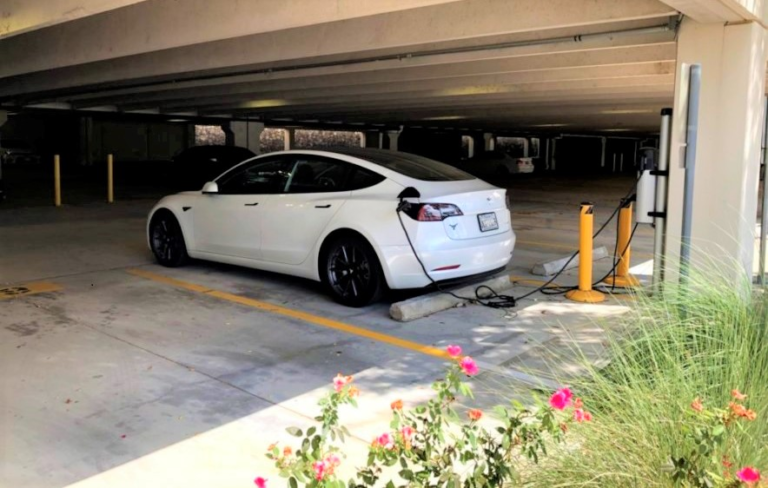
Electric vehicle charging in a suburban Austin, Texas, workplace garage. (Photo by Kay Bell)
…
One of our errands this week was getting the hubby’s vehicle inspected. It’s required to renew the auto’s annual state registration.
We get to repeat the process in six months for my car. But when it comes to my Chevy sedan, I soon might be writing the state of Texas a larger check.
I drive a hybrid and there’s renewed interest in adding an annual surcharge to vehicles that don’t rely solely on fossil fuel.
Welcome, but pay, please: Sure, Lone Star State officials were thrilled when Elon Musk moved his Tesla headquarters to the Austin area. A bunch of them showed up last month for the Cyber Rodeo — Musk’s words, not mine; insert your new Texan enthusiasm joke here — at the grand opening of the electric vehicle company’s Giga Factory and its potential boost to the economy.
They’re not so thrilled, though, that more Teslas and its competitors are showing up in the state’s driveways and highways. The reason, of course, again is economic.
But this time, state officials are worried about the loss of gasoline taxes.
Texas’ gas tax is 20 cents per gallon. The federal levy is 18.4 cents per gallon. Those combined pump levies cover a major portion of Texas road maintenance and expansion projects.
Neither the state nor federal gas tax has been increased since the early 1990s. But rather than hike that amount, lawmakers in this state with a heritage tied to oil are again looking at adding fees on alternatively fueled vehicles (AFVs), most commonly electric and hybrid autos.
The reasoning behind the new fees? Electric vehicles (EVs) use no gas. Hybrids use a reduced amount. That means AFV drivers essentially are getting free rides on the state’s roads that they also use.
Plus, say AFV fee advocates, the charges are only fair since, according to the National Conference of State Legislatures (NCSL), 45 states and the District of Columbia provide incentives for certain EVs and/or plug-in hybrid vehicles. Check out the NCSL’s interactive incentive map to see what’s available where you live (and pay taxes).
Dollars for driving AFVs: True, you don’t see as many AFVs as gasoline powered autos on Texas roads as plain old pick-up trucks. The latest count shoes that energy-efficient driving options account for just slightly more than 1 percent of the more than 25 million vehicles registered with the state.
That number, however, is expected to increase.
Climate change concerns are reaching critical levels. Younger drivers are more interested in AFVs. And, probably of most interest to state legislatures, most auto manufacturers are planning to shift a large part of their production to electric vehicles in the coming years.
A recent measure that didn’t make it through the Texas legislature called for fees of $200 for AFVs and $40 for hybrid electric vehicles with a gross weight less than 6,000 pounds. The fee would be $250 for AFVs and $50 for hybrid electric vehicles with a gross weight of 6,001 to 10,000 pounds.
The proposal was projected to bring in $37.8 million to the State Highway Fund (SHF) in fiscal year 2022. Industry and market forecasts used by the Texas Comptroller indicate that the number of vehicles subject to the fee and associated revenue gains will increase annually. By 2026, the projected revenue is nearly $136 million.
Already the norm: New Texas company Tesla obviously will fight the AFV fee, along with the rest of the auto industry making the shift to EVs.
But the issue is expected to come up again in the next legislative session. And there are indications that it finally could pass.
Neighboring Louisiana, another state with a large fossil fuel sector, also is moving forward with similar AFV tax legislation.
If the efforts succeed, Texas and Pelican would join the 30 other states that already have such fees. NCLS has another interactive map, this one states with fees on plug-in hybrid and/or EVs. If you prefer a text version, check out the Kansas Legislative Research Department’s paper on the nationwide charges.
If you decide to go electric or some other energy-efficient option with your next auto, enjoy the refueling savings. But also find out whether you’ll owe more to your state when license and renew your tags each year.
You also might find these items of interest:
- When did your state adopt its gasoline tax?
- Don’t get your hopes up for a federal gas tax holiday
- Senate tax chair pushes clean-energy tax breaks to cut reliance on foreign oil