


Casino sportsbooks like this one in Las Vegas still take plenty of sports bets, but thanks to the Supreme Court’s 2018 ruling allowing states to open up sports gambling within their borders, this year’s Super Bowl wagering broke betting records.
Happy Super Bowl Monday hangover!
I’ll try to type softly for all y’all skipping work today to recover from either celebrating your Kansas City Chiefs hoisting the Lombardi Trophy again or hunkering down because you drowned your Philadelphia Eagles’ fan sorrows a bit too much.
Regardless of the National Football League championship result, I hope at least some of your big game wagers paid off.
Record Super Bowl betting: Not to be presumptuous, but the fact is the annual U.S. professional football title game is the single biggest wagering event, with about 1 percent of all the money bet on sports over the course of the year bet on the Super Bowl.
And Super Bowl LVII set some new wagering records, in part because it was the first NFL championship game played where sports betting is legal.
There were 5 new records set during the 2023 Super Bowl…and it was also a record setting night for sportsbooks. @contessabrewer reports: pic.twitter.com/IrSDcGYNE6
— Squawk Box (@SquawkCNBC) February 13, 2023
If you were part of this new betting record and cashed in, enjoy your added dough. Remember, though, that Uncle Sam gets to share in your good luck.
Tax reports of your winnings: All your Super Bowl winnings, as well as any other gambling proceeds throughout the tax year, are taxable income.
The good news is that you don’t have to tell the U.S. Treasury about your good luck this year until the 2023 filing season in 2024. But you do need to be aware now of the tax consequences of your winning wagers.
That’s especially true if you placed your wagers with a legal sportsbook and won enough to trigger the bookmaker notification of your winnings to you and the Internal Revenue Service.
Some gambling winnings are noted on Form W-2G. This applies to winnings of —
- $1,200 or more from bingo or slot machines;
- $1,500 or more from keno;
- $5,000 or more from poker tournaments; and
- $600 in winnings from other types of gambling, if the payout is at least 300 times the amount of the wager.
If your winnings do require issuance of Form W-2G, federal taxes are withheld at a flat rate of 24 percent. Withholding is required when the winnings, minus the bet, are (1) more than $5,000 from sweepstakes, wagering pools, or lotteries, or (2) at least 300 times the amount of the bet.
Even if you don’t receive a W-2G, note that all gambling winnings are taxable. Yes, even the winning bets placed illegally. Just look at what happened to Al Capone he didn’t tell Uncle Sam’s tax collector about his nefarious earnings.
That underscores why it’s important to keep documents, such as wager statements and payment slips, any time you gamble. These documents also help confirm the accuracy of what’s on any tax statements you receive.
Reporting winning bets on your return: All of your gambling proceeds, as well as all the other types of unconventional income you made last year, is detailed on the first page of Schedule 1 (Form 1040), with the total amount transferred to your Form 1040.
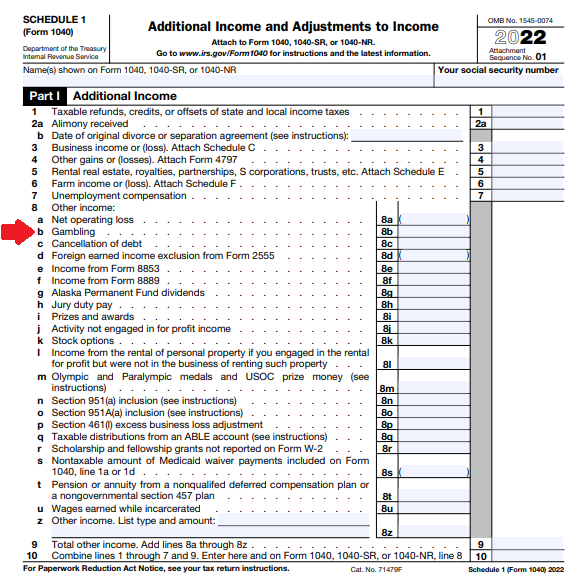
Specifically, note line 8, the wonderful “other income” catch-all. This is where you report any taxable income that’s not entered elsewhere on your tax return or other schedules.
For gambling proceed purposes, note line 8b, pointed out on the Schedule 1 reproduction below.
…
The Form 1040 instructions‘ section on Schedule 1 tells taxpayers to “Enter on line 8b any gambling winnings.” It adds that taxable winnings include amounts from “lotteries, raffles, a lump-sum payment from the sale of a right to receive future lottery payments, etc.”
Once you complete Schedule 1’s other income lines (8a through 8z), add them up and enter that total on line 9.
On line 10, add all the amounts in the schedule’s final column to show how much other income you got. Then transfer that amount to line 8 of your Form 1040 or, for older filers, Form 1040-SR.
Also remember to attach Form(s) W-2G to your return if any federal income tax was withheld from your gambling payout(s).
Reducing your gambling income: If you’re a very successful and/or lucky bettor, I can’t let you leave without noting that you can reduce your taxable gambling earnings.
One itemized deduction that survived the 2017 tax reform changes was the ability to deduct your gambling losses. You can tally your losses on the “Other Itemized Deductions” section of Form 1040 Schedule A.
Note, however, that your bad betting luck only goes so far. You can only use your gambling losses to offset, perhaps zero out, your winnings.
You cannot use them to produce an income loss on your return.
A few more gambling tax matters: If you don’t itemize, which you might not especially now that the standard deductions are so much larger under tax reform, then you can’t reduce your gambling winnings at all. You must simply report all the money you made on winning wagers on Schedule 1.
Winners who live in states with income tax also should be aware that their state tax department also might (probably) collect from gambling winnings.
Finally, if your gambling winnings and other income are substantial and federal taxes aren’t withheld, consider making estimated tax payments. Sending these amounts in a timely fashion to the IRS will help ensure that your betting payouts aren’t reduced further by tax penalties and interest.
You also might find these items of interest:
- Food, brew, and art on the line in Super Bowl LVII bets
- Red Gatorade shower and other Super Bowl LVII prop bets
- A look as all the other income reported on Form 1040 Schedule 1

