

Taxpayers who qualify to use Free File, the Internal Revenue Service’s no-cost online tax preparation and efiling program, now can get to work. As noted in my filing season post update yesterday, Free File began accepting returns Friday, Jan. 9.
This year, even more individuals should qualify to use the free filing option. It’s available to taxpayers whose 2025 adjusted gross income (AGI) is $89,000 or less. That earnings limit applies to all filers, regardless of tax filing status.
With IRS Free File now accepting individual tax returns, eligible taxpayers can prepare their federal income tax returns ahead of the official start of the 2026 filing season on Jan. 26. That’s the day the IRS will start processing 2025 tax year returns.
But Free File users’ two-week head start doesn’t necessarily let them jump the filing line. Even though they can submit their 1040 forms early via a Free File software provider, the returns won’t be officially filed until the 26th.
That’s standard tax season practice. The participating Free File companies — there are eight familiar ones again this year — will hold the completed returns and then electronically file them once tax season officially begins.
But at least the taxpayers are done with this annual chore.
The same eight: If you used Free File last year to complete your federal taxes, then it will be tax déjà vu this year.
As noted, the same eight tax software companies, all members of the Free File Alliance which is now in its 24th year of partnering with the IRS to operate Free File, are back. They are —
- 1040Now
- 1040.com (offered by Drake)
- ezTaxReturn.com (Spanish version available)
- FileYourTaxes.com
- FreeTaxUSA (offered by TaxHawk)
- OnLine Taxes (OLT)
- TaxAct
- TaxSlayer
Free File provider flexibility: Note, however, that while the Free File program establishes general parameters, the no-cost IRS.gov option isn’t strictly standardized.
Free File each year establishes the maximum income eligibility threshold, which is $89,000 this year. But the participating tax software companies have some leeway in determining which taxpayers can use their programs.
Notably, they can set their own requirements for users. These may include taxpayers’ age, a lower income amount, military status, and residency in certain states.
And speaking of states, if you live in a state where you must file a return with that jurisdiction’s tax department, don’t automatically assume it’s part of the Free File package.
Each Free File software provider, whom the IRS refers to as trusted partners, also gets to decide what state-filing services it will (or won’t) offer. Some partners do offer free state tax return preparation and filing, but not necessarily to all states.
Finding your best Free File option: The state filing component is just one reason why you need to be a savvy Free File shopper. The IRS.gov Free File site, which is the only one that guarantees you get to the legitimate, Uncle Sam approved, no-cost online tax prep and efiling services, can help.
It gives you two ways to find the software option that fits your filing needs. At the IRS choose a trusted partner page, you can click “Browse all trusted partners” or “Find a trusted partner.”
The browse option will take you to a page with information on all eight of this year’s Free File software providers. Each company highlights its requirements and offerings.
The images below are what you’ll see. But you still need to go to the IRS Free File website. These photos are screen shots, meaning they’re not interactive.

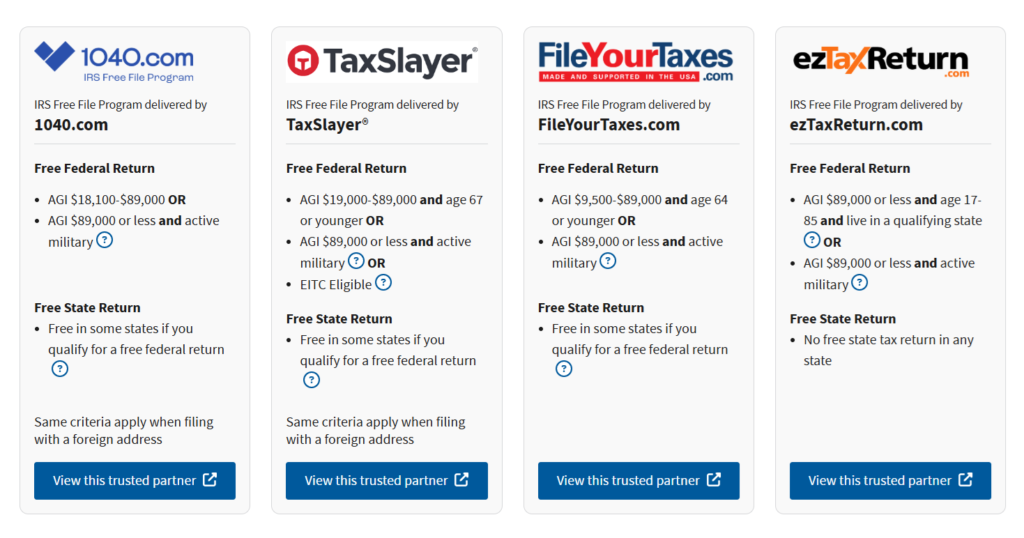
But at the tax agency’s official Free File options browsing page, the “View this trusted partner” box at the bottom of each company’s summary is a live link. It will take you to the Free File versions’ websites. Once there, you can get more information and/or start working on your tax return.
Or, you can use Free File’s online search tool to find which of the eight options are right for you. To reach the proper determination, you must answer three pages of questions.
Don’t freak out. They’re short pages, with basic queries about your income and tax situation.
Once you answer them, the search results will tell you which software offering(s) look like good matches for your 2025 federal — and, where applicable and available, state — tax filing needs.
Fillable forms available Jan. 26: The Free File Alliance says that each year Free File makes it possible for more than 70 percent of all taxpayers, or around 100 million people, to complete and e-file their taxes without having to pay a cent.
That’s pretty impressive. But that still leaves a lot of taxpayers out of Free File luck, primarily because their AGI is more than the eligibility threshold.
Free File hasn’t forgotten about these filers whose earnings last year were more than $89,000. They can use the companion program, Free File Fillable Forms, which I’ve given the acronym FFFF. It will be available on the Jan. 26 opening day of the 2026 tax season.
With FFFF (and yes, I know it sounds like a rude sound a cartoon character might make), you select the forms you need from the IRS’ list of the most commonly used forms (note, the IRS hasn’t yet updated this for the current tax season), fill them out at your computer, and then electronically submit them to the IRS at no cost.
However, you will have to do more work. FFFF doesn’t have a programmed tax software component like those provided by the Free File options. So, you must complete the forms yourself (including the necessary math calculations), and have enough knowledge of the tax laws so that you do so correctly.
This is where many taxpayers right about now are making that FFFF sound.
Still, if you aren’t eligible for the full Free File option, and are comfortable getting more hands-on with your Form 1040, then using the free fillable forms could be a good, money-saving alternative. You can read more about FFFF in the option’s official user’s guide IRS Publication 5274.
Doing your own state taxes: Finally, if you take the fillable forms route for your federal return, but live in a state with a personal income tax, you are going to face a state filing detour.
FFFF only provides federal tax forms. You’re on your own when it comes to meeting your state’s tax filing obligations. Why yes, that is a repeat FFFF utterance I’m hearing over the internet from state tax paying folks.
Your best option here is to check with your state’s tax office. Most offer their own free online state return filing service for residents.
And if you are able to use one of the eight Free File software programs to file your 2025 taxes, check my earlier post on the start of the 2026 tax season for what you’ll need to get started. You also can get more information from IRS.gov’s Frequently Asked Questions about Free File.


working from home
I’m extremely impressed with your writing skills and also with the layout on your
weblog. Is this a paid theme or did you modify it yourself?
Either way keep up the excellent quality writing, it’s rare to see a nice blog like this
one today.