


Photo by Ketut Subiyanto from Pexels
…
The COVID-19 pandemic has reshaped work. Millions who lost earnings when the coronavirus cut their workplace hours filled the fiscal gap with gig jobs. Others left their wage-paying work entirely, opting to start their own businesses.
That’s meant these entrepreneurs are facing self-employment tax tasks for the first time. It also means many of them are claiming their first home office tax deduction.
And that tax-saving break itself means one more tax decision. Are you going to use the regular home office deduction, or go with the simplified method?
As with most things tax, the answer is “it depends.” But if tax patience and record keeping are not among your strong attributes, the simplified home office claim might be best.
Here’s an overview of how it works.
Appeal of less paperwork: Even if you use tax software or hire a tax pro, one of the simplified home office deduction’s biggest attractions is how much less it asks of you.
Instead of filling out the 44-line Form 8829 to claim your home-office deduction, you can use the significantly streamlined worksheet on page C-12 of the Schedule C instructions.
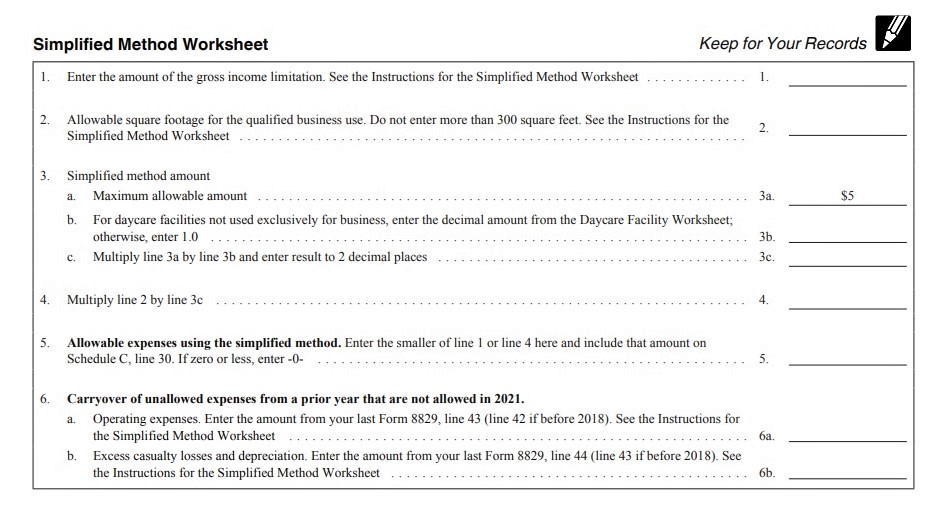
See more tax forms and more about them at Talking Tax Forms!
Yes, that’s it. Just six official lines, with a few alphabetic sub-lines. The worksheet and its instructions, which follow the form in the Schedule C instructions, together take up just one page.
How it works: The simplified method is an alternative to the calculation, allocation, and substantiation of actual expenses. That means, generally, no tracking down all those receipts related to your home’s work use.
Instead, in most cases, you’ll figure your home office deduction by multiplying the area in your home, measured in square feet, that you use regularly and exclusively for business. Measure carefully. The area you use to figure your simplified deduction cannot exceed 300 square feet.
Once you determine your home office’s size, then you multiply it by $5. This dollar amount means the maximum simplified home office calculation is $1,500. If your home work space is smaller, then your deduction amount will be less.
Multiple home businesses, one space limit: Some individuals conduct more than one business that qualifies for the home office deduction. That’s the case, for example, for taxpayers with multiple gig jobs.
Here, your choice of the simplified method applies to all your qualified business uses of your home. But you’re still stuck with the 300 square foot maximum, not 300 square feet times the number of businesses.
Instead, you must allocate the actual square footage used, up to the maximum 300 square feet, among your qualified business in which it’s used. The Internal Revenue Service says you can do this “in any reasonable manner you choose,” but you cannot apportion more square feet to a qualified business use than you actually used for that business.
Also note that when you use your home for more than one business, you must file a separate Schedule C for each operation. Do not combine your deductions for each business use on a single Schedule C.
Easier not always better: The simplified home office deduction method is preferred by many small business bosses because it requires little or no record keeping.
Instead of determining all your actual home expenses, such as mortgage interest, utilities, insurance and home maintenance and then calculating the portion of them that apply to your home office, you just use your office space’s size.
But while the easier option will save you some time, it might not save you as much tax money.
If you have a larger office and/or more substantial expenses related to your home office, you might be better off using the original and more complicated deduction method. So you need to run the numbers, at least preliminarily, before you make a final deduction choice for the tax year.
You can read more about the standard home office deduction in my earlier post, Home office tax deduction still available, just not for COVID-displaced employees working from home
Home office rules still apply: You can choose to use the simplified or regular home office deduction every year, based on how your business did that year and your tolerance for doing the tax calculations.
Note, however, that regardless of which home office deduction method you use, some things don’t change. Your home office still must meet the tax rules to be counted as a tax-deductible work space.
The two big requirements are that your office must be:
- Used regularly and exclusively for business. It doesn’t have to be a separate room; a portion of room designated for work use only counts. But regardless of how large or small, the room or area cannot be used for personal tasks, too.
- Used as your principal place of your business. This is possible even if you conduct business outside your home, for example, to meet with clients, as long as you use your home substantially and regularly to conduct business.
Regardless of the method used to compute the deduction, you may not deduct more business expenses than money you made. If you use the regular home office deduction method, you may be able to carry forward some of these business expenses to the next year. There’s no business expenses carry forward for the simplified deduction.
And while there’s no need for exhaustive records if you use the simplified home deduction method, you still should keep good business records. If the IRS has any follow-up questions about your company, you’ll be glad you kept track of all your business expenses.
In addition to the Schedule C home office information, you can find more on business tax breaks in IRS Publication 587, Business Use of Your Home.
You also might find these items of interest:
- Business closure tax tasks
- Tax implications of business entity choices
- How ordinary & necessary expenses become tax deductions
- Profit motive is critical to sustain business tax deduction claims

