

Photo by Vitalii Vodolazskyi/stock.adobe.com/GAO
A new Government Accountability Office report says that tax fraud likely costs the U.S. Treasury anywhere from $116 billion to $304 billion a year. It has some suggestions as to how the Internal Revenue Service can stem these losses.
The Trump administration’s new multi‑agency anti-fraud task force has been focusing on rooting out fraud in federally funded programs. The White House also might want to consider revitalizing the Internal Revenue Service, which has been eviscerated by other administration actions.
A robust federal tax agency with enough staff and resources could help stem as much as $304 billion that a government watchdog estimates the U.S. Treasury loses each year to tax fraud.
That amount is the top of a first-of-its kind lost revenue estimate range from the Government Accountability Office (GAO). The “good” news in the recently released GAO report is that both detected and undetected tax fraud losses could amount to only $116 billion a year.
To paraphrase that famous financial adage usually misattributed to the late Illinois Republican Sen. Everett M. Dirksen, “$116 billion here, $304 billion there, and pretty soon you’re talking real money.”
Both amounts and all in-between are enough to make a substantial difference to Uncle Sam’s myriad programs. That was a major motivator of the GAO study.
“The estimate could help Congress and agency officials understand the potential scale and scope of tax fraud loss and decide how to allocate resources for fraud risk management,” write the GAO report authors.
Fraud opportunities: The GAO report notes that the federal government each year takes in trillions of dollars in revenue, with IRS collections being the single largest source.
Most taxpayers pay their taxes voluntarily and on time. Others, however, do not comply with tax law, including by committing fraud, the willful misrepresentation to obtain something of value.
Criminals, including organized illicit groups, use stolen identity information to fraudulently obtain taxpayer refunds at scale. Some individuals and businesses intentionally evade taxes, failing to pay or deliberately underpaying taxes owed. And some fraud is committed by unscrupulous tax preparers.
All these fraud instances (many of which are regulars on the IRS’ annual Dirty Dozen tax scam list) also result in nonfinancial harms, notes the GAO. The most obvious is taxpayers who are unwitting victims of dishonest tax advisers and perpetrators of illegal tax scams and identity theft schemes.
The bottom line, literally, is that these fraud revenue losses mean less money for critical government operations and services. The lost tax dollars also exacerbate annual budget deficits, increases the national debt, and erodes public confidence in the integrity of the tax system, notes the GAO.
Figuring out the extent of tax fraud
.
Quantifying fraud losses: Yet, despite the harm tax fraud causes, GAO found there was no comprehensive estimate of the amount of U.S. federal tax revenue lost to fraud.
To determine such a number, the GAO gathered data on tax cases from 2018 through 2024 that were handled in court or addressed directly by the IRS, analyzed the agency’s documentation, and IRS officials. GAO also incorporated tax fraud information from other sources, such as academic literature.
After running its performance audit from September 2024 through September 2026, the GAO came up with the first-ever estimate, $116 billion to $304 billion, of revenue lost to tax fraud.
That estimate range is about 2 percent to 6 percent of total tax owed. Or, as the GAO’s WatchBlog notes, “To put that in perspective, revenues lost to tax fraud could be as much as the entire annual budget of the Navy, which was $292 billion in FY 2026.”
IRS anti-fraud efforts, challenges: The IRS is keenly aware of the scope of tax fraud. In conjunction with Security Summit partners, the IRS has instituted and expanded a variety of anti-fraud efforts and taxpayer security measures.
IRS Criminal Investigation (IRS-CI), the agency’s law enforcement division, also devotes much of its resources to stopping and prosecuting criminal fraudsters. IRS CI’s latest annual report (for fiscal year 2025) touted “a significant increase in the amount of tax fraud identified — more than double the amount uncovered” compared to fiscal 2024.
GAO acknowledged IRS efforts to prevent, detect, and respond to tax fraud. The report cited the agency current anti-fraud methodology; that is, it selects the most appropriate response to suspected fraud based on the facts and circumstances of the case, agency resources, and the expected likelihood of collecting any delinquent taxes.
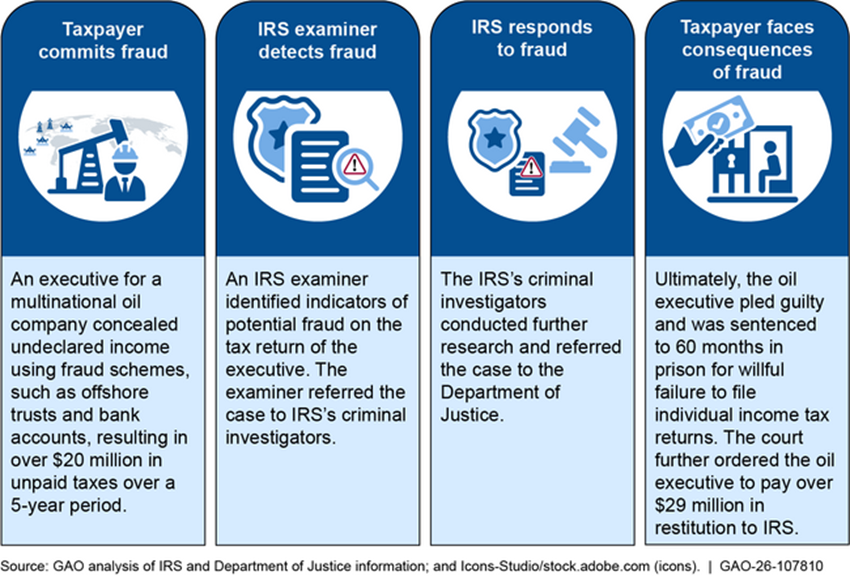
The report graphic below is an example of how the IRS detected and responded to fraud on a tax return.
Creating an anti-fraud strategy
.
Anti-fraud strategy lacking: But the watchdog agency also pointed out that the IRS’ approach to fraud risk management has been ad hoc and managed by individual IRS divisions.
Specifically, although IRS has assessed its fraud risks consistent with leading practices, it has not designed and implemented a specific strategy to mitigate fraud risks in a strategic and coordinated manner. the IRS’
“Further, IRS is not well-positioned to develop such a strategy because it lacks an anti-fraud entity to oversee such an effort across the agency,” said the report.
GAO’s Fraud Risk Framework provides a comprehensive set of key components and leading practices that serve as a guide for agency managers to use when developing efforts to combat fraud in a strategic, risk-based manner.
Its proposed anti-fraud strategy would integrate existing and new fraud controls to help the IRS address fraud risks. It considers the benefits and costs of control activities to address identified fraud risks, such as how the potential reduction of fraud losses compare with the cost for implementing certain fraud controls.
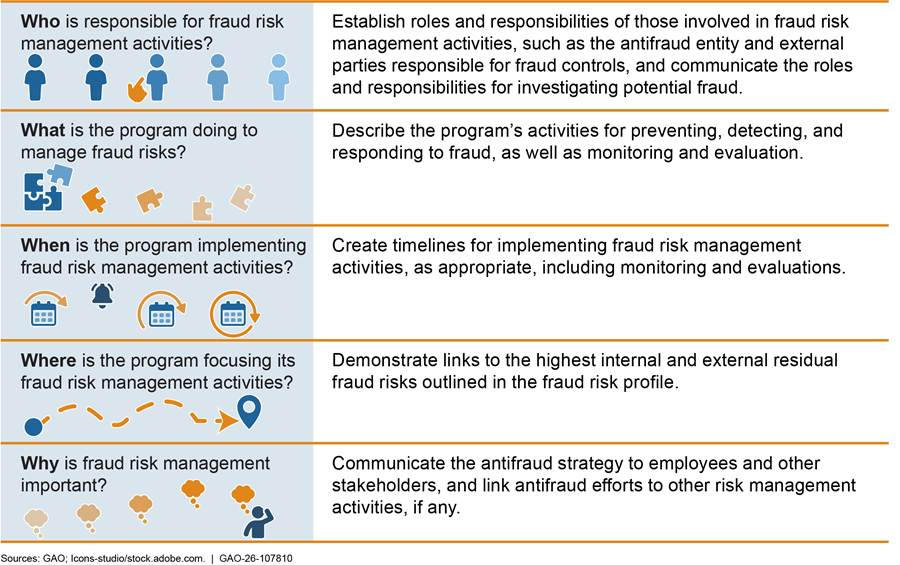
The GAO report graphic below shows the key elements of an anti-fraud strategy.
GAO suggestions for IRS anti-fraud efforts: The GAO had two recommendations for how the IRS could better administer anti-fraud efforts.
First, the IRS Commissioner (or, since one has not been confirmed since short-term tax chief Billy Long left, it is CEO Frank Bisignano in charge), should develop and document an agency-wide anti-fraud strategy, or direct divisions to develop and document anti-fraud strategies at the operating level with oversight by the designated anti-fraud entity.
Second, IRS leadership should designate an anti-fraud entity responsible for coordinating and overseeing fraud risk management activities.
The agency told the GAO that it will evaluate the situation and let the watchdog know what actions it will take regarding both recommendations.
Tax Felon Friday: Tax fraud pleas, verdicts, and the sentencing of those convicted are a regular part of the ol’ blog’s Tax Felon Friday feature. So, it’s only fitting that the GAO’s estimate of the extent of annual tax fraud gets added to this special list of posts.
You can catch up on tax miscreants who have been charged and/or adjudicated for their illegal actions at the aforementioned Tax Felon Friday page.
And if you want more tax crime news, notably items published long before I gave them a special end-of-week feature moniker, peruse the ol’ blog’s tax crimes category. You’ll find this post at the top of that collection right now, so just scroll down for more.
…
Advertisements
🌟 Search Amazon Tax Products 🌟
The text link above is an affiliate ad. If you click through and then buy a product, I receive a commission.
