And then there were eight.
Or there will be eight states with no individual income tax in 2028. That’s when Washington state’s new millionaires’ tax is scheduled to go into effect.
The Evergreen State’s legislature passed the measure in the waning days of its most recent session. It’s awaiting the expected signature of Democratic Gov. Bob Ferguson, who backs the proposal.
Once in effect, the new levy would impose a 9.9 percent annual tax on personal earnings of more than $1 million. The law would apply to 2028 amounts, with affected taxpayers’ first payments due in 2029.
That time frame, however, is expected to slip.
When Washington began chipping away at its no individual tax status in 2021 by enacting a now 7 percent or 9.9 percent tax on capital gains, depending on the investor’s income, the law was challenged in court before finally taking effect.
State budget boon vs. rich resident exodus: If and when the millionaires’ tax does go into effect, it is expected to affect around 20,000 Washington households. That’s about 0.5 percent of the state’s taxpayers.
The projected revenue from the tax is nearly $4 billion a year.
Supporters of the tax say it will generate billions of dollars each year to fund education, childcare, and other public services. Opponents say the revenue won’t be that much because the wealthy simply will move.
Some rich Washingtonians, such as Amazon founder Jeff Bezos and former Starbucks chief executive Howard Schultz, already have moved.
Schultz, however, says his recent relocation to no-income-tax Florida, specifically Miami, was for family, not financial reasons. That’s the same message Bezos sent when he also left for Miami in 2023.
Expanding wealth tax talk: Washington’s millionaires’ tax has generated conversation beyond the state. So, it’s no surprise that this weekend’s Saturday Shout Out features some of the wealth tax talk.
First off is an analysis of the impending Washington law from the Tax Foundation. Jared Walczak, Senior Fellow at the Washington, D.C.-based tax think tank and president of Walczak Policy Consulting, says the “Proposed Washington Income Tax Would Yield a Top Rate of More Than 18 Percent.”
Many high earners could face the highest combined state and local top rate in the country (18.037 percent split across employer and employee), writes Walczak. Plus, he says, the tax would largely fall on small business owners and on tech workers receiving restricted stock units (RSUs) in compensation.
The Wall Street Journal’s editorial board also has a dim view of the proposal, calling it “Washington State’s Income Tax Con” that will inevitably capture the middle class.
Elsewhere, the Associated Press looks at other recent wealth tax efforts across the United States in “Some states are reviving a push to tax the rich.” They include California (which already has a surtax on millionaires, and now is looking at getting more from billionaires), Rhode Island, Michigan, and New York.
At the federal level, Vermont Independent Sen. Bernie Sanders and Rep. Ro Khanna, a California Democrat, have introduced a proposal for a 5 percent tax on billionaires.
Their bicameral Make Billionaires Pay Their Fair Share Act would establish a 5 percent annual wealth tax on the United States’ 938 billionaires. Those individuals, say the lawmakers, are collectively worth $8.2 trillion.
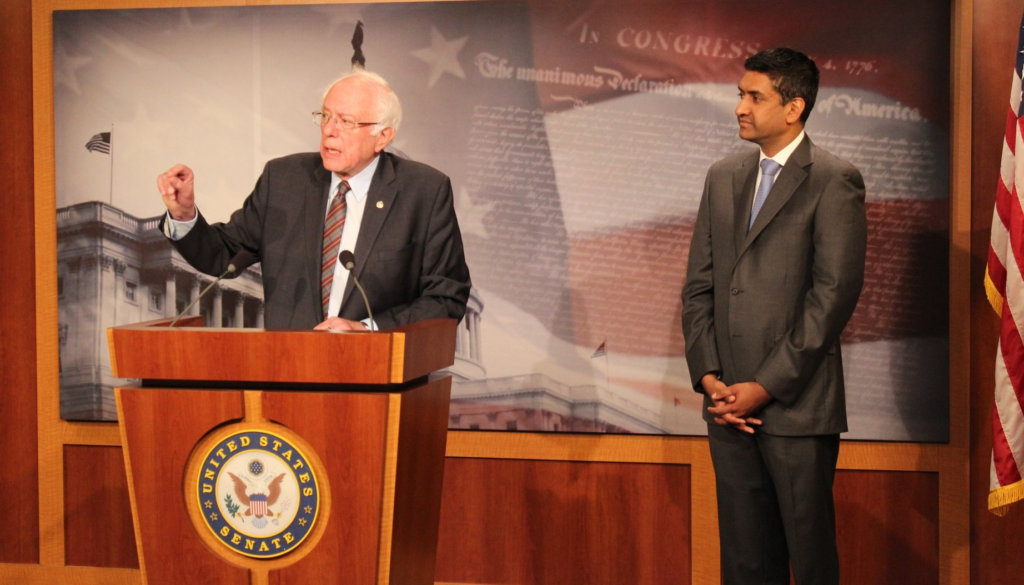
Sanders (left in the above photo, from Khanna’s Facebook) and Khanna would use the federal billionaires’ tax money to, among other things, —
- Provide a $3,000 direct payment to every man, woman and child in a household making $150,000 or less — $12,000 for a family of four;
- Expand Medicare to cover dental, vision, and hearing for seniors; and
- Build, rehabilitate and preserve more than seven million affordable homes.
The lawmakers provide an economic analysis supporting their bill from two University of California, Berkeley professors.
Others, however, aren’t convinced of the fiscal value of wealth taxes. That brings us to today’s final shout out.
Adam N. Michel, director of tax policy studies at the Cato Institute, a Washington, D.C.-based libertarian think tank, writes on that organization’s website that “Wealth Taxes Raise Less Revenue Than You Think.” Michel argues that estimates of revenue from increased taxing of the rich “still assume that behavioral responses are limited to the small number of taxpayers directly subject to the wealth tax. In reality, taxpayers just below the threshold will also respond.”
Most states collect income tax: Wealthy or not, most U.S. residents face more than just federal income tax filing (and paying) every year.
Washington is one of only nine states that do not impose a broad-based personal income tax. The others are Florida, New Hampshire, Alaska, South Dakota, Wyoming, Texas, Tennessee and Nevada.
Most residents of the other 41 states the District of Columbia must file returns and pay tax to their resident jurisdictions each filing season. In some cases, they also must deal with city and county levies.
If you need or want more information on your state tax rates and filing responsibilities, check with your state’s tax officials. This state tax department directory will get you to appropriate website.