


Photo by Polina Tankilevitch
Just be ready to deal with some potential technological issues when you move into the IRS-preferred online tax world.
If you’re spending Washington’s Birthday working on your taxes, you are not alone.
This official federal holiday, often incorrectly referred to as Presidents Day (with various apostrophe variations), is historically one of the busiest periods of the filing season, judging by the spike in calls to the Internal Revenue Service’s telephone hotlines.
But instead of waiting on hold, and eventually getting someone who isn’t really trained in tax, the IRS recommends we instead use IRS.gov options, today and for the rest of the filing season.
One of those options is a personal taxpayer online account.
IRS account uses: The agency’s Individual Online Account page notes that once you set up official access to the information the IRS has about your filings, you can take care of myriad tax tasks.
They include —
- Get tax records, including wage and income transcripts and adjusted gross income from the most recently filed tax return.
- View, approve, and sign authorizations from tax professionals.
- Request and view an identity protection PIN (IP PIN).
- Make a payment and schedule or cancel future payments.
Changing payment systems: Long-time readers know that I’ve used the tax agency’s Electronic Federal Tax Payment System (EFTPS) system for decades to pay annual filing amounts due, as well as pay estimated taxes.
That’s about to change.
The IRS ended new individual enrollment in EFTPS in late 2025. In January, the agency confirmed that some of the agency’s legacy systems are being phased out. In my (and many others’) case, EFTPS payment options “will be sunset for individual taxpayers in late 2026.”
So, I took the IRS’ advice and created an online account so I could use it to make future payments.
Actually, I already had an online account. I set it up years ago as part of my research for a blog post. So, I thought I was set as far as making payments.
Not so, or at least not so easily.
For privacy reasons, each taxpayer must create a separate account. That also makes using my personal IRS account a bit problematic when it comes to actions connected to the joint returns the hubby and I have filed over many decades.
The issue is his name and Social Security number (SSN) are listed first on our 1040s. That’s also how our EFTPS account was set up. So, all things considered, it was easier for the hubby finally to have his own IRS online account which we will use once EFTPS is gone.
Three (for now) accounts, more questions: Of course, I’m the one accessing the hubby’s new IRS account, with his full and enthusiastic consent since I do our taxes. And in doing so, I learned that the first SSN and filer name do make a difference.
His IRS account shows all our annual balance due and four estimated tax payments made over the last five years. It also shows the estimated payment I already scheduled via EFTPS for this April 15. More on this probably final EFTPS action in a minute.
However, from the things that make you go hmmmm file, IRS account only shows our payments through the 2022 tax year. And it doesn’t show the pending 2026 payment for the first quarter estimated tax amount.
That’s interesting (and a bit disquieting), since I’ve had my IRS account for years, and the hubby’s was just established this month. Perhaps the disparity is due to IRS reduced staff issues or thanks/no thanks to Department of Government Efficiency (DOGE) fiddling.
Either way, I’ll keep checking to see when my account gets updated.
Don’t delay: We all know that tech issues crop up all the time. So, the differences in our separate IRS online accounts, while a bit frustrating, is not that surprising.
It also highlights why you need to take care of such technological tax matters well before any tax deadline arrives.
If you plan to use your IRS online account in connection with this year’s Form 1040 filing, set it up well before April’s Tax Day arrives.
Ditto for any bank account where you want the IRS to send your tax refund.
Plan for potential online problems: That same get ready approach also applies to any federal tax payments.
It looks like from my preliminary 1040 entries we’ll get a refund. Yes, part of that tax cash is from some One Big Beautiful Bill Act (OBBBA) changes, which meant our 2025 estimated tax payments turned out to be more than enough.
But we still have to pay estimated taxes for 2026. That first payment is due on April 15. So, I headed to the hubby’s online IRS account to schedule it.
Not so fast. Instead, this morning I got a message, screenshot below, that the payment option was unavailable.
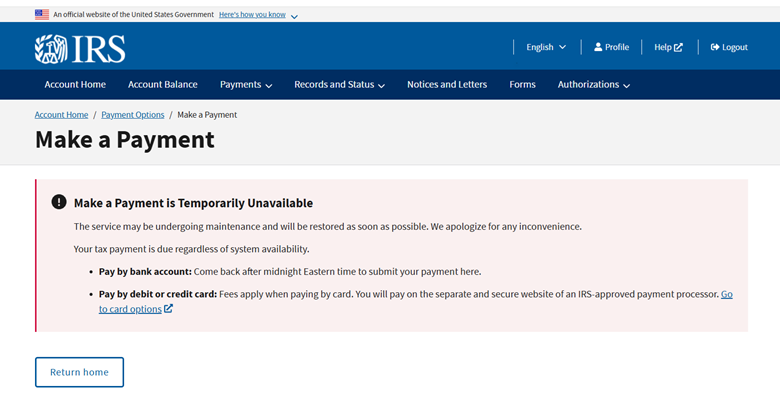
So, being impatient and ready to get this tax task out of the way, I headed back to EFTPS, as I mentioned a bit earlier in this post. There I was able to schedule the April 15 estimated payment amount.
And, as also noted earlier, that first quarter 2026 estimated payment showed in the pending and scheduled payments section of the hubby’s IRS account. At least the two IRS sites are able to communicate.
Ah, technology, tax and otherwise. It’s great until it isn’t.
The bottom line, is yes, the IRS is correct that online tax help and filing options — don’t forget Free File if your adjusted gross income is income (AGI) is $89,000 or less, regardless of tax filing status — can be useful. But make sure you know what they offer and how to use them.
And do so early enough in the filing season so that you don’t run into a deadline situation that could cost you.

