

And if you’re paying by check or money order, make sure you mail it to the correct address by that date. The IRS has changed the mailing address for old-school estimated taxpayers in 18 states.
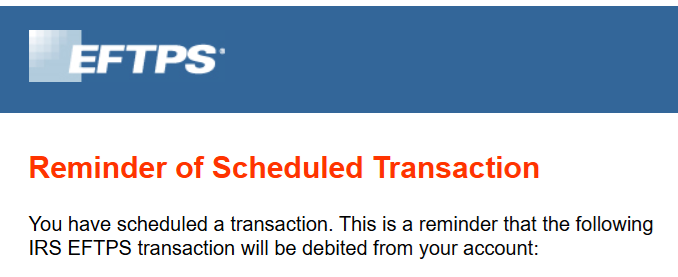
I got the email excerpted above from the Internal Revenue Service’s Electronic Federal Tax Payment System (EFTPS) reminding me that I’d scheduled a payment on Monday, Sept. 15, of my third estimated tax amount for this year.
Since the IRS reminded me, I thought I’d pass along the favor to the ol’ blog’s readers who, like me, must make these four extra tax payments a year on income that’s not subject to withholding.
I know, my advice to pay this month’s estimated tax amount topped last week’s September tax moves post. But it’s important. You could face tax penalties if you miss the estimated tax due date, or don’t paying the proper amount. So, let the re-reminding begin!
September payment period: The September estimated tax amount is the third of the tax year. It pays tax on income earned in June, July, and August that wasn’t subject to withholding.
For most regular payers of estimated tax, that will be the same amount as the estimated payments made in April and June. That’s because most estimated taxpayers make a good estimate of their year’s earnings that aren’t subject to withholding, figure the total tax due, and divide it by four.
As the table below shows, they then send those amounts to the Internal Revenue Service to meet the payment deadlines in on the 15th of April, June, September, and January of the next year, as shown in the table below.
| Payment # | Due Date* | For income received |
| 1 | April 15 | Jan. 1 through March 31 |
| 2 | June 15 | April 1 through May 31 |
| 3 | Sept. 15 | June 1 through Aug. 31 |
| 4 | Jan. 15 of the next year |
Sept. 1 through Dec. 31 |
|
*If the 15th is on a weekend or federal holiday, |
||
Yes, those due dates do not correspond to usual January to December quarters. Estimated taxes get their quarterly descriptor simply because there are four of them. And yes, it is confusing. But there is a push to re-align the estimated tax payment deadlines to be truly calendar quarterly.
Ways to pay estimated taxes: The IRS urges estimate taxpayers to pay their quarterly amounts electronically. It’s generally easier for both taxpayers and the tax agency.
The IRS offers a variety of e-payment options, most of which are familiar to taxpayers who also electronically pay their tax bills when they file their annual Form 1040 tax returns. They include —
- Use your IRS Online Account.
- If you have a checking or savings account, remit via Direct Pay.
- Use a credit/debit card or digital wallet.
- Send your payment (like me!) using the Electronic Federal Tax Payment System (EFTPS).
- Use the IRS2Go app if you’re on the go.
Note new 1040-ES mailing addresses: If, however, you prefer paper, the IRS still accepts checks and money orders. Make the estimated tax amount payable to the “United States Treasury.” You also need to download and send Form 1040-ES with your check or money order.
And with the September payment, paper filers need to make sure they send their check and 1040-ES form to the correct IRS office.
This summer, the tax agency announced changes to the mailing addresses for paper 1040-ES payments from taxpayers in 18 states.
IRS Publication 3891 notes that the estimated tax payment mailing address for taxpayers in Alaska, California, Colorado, Hawaii, Idaho, Kansas, Michigan, Montana, Nebraska, Nevada, North Dakota, Ohio, Oregon, Pennsylvania, South Dakota, Utah, Washington, and Wyoming now is P.O. Box 1300 in Charlotte, North Carolina 28201-1300.
Previously, these taxpayers made these payments to Post Office boxes in Cincinnati, Ohio.
And despite the document’s name, Lockbox Addresses for 2026, tax practitioners have confirmed that the change is effective immediately.
So, if you’re mailing your payment and live in one of those states, send it to the Charlotte address. The IRS will accept your payment as timely filed as long as the envelope’s postmark is Sept. 15.
And if, like me, you’ve set up an electronic payment for Monday, Sept. 15, make sure you have enough money in your account to cover it.
You also might find these items of interest:
- The scoop on estimated taxes
- Estimated taxes: Why, when, and how to pay them
- A quick estimated tax Q&A in advance of the deadline
