By Norman Rockwell at Google Cultural Institute, Public Domain
…
The annual Scripps National Spelling Bee is underway in Washington, D.C. It looks a bit different nowadays from Norman Rockwell’s painting “Cousin Reginald Spells Peloponnesus (Spelling Bee)” above, although emotions still run high. The Spelling Bee’s official words come from the Merriam-Webster Unabridged Dictionary. But if you’re looking for some tax terms this week or beyond, you can check out the ol’ blog’s Tax Glossary.
…
It’s Bee Week!
The 247 young spellers from across the United States and around the world who are competing for the 2026 Scripps National Spelling Bee (SNSB) trophy are in Washington, D.C. This is the 101st year of the Spelling Bee, as it is popularly known.
I have such respect for the students who make it to the finals in our nation’s capital city. These scholars must master more than just the words they are asked to spell. They also must conquer their nerves, as they compete before an audience and it is nationally televised.
The words will come from the Merriam-Webster Unabridged Dictionary. It is the official dictionary of the SNSB, making it the source of words and word information for all Spelling Bee rounds.
And if you were wondering, yes, Merriam-Webster does contain some tax words. So, maybe taxes will play a role in determining this year’s SNSB champion.
OK, that’s probably not going to happen.
But it could if this year’s event is so close that it has to turn to terms not normally used. That happened in 2019, when the Spelling Bee ran out of words that might challenge the contestants and ended up having eight winners.
Tax terms: All this word talk got me thinking about the ol’ blog’s Tax Glossary.
Sure, it’s not a Spelling Bee official source, but it could come in handy for those of us who deal with taxes on a regular basis. It’s perhaps more useful for those who don’t deal with taxes daily.
The first edition of the Don’t Mess With Taxes glossary was way back in 2007. It was a very slim volume.
Since then, the glossary has gone through several iterations, i.e., individual posts. I finally consolidated them in one standing official tax glossary. OK, it’s got five parts, but taken together they represent the single version to which new tax terms now are added.
Most of the entries are specific tax terms. There also are some acronyms, many of which are created by members of Congress trying to come up with memorable names for tax (and other) legislation. And there are some general financial definitions thrown in for good measure.
So, shameless plug warning, check the Tax Glossary out if you’re looking to test or add to your tax terminology prowess. It also could boost your esteem a bit if it takes a hit watching teenagers who know many, many more words than you or I!
And if you find the ol’ blog’s tax glossary is missing a tax word or two, please let me know via the comments and I’ll add it.
Bee-ing nostalgic: The arrival of Bee Week also got me thinking about when I was my elementary school’s spelling bee champion. I remember practicing with my dad as he read words from the official list.
I also remember standing next to the junior high (that’s what we called middle school back then) and high school champs so our local small-town newspaper photographer could snap a picture. That yellowed clipping is stashed somewhere in my mom’s collection of notable accomplishments by my brother and me.
I do, however, still have the trophy. But I don’t have any recollection of what word I spelled to win. Nor do I remember any of the actual competition.
To be honest, I found the whole thing a bit stressful, and never participated again. I am thankful that my parents were fine with me choosing to enhance my vocabulary simply by reading rather than through a more formal competitive process.
So, as I noted earlier, I totally respect the young people whose knowledge and poise helped them get to the Scripps National Spelling Bee (SNSB). They all already are champions, with or without having to spell any tax terms!
Bee-ing there: The 2025 SNSP Champion was Faizan Zaki, featured wearing his medal and holding the Scripps Cup in the image below.
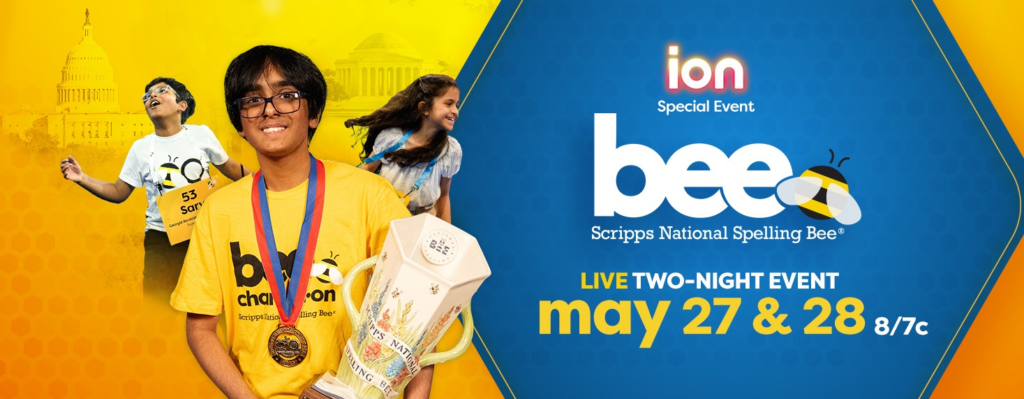
The teenager from Allen, Texas (a Dallas-Fort Worth metroplex suburb) correctly spelled “éclaircissement” to win. It means “the clearing up of something obscure : enlightenment.”
At 15 letters long, Faizan’s winning word tied “scherenschnitte” (the art of cutting paper into decorative designs), used in 2015, as the longest winning word in Bee history.
If you don’t have tickets to this year’s Spelling Bee, no worries. You can watch the competition, which runs from May 26 to May 28 on television.
The Bee’s four stages will be broadcast on ION and the Scripps National Spelling Bee Homepage. The full schedule is below.
- Preliminaries (8 a.m. to 3 p.m. ET Tuesday, May 26);
- Quarterfinals (8 a.m. to 1 p.m. ET Wednesday, May 27);
- Semifinals (8 p.m. to 10 p.m. ET, Wednesday, May 27); and
- Finals (8 p.m. to 10 p.m. ET, Thursday, May 28).