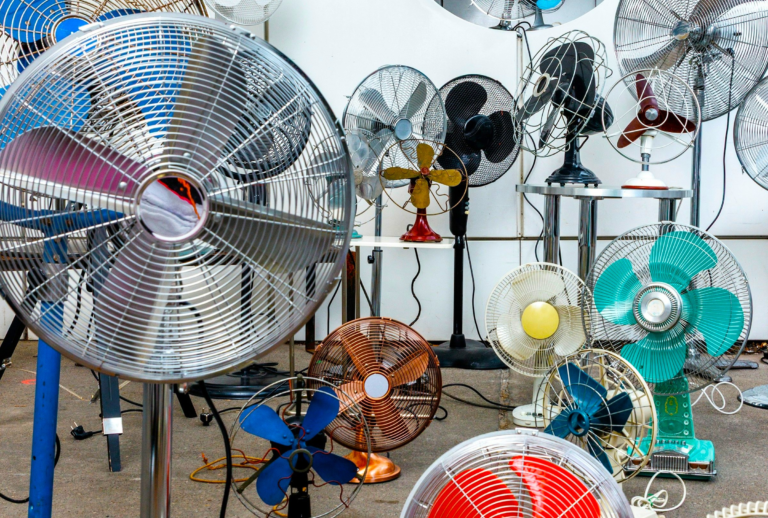
House fans can help make a room more comfortable, but an operational air conditioner is better. Federal tax breaks used to help pay for some energy efficient residential HVAC systems. Now that Uncle Sam’s tax credits are gone, some states are stepping in to help their residents chill, literally and economically. (Photo by Marlen Stahlhuth for Unsplash+)
…
I was going to walk this morning, but I got up late. By late, I mean I got up after the sun had risen. Once it’s daylight outside, it’s too hot to walk, at least very far.
So, I stayed in my air-conditioned house. I’ll try again tomorrow; maybe even set my alarm so I can head out as the day debuts.
I’ve never lived without AC, either as a renter or owner, except in times when a power outage forced this issue.
So, when the hubby and I moved back to Texas and bought our house, its two older AC units (one for each floor) were a bit of a concern.
But we got lucky. They both held on long enough, and went kaput years apart, letting us spread the replacement costs over a longer time frame.
Plus, each unit had great tax timing. When we did have to replace each, it was at times when Uncle Sam was providing tax credits for such residential energy expenditures.
The Trump administration, however, has ended that assistance. The One Big Beautiful Bill Act (OBBBA) eliminated multiple individual tax credits that helped homeowners pay for a variety of residential energy efficient changes and upgrades.
But you still may be able to get some tax and other assistance from your state and local governments.
Abrupt end to federal energy tax help: The Residential Clean Energy Credit (Internal Revenue Code Section 25D) and the Energy Efficient Home Improvement Credit (Internal Revenue Code Section 25C) were scheduled, under the Biden administration’s Inflation Reduction Act, to gradually phase out over many years.
However, the OBBBA’s enactment on July 4, 2025, set hard, in multiple senses of the word, deadlines for homeowners seeking tax help in making both incremental and larger scale energy-efficient home upgrades.
The Republican-crafted legislation unequivocally mandated that the federal tax credits under Internal Revenue Code Sections 25D and 25C “shall not apply to property placed in service after December 31, 2025”
Homeowners who weren’t able to get systems fully installed and operational by the end of last year were out of federal tax help luck. Many, unable to meet the quicker deadline or cover the projects’ costs on their own, decided to forgo the energy efficient changes.
Others, however, found help from more local legislators.
States step up: “With the federal landscape fundamentally altered, the availability and generosity of state and utility-level incentives become the primary determinants of project viability in 2026 and 2027,” notes Michael Haines, founder and chief commercial officer of the Florida-based HVAC distributor AC Direct.
Haines’ provides a detailed breakdown of the programs expected to be active during the next couple of years. His post focuses on states with the most significant policy frameworks and available data.
And that piece, 2026-2027 U.S. Solar & HVAC Incentives State-by-State Analysis in a Post-Federal Credit Era, earns this weekend’s first Saturday Shout Out.
Below are the states Haines analyzed, listed in the order they appear in his post and with his tagline and brief synopsis for each.
- California: Navigating a Mature but Evolving Market — California’s incentive landscape in 2026-2027 will be characterized by the transition of its flagship programs and a continued focus on grid resilience and equity.
- New York: A Model of Long-Term State-Led Investment — New York stands out for its comprehensive, long-term, and well-funded state-level programs that are explicitly designed to operate through the end of the decade, providing a stable and predictable incentive environment for 2026 and 2027.
- Massachusetts: A Multi-Year Plan for Deep Decarbonization — Massachusetts employs a structured, multi-year planning process for its energy programs, providing clear visibility into the incentive landscape for 2026 and 2027.
- Texas: A Market Dominated by Tax Policy and Local Utilities — Unlike states with centralized, state-administered incentive programs, the Texas market in 2026-2027 will be defined by a combination of a powerful statewide property tax exemption and a diverse array of programs offered by individual municipal utilities and electric cooperatives.
- Florida: A Patchwork of Utility Offerings and Tax Exemptions — Florida’s incentive landscape for 2026-2027 will be anchored by strong statewide tax exemptions, complemented by a variety of programs offered by its large investor-owned and municipal utilities.
- Illinois: State-Managed Programs Driving the Market — Illinois has a robust, state-managed incentive structure for solar energy that provides clear guidance and funding commitments for the 2026-2027 period.
- Arizona: Utility Programs and State Tax Credits — Arizona’s incentive structure relies on a combination of state tax credits and a diverse set of programs offered by its major utilities.
- Colorado: A Mix of State Credits and Utility Rebates — Colorado’s incentive framework for 2026-2027 will be a blend of a direct state tax credit for heat pumps, robust utility programs, and various local municipal rebates.
- North Carolina: Emerging IRA Programs and Utility Incentives — North Carolina’s incentive landscape in 2026-2027 will be heavily influenced by the rollout of its new statewide rebate program funded by the IRA and key offerings from its largest utility, Duke Energy.
As for states that didn’t make it into Haines’ list, he notes that “the incentive landscape in 2026-2027 will be more varied and often less robust. However, several key trends and resources will be universally relevant.”
DSIRE-ing state renewable data: One of those resources he cites is DSIRE, the acronym used for the information gathered in the Database of State Incentives for Renewables and Efficiency. It gets this weekend’s second shout.
DSIRE describes itself as “the most comprehensive source of information on incentives and policies that support renewables and energy efficiency in the United States.” The program was established in 1995, and is operated by the North Carolina Clean Energy Technology Center at N.C. State University.
Its website’s homepage has an interactive map highlighting each state’s (and territories’ and District of Columbia’s) policies and incentives. They range from rebates to loans to tax breaks, for both businesses and individuals. Move your mouse icon to your location, then click for details.
PACE-ing energy efficient financing: Property Assessed Clean Energy financing, known as PACE, is another state-based group that promotes energy efficiency, renewable energy, and water conservation projects.
This weekend’s third shout goes to PACENation, the national nonprofit association that advocates for PACE financing.
PACE’s goal is to expand adoption of energy efficiency and related projects in our nation’s buildings. It does so by providing 100 percent financing for qualifying project costs. PACE financing is repaid as an assessment on the property’s regular tax bill, and is processed the same way as other traditional local public benefit assessments, such as those for sidewalks and sewers.
PACE-enabling legislation is active in 40 states plus D.C., but primarily for commercial projects. Residential PACE is currently offered only in California, Florida, and Missouri. You can see what programs are available where you live at PACE’s interactive map.
Staying on top of state renewable news: Today’s fourth Saturday Shout Out goes to Novogradac’s coverage of State Renewable Energy Tax Credit Legislation. What happens in states’ legislative chambers will determine in part what programs will make it into DSIRE’s database.
The consulting and professional services firm, which has offices in 14 states across the country and Washington, D.C., also has a Renewable Energy Tax Credit News section.
Returning to Capitol Hill: And if you want to let federal lawmakers in the national capital know your thoughts on renewable energy — and, of course, the possibility of future tax breaks (again) in this area — you can start with the U.S. Representatives and Senators who are members of The House and Senate Renewable Energy and Energy Efficiency (REEE) Caucuses.
The REEE members directory on the Environmental and Energy Study Institute’s (EESI’s) website gets the ol’ blog’s fifth and final shout out this Saturday. That page also has more about the REEE Caucuses’ interest in and efforts on behalf of energy and environmental issues.
I hope it’s not too hot where you are. Or if it is, you have a good cooling system. Or access to a beach!
And if you need or want to upgrade your system with a little bit of tax help or other public incentive, I hope this post is of help.
…
Advertisements
🌟 Search Amazon Home Products 🌟
The text link above is an affiliate ad. If you click through and then buy a product, I receive a commission.