

…
The Internal Revenue Service is appealing a federal court ruling that it improperly collected tax penalties and interest during the COVID pandemic. That legal process will take a while, but if you faced these charges, you need to take these steps to take by July 10 to claim refund of the amount you were assessed.
…
COVID-19 continues to ripple through our lives, but at least this time it could be a positive for millions of taxpayers.
They paid penalties and interest to the U.S. Treasury when their tax payments were delayed during the coronavirus pandemic six years ago. A federal court ruling last year left the door ajar enough for these taxpayers to file a refund claim for that money.
But these filers need to submit Form 843 to the Internal Revenue Service by July 10 to get their COVID penalty refunds.
Tax date determination: The IRS is appealing the U.S. Court of Federal Claims decision, handed down in Kwong v. United States on Nov. 25, 2025.
The court said that applicable tax law during the COVID-19 federal disaster period — which began with its declaration on Jan. 20, 2020, and ran through May 11, 2023 — provided for automatic postponement of filing and payment deadlines during that time frame, plus 60 days.
Therefore, per the court’s reading of the tax law, any IRS-collected late penalties and interest during that time was improper.
Standing tax law says taxpayers have three years from their original filing deadline to collect tax money they are owed. The Kwong ruling’s additional 60 days pushed the three-year claiming deadline to July 10, 2023.
If the IRS ultimately wins its legal challenge, it won’t matter if the affected taxpayers have filed refund claims.
But if the agency loses, filers who paid penalty and interest could be refunded those charges. The actual payment of those refunds could be months (or more) down the road. It depends on the pace at which the legal system in this case moves.
And to ensure payment whenever a taxpayer-positive decision might happen, affected filers must make their refunds claims by July 10.
Transcripts can help determine eligibility: Your first step is figuring out whether you qualify for COVID penalty relief. You can check this yourself by reviewing your tax records.
If you didn’t keep your filing and follow-up records, you need to get the information directly from the IRS. The quickest way to do this by checking (or creating) an online taxpayer account. From there you can download your relevant tax transcripts.
Transcripts show each year’s tax information, including filing status, taxable income, and any adjustments the IRS made after it processed your original return. These documents also show payments, penalties, and interest with dates they were made or assessed.
The simplified fictional tax transcript below, created by National Taxpayer Advocate (NTA) Erin Collins’ office, shows a taxpayer’s account transcript for a 2021 income tax return filed after the original due date. It shows the filer’s withholding, a payment sent with the return, failure-to-file and failure-to-pay penalties and interest charged (highlighted in yellow), and subsequent payments that fully satisfied the balance. The transaction dates show when the transactions occurred.
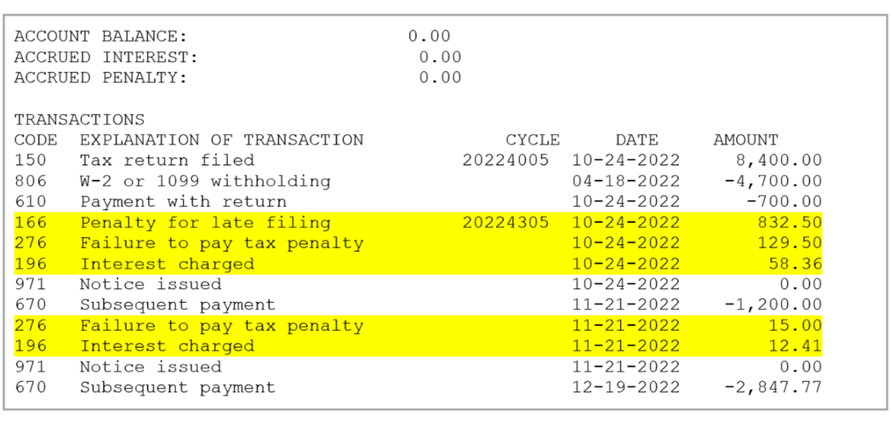
“Although this return was filed late under normal tax rules, it was submitted before July 11, 2023. Under the COVID-19 relief rules, it may be treated as timely. As a result, the penalties and related interest shown above may have been charged incorrectly and could be eligible for refund or abatement,” notes Collins.
The NTA website also offers more on how to use IRS tax account transcripts to identify potential COVID-19 disaster relief refunds.
If you determine or believe that you qualify for a refund, you can file a protective claim. As the name indicates, such a claim preserves a taxpayer’s rights pending final resolution of this issue.
Old-fashioned filing Form 843: In this case, the protective claim is made by filing IRS Form 843, Claim for Refund and Request for Abatement.
You’ll use the information from your tax transcript to complete Form 843.
You also must specify on the form that it’s a protective claim based on the Kwong v. United States decision.
In you are making a claim for multiple potential COVID refunds, file a separate Form 843 for each tax period and type of tax.
Note, too, that Form 843 must be downloaded, filled out by hand, and mailed to the IRS.
Just where do you send your Form 843? It depends on where you live.
Form 843’s instructions say on page 3 that if you’re filing it in connection penalties, mail the form to “the service center where you would be required to file a current year tax return for the tax to which your claim or request relates.”
Since most of us electronically file our annual returns, you’ll need to check another IRS publication, the instructions for Form 1040, to find that address. You’ll find it in the list of mailing addresses of the IRS campuses on the last page (that’s page 126) of that booklet.
Get mailing deadline proof: Most importantly, make sure you meet the fast-approaching July 10 deadline.
You also want proof you did, in IRS parlance, timely file your claim by having it postmarked on or before the tax — or protective Form 843 claim — due date.
To do that, mail you’re your Form 843 via U.S. Postal Service certified mail as soon as possible before July 10. Using the certified mail option will give you paper documentation that you met (or filed before) the deadline.
Yes, certified mailing does cost more. But the service and its accompanying receipt will protect your Form 843 claim mailing from the USPS rule change that, in some cases, means a postmark is created when the correspondence is processed at another postal facility, and not when you drop it off at your local postal branch.
…
You also might find these items of interest:
- July 10 is deadline to file for COVID tax
- IRS-CI continues pursuit of COVID-connected tax criminals
- IRS’ online options, like an individual account, can help you avoid tax-help phone delays
…
Advertisements
🌟 Search Amazon Tax Products 🌟
The text link above is an affiliate ad. If you click through and then buy a product, I receive a commission.


Best SEO Backlink Services
Hello, just wanted to say, I loved this blog post.
It was practical. Keep on posting!
Viki Wu
Thank you for flagging the transcript route, because it’s the only practical way for most people to know whether they’re affected — the penalty and interest lines on the account transcript (the “failure to pay” and “interest charged” entries with 2020–2023 dates) are what Form 843 needs, and a lot of filers paid these charges via a notice years ago and have no other record. Two practical notes for anyone filing the 843 by the deadline. First, a protective claim is allowed and is the right move here: the form can state that the claim is contingent on the outcome of the Kwong appeal, and the IRS will hold it rather than deny it, which preserves the refund right if the government loses. Second, the three-year clock is measured from when the tax was paid, not from the return date, and penalty and interest are often paid months after the return — so some people whose original deadline has “expired” may still be inside the window for the penalty portion; the transcript payment dates settle that. One thing worth adding for the paycheck side of the same story: many of the taxpayers who owed and paid late in 2020–2021 were people whose withholding fell short in a year of job changes and unemployment income, and the underpayment penalty (Form 2210) is separate from the failure-to-pay penalty the court addressed — the ruling covers the latter, so anyone expecting a refund of a 2210 estimated-tax penalty will be disappointed. Checking the W-4 now so the same shortfall doesn’t recur is the cheaper fix than a refund claim later.
Comments are closed.