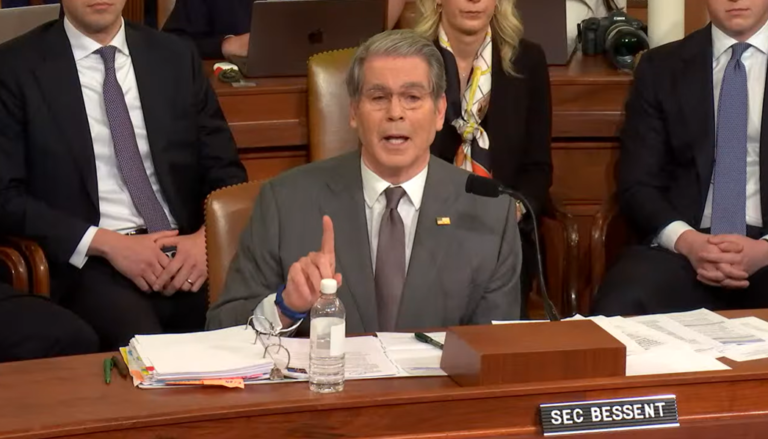
Treasury Secretary Scott Bessent fielded questions about delayed paper tax refund checks during a June 4 Ways and Means Committee hearing. You can listen to the relevant section at 1 hour 28 minutes into the session. (Screen capture of W&M hearing video)
…
By May 8, the Internal Revenue Service had issued more than 99 million tax refunds. Most of those went to taxpayers who told Uncle Sam to electronically deposit the money into their bank accounts.
Meanwhile, a sizeable group of taxpayers without accounts, often referred to as unbanked, are still waiting for their refunds. And members of Congress continue to seek answers from IRS leaders about the delay.
When Treasury Secretary Scott Bessent testified at a June 4 Ways and Means Committee hearing, Democratic Rep. Danny Davis of Illinois pressed Bessent for details on the agency’s slow paper refund processing.
The lawmaker’s inquiry came after Bessent’s opening statement, in which he touted the increase this filing season in the number of tax refunds issued and larger average refund amounts.
Davis, however, was not thrilled with Bessent’s answers about taxpayers whose refunds weren’t among the general statistics.
First Congressional inquiry months ago: The refund delays first came to public attention in early March.
That’s when Davis, ranking member of the W&M Subcommittee on Worker and Family Support, and his Democratic colleague Rep. Terri A. Sewell of Alabama, ranking member of the W&M Subcommittee on Oversight, wrote to Bessent seeking information about the tax refund delays.
As of their March 9 letter date, the IRS had notified around 830,000 taxpayers via Notice CP53E that their refunds were on hold while the agency sought bank account that would allow for direct deposit. By the end of March, the IRS has sent the notice to nearly 1.5 million taxpayers.
At the June hearing, Davis cited IRS data showing that as of April 18, around 3.4 million taxpayers had received the delayed refund notices.
Slow administration response: In addition to being displeased with the numbers of unbanked taxpayers who’ve had to wait, some for up to 10 weeks to get paper tax refund checks, the Illinois Representative also was not happy with Bessent’s initial response to inquiries.
The letter Davis and his colleagues sent to Treasury had asked for a reply by March 23. Davis said he got a letter from the IRS on June 3, the day before the W&M hearing at which Bessent would appear.
Davis also told the Treasury Secretary that while the belated letter “contained some high-level information, it is insufficient to reassure me that Americans are receiving their refunds quickly.” He also noted that information in the response was “substantially outdated.”
The bulk of the notices went, not surprisingly, to residents in some of the most populous states. They included taxpayers in Davis’ Illinois, as well as in California, Florida, New York, Pennsylvania, and Texas.
“Secretary Bessent indicated that he would work to answer my questions,” Davis said after the hearing. “I hope that will occur without another 3-month delay and that the information in the response will be timely and accurate.”
Bessent, in response to Davis’ questions, said that the IRS is working through the refund delays. Much of the time, he said, has to do with verification of taxpayer data.
Davis asked Bessent for a face-to-face follow-up meeting to discuss the delayed refund issue.
Valid reasons for e-transition: Treasury’s response has been consistent when asked about the transition to electronic government services.
The IRS refund action was following the direction of March 25, 2025, White House executive order to move to more such activities.
The switch officially happened on Sept. 30, 2025. It now covers public interactions ranging from communications to financial transactions.
The reasoning is sound. Paper tax checks are more vulnerable to theft and fraud. Plus, electronic payments are faster and cheaper.
But while most U.S. taxpayers have successfully shifted to electronic filing and direct deposit of tax refunds, millions of Americans do not have any kind of financial account.
The reasons vary. Some simply do not trust electronic activity to safeguard their money or private information. Others cite religious reasons. Some are in domestic relationships where they fear the change could incite a violent partner.
Traditional taxpayers deserve better, too: Regardless of the differing reasons to eschew electronic financial transactions, many also share one thing. Every filing season they rely on their IRS refunds to cover day-to-day necessities.
They deserve a smoother process than the one used this filing season, despite the federal government’s valid reasons for moving to more electronic operations.
Here’s hoping the Congressional pressure can help Treasury and the IRS develop a system that will serve these taxpayers’ needs. And in a timely fashion.
You also might find these items of interest:
- Open a bank account to get your tax refund sooner via direct deposit
- Don’t fall for fake IRS letter scam seeking tax-refund related bank data
- IRS’ online options, like an individual account, can help you avoid tax-help phone delays
…
Advertisements
🌟 Search Amazon Tax Products 🌟
The text link above is an affiliate ad. If you click through and then buy a product, I receive a commission.