
The Internal Revenue Service has sent more than 830,000 taxpayers a notice asking for their bank information so that their refunds can be directly deposited. But scammers also are sending out a fake IRS CP53E notice, seeking people’s bank data for nefarious purposes.
…
The Internal Revenue Service has sent more than 830,000 taxpayers a notice asking for their bank information so that their refunds can be directly deposited. But scammers also are sending out a fake IRS notice, seeking people’s bank data for nefarious purposes.
Uncle Sam’s efforts to more fully embrace digital services is causing a problem for more than 830,000 taxpayers without bank accounts.
The Internal Revenue Service has delayed mailing them paper U.S. Treasury tax refund checks. Instead, the IRS sent them Notice CP53E seeking their bank information so their refunds can be directly deposited.
Without an acceptable financial account, these taxpayers face a delay of up to 10 weeks of their refunds as checks.
But the IRS’ legitimate account inquiry also has created a problem for other taxpayers. Tax scammers are using the direct deposit request as a way to steal individuals’ financial info.
Fake IRS bank account letters: WSB-TV, Cox Media Group’s ABC affiliate in Atlanta, reports that some Georgia taxpayers have received letters that appear to be from the IRS, but actually are from con artists.
The first sentence of the bogus notice gets right to the point, with the phony IRS telling recipients, “We couldn’t direct deposit your 2025 Form 1040 refund.”
In fact, even tax attorneys and accountants are having trouble determining which mailings are legitimate IRS CP53E notices and which are coming from agency impersonators, according to WSB-TV investigative reporter Justin Gray.
Using real IRS delivery method: Making matters worse is that the apparently being well-crafted fake IRS documents are arriving by mail.
Taxpayers have been warned for decades that the IRS generally will not initiate taxpayer contact by phone, email or social media. When there is an issue with a taxpayer’s account, the agency typically first reaches out to filers via a U.S. Postal Service mailing.
Scammers have used similar paper schemes in the past. For example, back in the summer of 2023 crooks crafted a fake IRS letter saying targeted taxpayers were owed refunds. But that correspondence was sent via a private delivery service.
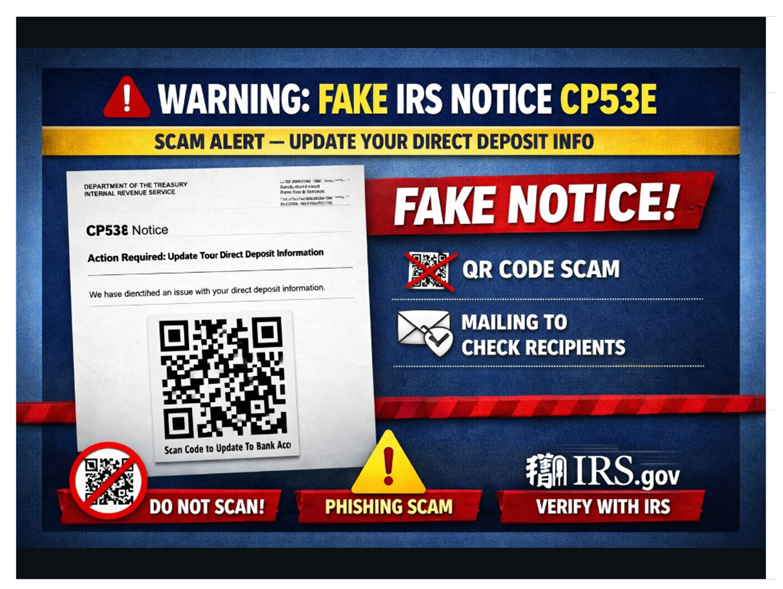
Other real IRS touches: One Atlanta-area recipient of the fake IRS letter told WSB-TV that her mailing included a QR code.
Baker Business Tax via Instagram
…
The fake IRS notice told the recipient that scanning it would immediately update her banking information, producing a quicker direct deposit of her 2025 refund.
“I wasn’t getting a refund, so they didn’t need my bank account. That was the only reason that I actually stopped and said this doesn’t seem legit,” the taxpayer told the TV station.
Suspected scam protection steps: That taxpayer didn’t scan the code, which was a smart move.
Although the IRS does include QR codes in some of its notices, an IRS spokesperson told WSB-TV that the agency’s real CP53E notice does not include that scannable option.
The fake QR code is a good reminder to be cautious any time you get any purported outreach from the IRS. Do not scan QR or more basic barcodes. Do not click on links in emails or texts. And do not open any attachments.
The wary scam target also called her accountant, which is another correct move to make when you get any communication from the IRS.
If you don’t have a tax pro, you can call the IRS directly when you have questions about any tax-related issue or contact that seems suspicious. The agency’s toll-free number is (800) 829-1040.
Online account helps: An even quicker way to resolve or at least get more information about a tax matter is to go directly to your online taxpayer account. If you don’t have one, it’s easy to set up at the special IRS.gov account for individuals page.
Once your online account is established, you can access your tax data, check on your tax payment or refund, and see any questions the IRS might have about your taxes.
Your tax info is available 24/7 directly from your computer or mobile device.
Alert the IRS: Also be sure to let the IRS know about the scam. The more details it gets about criminal attempts to steal from taxpayers and Uncle Sam, the better equipped it and its partner agencies are to stop the schemes and arrest the perpetrators.
In fact, the IRS has a new consolidated tax fraud web page that should make reporting of this latest fake mailing and other tax scams easier.
Most of all, however, take a moment any time you are contacted about a tax matter, whether it’s a situation that could benefit your or cause a bit more tax pain.
I know you want to comply with the tax laws, but the IRS generally doesn’t demand your immediate attention. You have time to check things out and make sure that the inquiry is indeed legitimate.
Even if it is, paying a bit more to Uncle Sam is a lot better than losing a whole lot more money, and potentially your financial and personal identity, to a tax scammer.
You also might find these items of interest:
- Tax scammers use AI to up their criminal schemes
- Social media tax scammers have cost duped taxpayers $162 million in IRS penalties
- ID theft protection tips in wake of whistleblower’s report on DOGE Social Security data collection
…
Advertisements
🌟 Search Amazon Tax Products 🌟
The text link above is an affiliate ad. If you click through and then buy a product, I receive a commission.