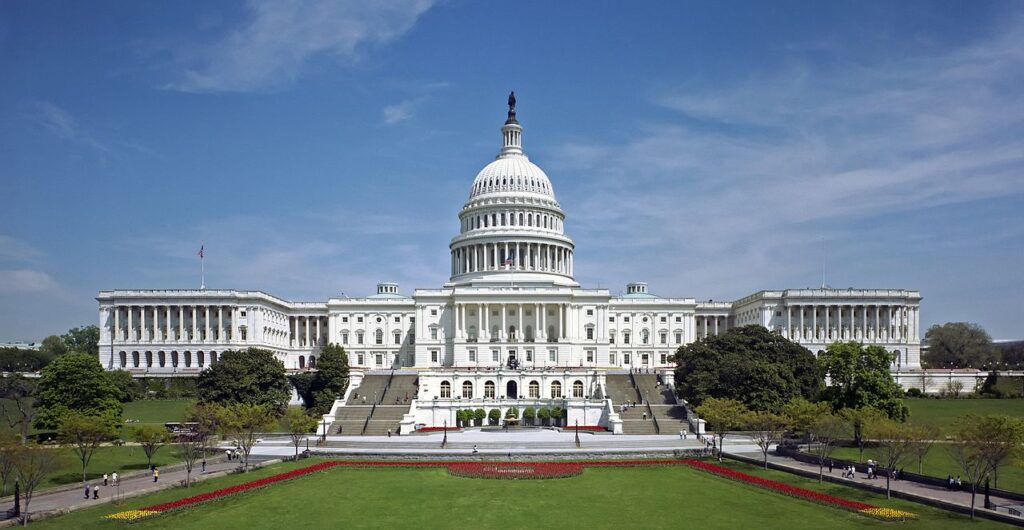
Photo by Jonathan Cooper on Unsplash
…
The federal government finally is fully open after the longest shutdown on record. But the battle to keep Uncle Sam’s offices operational in the 2027 fiscal year faces an Oct. 1 deadline.
…
The record 76-day partial federal government shutdown is over. Donald Trump on April 30 signed a Department of Homeland Security (DHS) funding bill.
Affected agencies now have money to run through the Sept. 30 end of the current fiscal year.
That’s money for most DHS operations, some of which — most notably the Transportation Security Administration (TSA) that provides safety checks at the country’s airports — had been relying on emergency funds to operate. The White House had warned lawmakers this week that the special financial source was running out.
So, Capitol Hill finally acted. And with Trump’s signature, the Federal Emergency Management Agency (FEMA), the Coast Guard, the Secret Service and the Cybersecurity and Infrastructure Security Agency, along with other sub-agencies that aren’t connected to immigration enforcement, join the TSA in finally obtaining full operational revenue.
ICE controversy continues: However, the measure does not include money for Immigration and Customs Enforcement (ICE) and Border Patrol.
Those agencies were funded earlier by money from a law supported only by Republican members of Congress.
The GOP, which controls the House and Senate, plans to fund those two controversial agencies for the rest of Trump’s term via the reconciliation process that does not require Democratic votes.
You can get a look at how this latest government shutdown compares with other closures in my earlier post Federal government shutdowns, then and now.
Another shutdown on the horizon? While the resolution of this record-setting shutdown should relieve worries Americans had concerning their summer travel plans, it’s just a temporary respite.
In just five months, we again could be looking at another federal government shutdown.
Given the escalating political intransigence as the midterm elections near, reaching fiscal deals could be difficult. But then, the possibility of voters heading to the polls while the federal government is closed again could be motivation.
The literal bottom line is that if Congress doesn’t pass by Oct. 1, the start of the federal government’s 2027 fiscal year, a dozen appropriations bills or a continuing resolution providing short-term funding, we could see Uncle Sam closing his doors again.
IRS money next year: As far as tax-related money for the coming 2027 fiscal year, the House Appropriations Committee on April 22 advanced the Financial Services and General Government (FSGG) funding bill. It contains $10.2 billion for the Internal Revenue Service.
That overall amount comes with a nearly $1.4 billion cut, from nearly $5 billion in fiscal 2026 to $3.6 billion in the coming fiscal year, for IRS enforcement efforts.
The GOP bill’s drastic cut of enforcement money was a major point of contention during the committee markup. Democrats warned that the move will have “a very real fiscal cost.” Reducing IRS enforcement funds is fiscally irresponsible, they argued, comparing it to a business that doesn’t collect its accounts receivable.
Other Democrats said that giving the IRS less money to go after unpaid taxes will effectively allow “the richest Americans to get away with not paying what they owe.”
Other IRS funding provisions were less contentious.
The committee-approved by a 34-to-28 party-line vote bill keeps funding for IRS taxpayer services at the FY26 funding level of nearly $3.04 billion. The Trump administration had requested a slight bump to $3.13 billion for taxpayer services.
For Technology and Operations, House Republicans allocated $3.6 billion for fiscal 2027, a $445 million boost over the current levels. That’s more than the $2.6 billion the Trump administration had requested for such IRS programs.
Republicans on the committee said the bill’s focus on new technologies will help the IRS cut wasteful spending and root out waste, fraud, abuse, and other improper payments across the government.
The measure is awaiting full House for consideration.
You also might find these items of interest:
- AI’s potential to increase IRS audits raises expectations and fears
- Improved IRS oversight of tax preparers could benefit taxpayers, says GAO report
- IRS’ lack of a plan to deal with taxpayer correspondence backlog could hamper other agency services, says GAO
…
Advertisements
🌟 Search Amazon Tax Products 🌟
The text link above is an affiliate ad. If you click through and then buy a product, I receive a commission.