


Getty Images for Unsplash+
The IRS has no plan on how to reduce its taxpayer correspondence backlog, which remained above pre-pandemic levels last year. A new government watchdog report warns that the accumulation could hamper the agency’s other taxpayer services.
The Government Accountability Office (GAO) says the Internal Revenue Service still has a backlog of taxpayer correspondence and no plan for how to reduce it.
The GAO report, Management of Agency Reforms and Workforce Planning Needed to Address Severe Risks to Future IRS Operations, that was released March 16 notes that the IRS’ logjam at the end of the 2025 filing season remained higher than such levels before the COVID-19 pandemic.
That alone is troubling, but GAO warns that without a plan to deal with the accumulated correspondence, other taxpayers services could suffer.
GAO examined those broader workforce changes and related planning efforts, as well as leadership developments at the agency, and the challenges of implementing new tax law provisions enacted under the One Big Beautiful Bill Act, both retroactive to 2025 and those taking effect this and future tax years.
GAO recommendations: Following its wide-ranging examination, the GAO recommended the IRS take three steps.
It called on the agency to develop a plan to address its taxpayer correspondence backlog.
It urged the IRS to update its strategic workforce plan.
And it suggested that the IRS establish an implementation team to manage agency reform efforts.
At the time of the GAO report’s release, the IRS had not agreed or disagreed with the recommendations.
If you want to take a break from your current (or 2022 tax year) filing, this weekend’s Saturday Shout Out goes to the GAO report.
You can thumb through the full 65-page PDF version. Or read the one the GAO posted at its website. Or, if you’re in a hurry, just check out the highlights.
Frustrated sympathy for IRS: In addition to shedding light on the IRS’ persistent workflow problem, the GAO accomplished something that I thought was impossible.
Its investigation revealed a rare instance where many of us can empathize with the tax agency. Admit it. Who among us hasn’t been swamped and overwhelmed?
Of course, we’re not responsible for the tax filing and associated financial implications of around 160 million of our fellow Americans.
And, commiseration aside, we all can agree the IRS needs to get its act together.
IRS operating obstacles: Of course, that itself is a challenge.
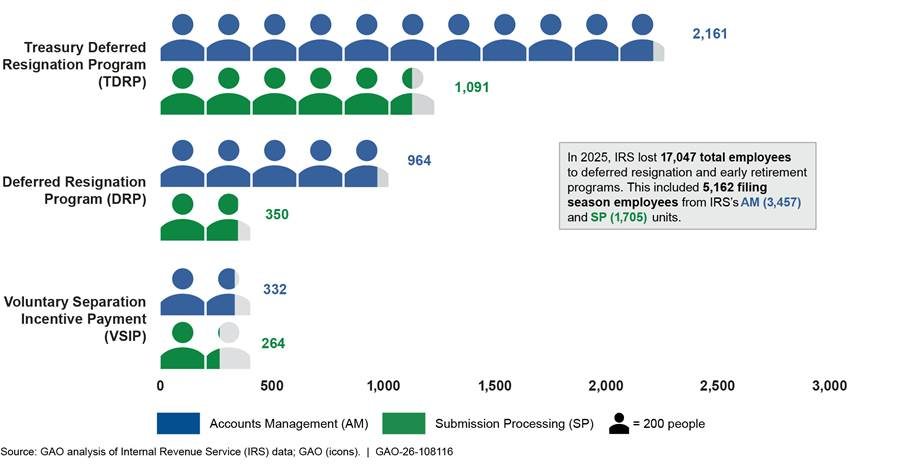
The agency started 2026 with its smallest workforce in years. In 2025, the IRS lost 17,047 total employees to deferred resignation and early retirement programs. These exits included 5,162 filing season employees from IRS accounts management (AM) and submission processing (SP) units.
Hiring and retaining personnel has been exacerbated over the years by Congressional budget cuts.
Capitol Hill also has stepped into, and most recently stopped, IRS efforts to expand taxpayers services. Yes, I am talking about the axing of Direct File.
Trump 2.0 also brought changes, most notably Elon Musk’s quasi-governmental Department of Government Efficiency (DOGE), which helped contribute to the aforementioned staff reductions.
And the still-spinning IRS leadership carousel has left Uncle Sam’s tax collector without a commissioner. Again.
So, while the federal watchdog’s look at IRS operations and recommendations to improve the tax collector’s services are welcome, the agency can’t do it alone.
Maybe it’s time for GAO to examine the motivations behind efforts in Washington, D.C. and beyond to hamstring IRS operations and ultimately its ability to better enforce tax laws and serve taxpayers.
Of course, any recommendations GAO might have in this area likely would be ignored.

