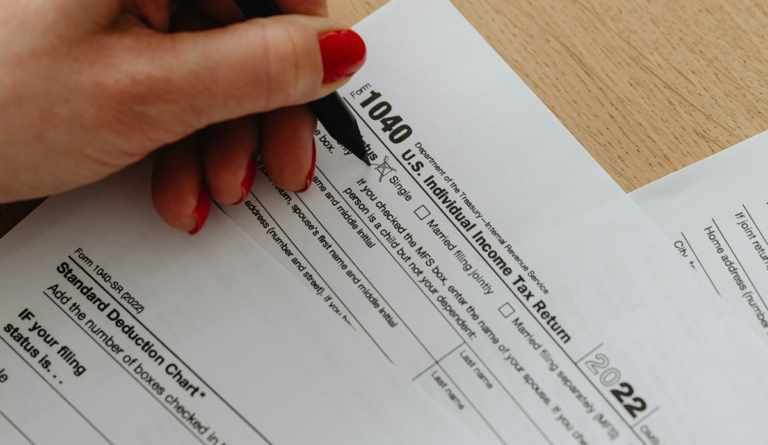
Photo by Karolina Grabowska for Unsplash+
If you didn’t file a tax year 2022 return back in 2023 and were due a refund, time is running out for you to get your money. April 15, 2026, is the deadline to submit that old tax paperwork to the Internal Revenue Service and claim your cash. Miss it, and Uncle Sam gets to keep your tax refund.
Collecting a refund is one reason you should file a tax return even if you aren’t legally required to do so. But every year, millions of people let their tax money languish in the U.S. Treasury.
The Internal Revenue Service, however, is trying to get the cash to its rightful owners. And those who didn’t file a 2022 tax year return back in 2023 only have a few weeks to claim their cash.
If they don’t file the missing 2022 return by April 15, 2026, they’ll forfeit their refunds.
That could happen this year to more than 1.3 million people across the nation who didn’t claim their tax refunds three years ago.
That three-year time frame is, per U.S. tax law, how long individuals have to claim their refunds. Since the 2022 filings originally were due on April 15, 2023, the final refund claiming deadline is this year’s Tax Day.
If the impending April 15 deadline is missed, the federal government gets to keep the nonfilers’ refunds. Forever.
More than $1.2 billion waiting to be claimed: The total of all these three-year-old unclaimed refunds is more than $1.2 billion. The IRS estimates the median refund amount is $686 for the 2022 tax year, meaning half of the waiting amounts are more than $686 and half are less.
Delaware taxpayers are right at the median $686 when it comes to the refunds unclaimed by 5,100 First State residents.
However, nonfilers in more than half the states (and the District of Columbia) could get a potential refund that beats the national unclaimed median amount. They are in the 29 jurisdictions shown, with their median amounts, in the table below.
| Alaska $721 | Maryland $739 | North Dakota $774 |
| Colorado $697 | Massachusetts $786 | Pennsylvania $703 |
| Connecticut $732 | Michigan $707 | Rhode Island $740 |
| District of Columbia $744 | Minnesota $711 | South Dakota $692 |
| Hawaii $784 | Nebraska $703 | Texas $687 |
| Illinois $714 | New Hampshire $745 | Vermont $719 |
| Iowa $709 | New Jersey $746 | Virginia $695 |
| Kansas $694 | New Mexico $700 | Washington $738 |
| Louisiana $694 | New York $757 | West Virginia $756 |
| Maine $733 | Wyoming $714 |
If you’re in one of the states getting less than the $686 median missed refund, you can find your amount in the IRS’ announcement. It also has details on the number of nonfilers in each state and D.C. who face losing their 2022 refunds if they don’t file by the April 15, 2026, deadline.
Old tax breaks could mean more money: But wait! There could be even more money!
The amount of money that some late filers might get could be larger if in 2022 they also were eligible for valuable tax breaks, like the Earned Income Tax Credit (EITC).
The EITC is available to lower- and moderate-income workers, with the amounts adjusted each year for inflation. The tax break is a dollar-for-dollar credit that can offset any tax owed. If you qualify for more EITC than you owe the Treasury, the excess credit comes to you as a refund.
The EITC was worth a maximum $6,935 in 2022 for jointly filing taxpayers who that year had three or more qualifying children. EITC claimants with two qualifying children in 2022 could get up to $6,164. The tax break was worth $3,733 for families with one eligible child. And taxpayers with no dependents could claim an EITC of up to $560.
The precise EITC amount also is based on income thresholds. The maximum EITC maximum income amounts in 2022 were —
- $53,057 ($59,187 if married filing jointly) for those with three or more qualifying children;
- $49,399 ($55,529 if married filing jointly) for people with two qualifying children;
- $43,492 ($49,662 if married filing jointly) for those with one qualifying child, and;
- $16,480 ($22,610 if married filing jointly) for people without qualifying children.
So, when you do finally file your 2022 tax year return by April 15 this year, check out the possibility that you also can claim the EITC for that prior year.
Getting the correct old forms: You can find current and prior year tax forms and instructions, such as the ones needed to file a 2022 return, at the IRS.gov forms, instructions and publications page.
If you prefer, you also can request the old form by calling toll-free (800) TAX-FORM, which is (800) 829-3676 if you don’t have a dial screen handy to translate letters to numbers.
The IRS also points out that taxpayers seeking a 2022 tax refund might have trouble getting that three-year-old refund if they also neglected to file returns in 2023 and 2024. Check all your filing records and make sure you’re up to date so that you can get your unclaimed money. The easiest way to do that is through your individual IRS account that you can establish at IRS.gov.
Also, the IRS notes that any refund amount for 2022 will be applied to amounts the taxpayer still owes to the U.S. Treasury or a state tax agency. These offsets include unpaid child support or other past due federal debts, such as student loans.
How to file a 2022 tax return: You have several options in filing and claiming your 2022 refund. But, notes the IRS, you should start the process now to make sure you have enough time to file before the April 15 deadline. Especially if you’re still working on your current 2025 filing.
Again, there’s no extension period for filing old returns to claim a refund. If you don’t do so by the three-year time limit, you lose your money.
To ensure that doesn’t happen, the IRS recommends the following filing options.
- Create or log in to IRS Individual Online Account. As noted earlier, this will allow you to view, download, or print your tax records and transcripts you need to file. You also can find transcripts of past tax returns, tax account information, wage and income statements, and verification of non-filing letters. You can create or log in to your Individual Online Account at IRS.gov.
- Request copies of key documents. If you’re missing Forms W-2, 1098, 1099, or 5498 for the years 2022, 2023 or 2024, you can request copies from your employer, bank, or other payers.
- Get a tax transcript by mail. If you’re unable to get those missing forms from employers or other payers, and cannot access your online taxpayer account, you can get a tax return or tax account transcript mailed to you by using Get Transcript by Mail on IRS.gov. You can also request a transcript be mailed to you by calling the automated phone transcript service at (800) 908-9946. If you take this route, get on it now, as the process can take weeks.
- Request a wage and income transcript. Another option is to file Form 4506-T with the IRS to request a wage and income transcript. This transcript shows data from information returns received by the IRS, such as Forms W-2, 1099, 1098, Form 5498, and IRA contribution information. You can use the information from the wage and income transcript to file your old tax return. Again, if you need to do this, do it now. The IRS says written requests can take several weeks, so check out the other electronic or phone options first.
Don’t forget state taxes: Most Americans live in states that also collect income taxes. So, chances are that many of the 1.3 million people who didn’t file a federal return in 2023 also neglected filing at the state level, too.
That could mean they also might have unclaimed state refund money.
If that’s you, check with your state tax department about taking care of that year’s corresponding state responsibility as soon as possible.
Even if you don’t get a refund, it’s always good to be on the up-and-up with any and every tax collector.
Now or never, whatever the reason: As noted earlier, these old, unclaimed tax refunds are an annual occurrence. And as also mentioned, there are many reasons for such oversights.
Sometimes people get busy and simply don’t get around to sending their returns to the IRS.
Some don’t realize they need to file at all. That’s often the case with students and increasingly, gig workers. In both of these cases, these folks aren’t in the main, traditional job earning pools, so filing is not necessarily routine for them.
Others know they are due a refund, but for some crazy reason (yes, I am judging!) think the amount is too small to mess with filing a 1040. If that’s you, we need to talk.
And some people don’t even know they might be due a refund.
Whatever the reason, the IRS isn’t worrying about the whys and why-nots. It is simply alerting these nonfilers so that they can get their tax year 2022 money. If that’s you, get to work filing that old Form 1040 and collect your money, before it’s too late.
You also might find these items of interest:
- Same 8 tax software companies return for Free File 2026
- 5 free tax prep and filing options, and a move to restore a sixth
- VITA and TCE sites offer free tax filing help to eligible taxpayers across the country
Advertisements
🌟 Search Amazon Tax Products 🌟
The text link above is an affiliate ad. If you click through and then buy a product, I receive a commission.