
Photo by WoodleyWonderWorks via Flickr
…
Did you do some back-to-school shopping (or plan to if you live in Connecticut) during this month’s state sales tax holidays?
If you’re a teacher or other school employee, find and hold on to those receipts. They could help you claim a tax break next filing season.
A couple of tax changes also have improved this tax-saving opportunity.
The long-standing educators’ expenses tax deduction — it’s been available in some form since 2002 — has been increased for the 2026 tax year. The Internal Revenue Service’s annual inflation adjustments last fall bumped this above-the-line tax deduction up from $300 per eligible taxpayer to $350 on returns to be filed next year.
And if you spend more than $350 on qualifying classroom supplies and itemize instead of taking the standard deduction, a One Big Beautiful Bill Act (OBBBA) provision gives you a shot at claiming that excess.
Beginning with the 2026 tax year, you can list those added educational expenses on Schedule A.
Most taxpayers claim the standard deduction, and most of its requirements also apply to the new itemized option. Here’s a look at the teachers’ tax break for both types of filers.
Who qualifies? This tax break often is referred to as the teachers’ expenses deduction (like I did in the preceding paragraph). Its official name, however, uses a broader definition.
The educator expenses tax deduction, as it is listed on IRS forms, is available to anyone who is a kindergarten through grade 12 teacher, instructor, counselor, principal, or aide.
These individuals must work for at least 900 hours during the school year in a facility that provides elementary or secondary education as determined under state law.
Both public and private school educators qualify. However, home-school teachers are not eligible to claim the educators’ deduction.
Individuals who work at pre-schools or, at the other end of the classroom spectrum, who are employed by a college or graduate school also do not qualify for this tax break.
What expenses can you claim? The usual school items obviously are covered. This includes books, supplies, and other materials used in the classroom.
So are an educator’s unreimbursed costs of instructional equipment, including computer hardware, software, and services.
Be careful not to double dip. If you are reimbursed by your school district for your personal classroom item expenditures, you cannot claim those costs on your tax return.
The IRS also reminds teachers and their eligible colleagues that home schooling costs don’t count. Neither do nonathletic supplies for courses in health or physical education when the amount is claimed as an above-the-line expense.
You also don’t qualify for either Educator Expense Deduction if you work at a pre-school, homeschool your own children, or are employed by a college or graduate school.
But your own efforts to enhance your teaching skills do count. The cost of professional development courses is an allowable educators’ deduction expense. Just make sure the courses are related to the curriculum or students you teach.
Are there differences for standard vs. itemized filers? Yes. The new OBBBA rules on who is eligible and what expenses qualify are a little broader for the itemized deduction than they are for the above-the-line deduction.
Starting this tax year, interscholastic sports administrators and coaches can claim their school-related expenses if they itemize. For health and physical education courses, the supplies don’t have to be related to athletics
Don’t worry if you’re not part of your school sports staff and itemize. The prior eligible educator roles still apply here, too.
So do the K-12 classroom levels and 900 hour requirements.
But there are no adjusted gross income percentage limits on the new itemized deduction for educator expenses incurred after Dec. 31, 2025.
And you can claim your first qualifying $350 as above-the-line deduction, then the rest of your expenses on Schedule 1.
How do standard filers claim it? Speaking claiming your classroom expenses, teachers who’ve been taking the above-the-line educator expenses deduction for years won’t see any changes.
You’ll still find the deduction on Form 1040 Schedule 1. Since the IRS hasn’t yet updated 2026 forms, that’s an excerpt of this year’s schedule, with the educator expenses line highlighted, below.
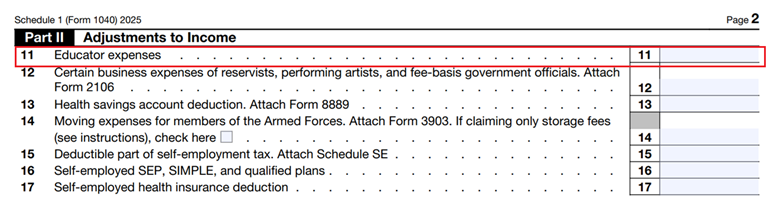
There are no percentages of adjusted gross income (AGI) to calculate. Just claim your classroom-related costs up $350 and attach Schedule 1 to your Form 1040 when you file.
If you are a teacher married to another educator and file a joint return, the deduction potential maximum increases to $700. Note, however, that the $350 claim applies to each spouse separately.
So, if one teaching spouse spent $400 and the equally educational spouse spent $300, the couple can only claim $650, not the possible maximum $700. That’s because only the maximum $350 can be counted by the bigger spender, and $300 for the more frugal husband or wife school employee.
How do itemizing filers claim it? If you are an educator who itemizes tax deductions and spent more than $350 this year on qualifying classroom material (which is highly likely according to numerous educational surveys), you have a two-step claim.
First, you take the Schedule 1 amount for $350 in expenses. A benefit here is that the amount will help and lower your AGI a bit and possibly help you claim other tax breaks.
Then you’ll claim the amount exceeding $350 on your Form 1040 Schedule A. The 2026 schedule will be revised to reflect this new educators’ option.
Again, this new, educator-specific itemized deduction isn’t subject to the prior-law 2 percent of AGI requirement. Neither is there a floor or a specific dollar limit on the amount you can claim.
Note, however, that the itemizing option is the only one available to school coaches or sports administrators, since these jobs don’t qualify for the above-the-line educator expenses deduction.
You’ll also have to itemize if your only educator expenses are for either non-athletic supplies for health or physical education classes, or items used for instructional activities outside a classroom. If itemizing otherwise would give you a smaller amount than your standard deduction claim, it wouldn’t be worth the trouble for just this tax break.
That’s right. A Congressional effort to help once again looks to have gone a bit awry in practical application.
But where a taxpayer’s personal and tax circumstances warrant, it could be worth the effort if you spent a lot to enhance your students’ educational experience.
Do you need to attach expense proof? Remember when I urged you to find those classroom supply receipts? You’ll need them for the accurate amount of eligible expenses to claim.
But the good news for taxpayers regardless of whether they itemize or claim the standard deduction is that you don’t need the documentation when you file.
Still, the tax lesson all us filers should take to heart is that good record keeping is invaluable.
As with all tax deduction and credit claims, records of your qualifying classroom purchases will help ensure you get the full amount if the IRS ever has any questions about your claim.
…
Advertisements
🌟 Search Amazon Tax Products 🌟
The text link above is an affiliate ad. If you click through and then buy a product, I receive a commission.