Timing is everything. That’s especially true with taxes and all its deadlines.
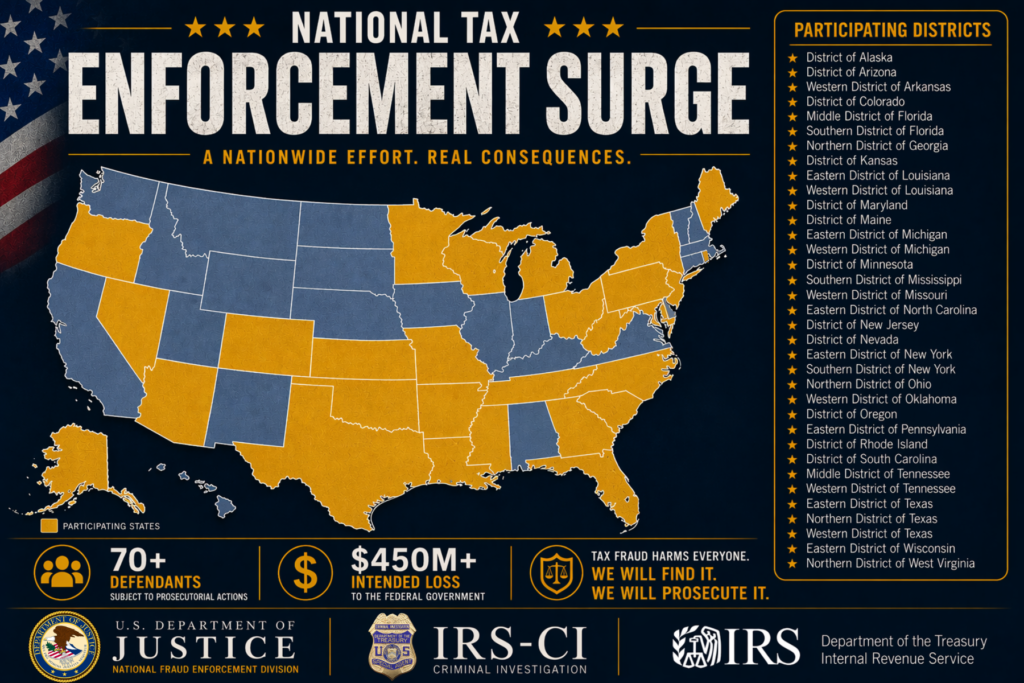
It also applies to the Oct. 14 announcement that recent nationwide efforts by the Department of Justice (DoJ), Internal Revenue Service, and IRS Criminal Investigation (IRS-CI) resulted in legal action against 76 people suspected of criminal tax acts.
Their alleged fraud attempts, according to the agencies, totaled an estimated $490 million in potential lost tax revenue.
The disruption of the suspected schemes and charges against alleged perpetrators took place over the last six weeks in what federal officials have dubbed the first-ever National Tax Enforcement Surge.
And here’s where timing applies. This successful collective law enforcement effort comes on the heels of a Government Accountability Office study that found federal tax fraud losses could be as much as $304 billion a year.
Multi-agency surge to catch tax crooks: The effort was led by the DoJ’s National Fraud Enforcement Division, which was created in early April. Its Tax Section members and U.S. Attorneys’ Offices across the country worked with IRS and IRS-CI agents to expose the tax fraud cases and bring charges.
DoJ prosecutors returned 23 actions with new charges against 31 defendants from the surge investigations. The estimated intended loss to the public arising from these allegations exceeds approximately $350 million.
The Fraud Division’s Tax Section and the U.S. Attorneys also were part of around 39 other enforcement actions, including trials, guilty pleas, and sentencings. These legal proceeding affected another 45 defendants whose actions produced an estimated intended loss of nearly $140 million.
“The investigations announced today involve hundreds of millions in identified tax losses to the United States, funds that should have supported the programs and services Americans depend on every day. When taxpayers evade their legal obligations, the burden does not disappear, it is shifted to law-abiding Americans,” said Jarod Koopman, chief of IRS-CI, the tax agency’s law enforcement arm, and overall Chief Tax Compliance Officer.
Memphis tax pro blues
.
Tax fraud blues: “Income tax fraud schemes strike at the very heart of our federal government’s financial ability to provide services and protection for our citizens, and we will use all available resources to punish and deter such dishonest criminal behavior,” added D. Michael Dunavant, U.S. Attorney of the Western District of Tennessee, which played a key role in the prosecutorial effort.
He also noted that the surge’s success sends a clear message: “There will always be a consequence, a reckoning, for stealing from the American taxpayer.”
IRS-CI’s official announcement cited three adjudicated cases that were part of the combined tax fraud crackdown and which left residents of the Home of the Blues singing their own sad songs.
- Memphis, Tennessee, tax preparer Lynnette Hogue pleaded guilty on Oct. 13 to preparing false tax returns for clients. The returns contained false and fraudulent items, which generated refunds the clients were not entitled to receive. Hogue also pleaded guilty to willfully failing to file her own tax returns, even though she earned substantial income from her tax return preparation business. Court documents revealed that the fraudulent filings cost the IRS of $4.1 million. Hogue is scheduled to be sentenced on Jan. 15, 2027, and faces a maximum penalty of four years in prison.
… - Rebecca Gilley, another Memphis tax preparation business owner, was sentenced to 30 months in federal prison on Oct. 8 for filing false tax returns on behalf of some of her clients. The returns were filed over five years, and included false education credits and sick and family leave credits. Court record indicate that in tax years 2020 and 2021 alone, Gilley filed more than 1,000 tax returns seeking more than $9.25 million in fraudulent sick and family leave credits. She often added these false items to her clients’ returns without their knowledge and rarely reviewed the final returns with the clients. In total, Gilley’s fraudulent tax filings cost the U.S. Treasury more than $350,000. She was sentenced to one year of supervised release and ordered to pay $289,908 in restitution to the IRS. She also is permanently be enjoined from operating as a tax return preparer.
… - Frank Jason Cole of Memphis pleaded guilty on Sept. 14 to wire fraud for preparing and submitting false tax returns. The case was developed after IRS investigative analysts examined tax filings associated with Cole that showed unusual filings of Form 944, Employer’s Annual Federal Tax Return. The filings included unprecedented business refund requests, notably Employee Retention Credit (ERC) claims, a COVID pandemic era tax break. Court records show Cole prepared and filed false business tax returns in 2022 and 2023 for 52 individuals, requesting more than $24 million in false refunds, of which over $19 million were paid. At his sentencing, scheduled for Jan. 21, 2027, he will face a maximum penalty of 20 years in federal prison, a three-year period of supervised release, restitution, and monetary penalties.
Beware unscrupulous tax pros: Beyond the Memphis location, I must note that all three of the individuals above prepared tax returns for others. That’s a good, albeit disheartening, reminder that some tax pros are in it for themselves, not their clients.
Unscrupulous tax preparers too often make it into the IRS’ annual Dirty Dozen tax scam list. Stay up to date on these schemes. And definitely thoroughly check out the person you are considering hiring to help you file your taxes.
You can read about more sketchy tax pros who were caught in the surge in the DoJ’s separate announcement. It cites another 11 cases in other parts of the country that were brought as part of the unified effort against tax fraud.
Nationwide tax fraud
.
The DoJ’s separate announcement cited another 11 cases in other parts of the country that were brought as part of the successful surge against tax fraud.
Tax Felon Friday: As you realized from the jail cell photo atop this post, the success of the multi-agency effort to stop, arrest, and prosecute tax fraudsters obviously makes it onto the ol’ blog’s Tax Felon Friday page.
In this standing feature, you can catch up on tax miscreants who have been charged and/or had their criminal cases finalized, as well as posts on other crime-adjacent tax information.
You also can find more tax crime news, notably items published long before I gave them a special end-of-week feature moniker, in the ol’ blog’s tax crimes category. You’ll find this post at the top of that collection, so just scroll down for more.