


…
Unfortunately for parents, finding — and paying for — child care isn’t as easy as stacking youngster’s blocks. At least the tax code offers some help in covering these expenses, with two tax-favored child care options expanded this year.
…
Parents have one less thing to worry (so much) about now that school is (or soon will be) back in session. Their children will be supervised by teachers and other educators for most weekdays.
But that doesn’t mean moms and dads are totally off the hook, especially when it comes to younger children.
If parents have jobs outside the home, they likely need child care for the hours that school is out, but they must still be at their jobs.
The tax code has long offered a variety of dollar-saving help for parents. The Republicans’ One Big Beautiful Bill Act (OBBBA), the massive domestic policy, budget, and tax reform bill enacted on Independence Day 2025, enhanced some of those tax breaks.
The changes include changes that took effect this 2026 tax year to two popular child care tax provisions.
Here’s look at how the OBBBA enhanced the Child and Dependent Care Credit and the workplace benefit that helps employees’ pay for dependent care.
Child and Dependent Care Credit: Any working parent will confirm that one of the biggest line items in their family budget is the one for child care. And it’s only going up.
The average parent spends 20 percent or more of annual income on child care, according to Care.com’s latest annual Cost of Care Report. It notes that 31 percent are dipping into savings to cover the expense. And those numbers were tallied before the current inflation burst.
Claiming the Child and Dependent Care Credit can help eligible parents recover some of those costs. A great thing about this tax break is that since it is a tax credit, the amount for which you qualify will offset any tax you owe a dollar-for-dollar.
And that amount increased this year per OBBBA. Starting this Jan. 1, the maximum Child and Dependent Care Credit percent went from 35 percent of your allowable child care expenses to 50 percent of that amount.
Yeah, I saw y’all cringe over the internet. Those percentage amounts mean you must do some math.
First, start with your total qualifying child care expenses. The maximum amount you’re allowed to claim is $3,000 if the care is for one youngster. It’s $6,000 if the care is for two or more.
The actual tax credit amount then is calculated as a percentage of that amount. Last year, that was 35 percent. This year and beyond, it is 50 percent.
So, the actual dollar tax credit claim this year could be up to $1,500 for one child’s care or $3,000 for the care of multiple children.
I am not a parent, but even I know that doesn’t make much of a dent in a family’s overall child care costs. But any amount of help, well, helps. And again, it is a tax credit that will directly reduce any amount you owe Uncle Sam.
Income affects credit amount: One of the key requirements to claim the Child and Dependent Care tax credit is that you (and your jointly-filing spouse, if you’re married) have income earned from work.
The exact Child and Dependent Care tax credit amount is based on a percentage of earnings. And those earnings, either as a single parent or a working couple, will affect just how much of the potentially maximum $1,500 or $3,000 tax credit you can claim.
As you make more, you’re allowed to claim a smaller percentage your care costs. The percentages of care expenses that can be claimed for taxpayers’ specific earnings ranges are shown in the table below.
The maximum credit amount of 50 percent of eligible expenses is available to taxpayers who make a maximum of $15,000 a year.
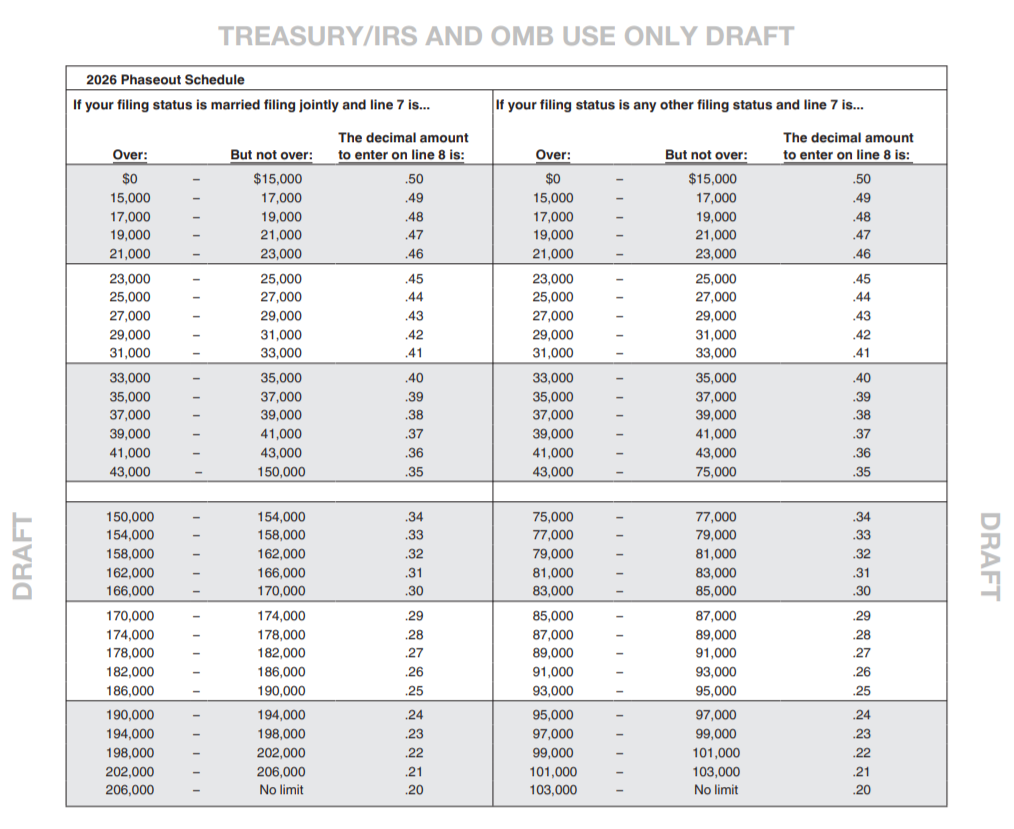
Once you earn $15,001 or more, the amount of the credit starts phasing down to a maximum of 20 percent of child care expenses. That income level is $206,001 for joint filers and $103,001 for all other filing statuses.
Again, these figures are from a draft table in preparation for 2026 tax returns. But this latest version was released on Monday, Aug. 24, so the Treasury Department and Internal Revenue Service probably won’t make many (if any) revisions between now and next year’s filing season.
When they are finalized, you’ll claim your child care costs on Form 2441 (this link goes to the 2026 tax year draft).
I’m again sensing your trepidation at having to deal with all these figures. But for most of us, tax software or our tax preparer will take care of the specifics.
Regardless of whether you, your computer or your tax pro does the calculating, it’s generally worth the extra effort since the result will immediately lower what you owe.
Other care credit considerations: You do, however, need to be aware of the other requirements that come into play when claiming the Child and Dependent Care credit.
The credit is available if you need the child care to go to your aforementioned job or jobs in families where both spouses work. But the IRS will allow your claim if you paid for care so that you could look for work.
In addition, the youngster for whom the credit is being claim must be younger than age 13 when the care is/was provided. That child also must be claimed as a dependent on your tax return.
You must provide the name, address and Taxpayer Identification Number (TIN) of the person who provided the care. That ID number generally is a Social Security number (SSN) or an Employer Identification Number (EIN).
Some caregivers, however, don’t count when it comes to claiming the Child and Dependent Care credit. You cannot claim the tax credit if the person you paid to care for your child was —
- your spouse;
- a parent of the child (for example, an ex-spouse);
- anyone listed as a dependent on your tax return (for example, your between-job brother whom you are supporting); or
- your own child age 18 or younger, regardless of whether they are a dependent on your tax return (for example, an older sibling looking after a younger one).
Also, while the Child and Dependent Care tax credit will directly lower the tax you owe, it is a nonrefundable credit. That means that if your credit amount is larger than your tax liability, you lose that amount. For example, if you get a $2,000 child care credit and owe $1,800 in taxes when you file, you can only zero out that $1,800 tax bill. The excess $200 from the child care credit cannot be sent to you as a refund.
Finally, note the tax break’s full name. If you have other older tax dependents (or a disabled spouse) who need care so you can work or look for employment, the Child and Dependent Care Tax Credit can help offset those costs, too.
Workplace dependent care assistance: While an immediate reduction in your tax bill via the Child and Dependent care tax credit is appealing, some folks get other tax-related care help from their employer.
They can put money into a tax-favored dependent care flexible spending account (FSA) at work. Yes, it operates like the more widely-used medical FSA company benefit.
Your workplace’s dependent care account is pre-tax. That is, it is funded via automatic paycheck contributions made before taxes are calculated. You then use this separate untaxed FSA money to pay eligible child and dependent care costs.
Beginning this year, the limit for workplace dependent care assistance increased from the prior $5,000 to $7,500.
The OBBBA change is the first permanent increase in the dependent care FSA limit since the 1980s. And while parents will find any increase in the allowed amount welcome, the new higher limit is not indexed for inflation.
Still, depending on your family and income situation, a workplace dependent care FSA may be more beneficial than claiming the Child and Dependent Care tax credit. Again, a tax professional can help you determine which works best for your circumstances.
Coordinating both benefits: Yes, it is possible to take advantage of both child care tax benefits. You just can’t double dip. If you have a dependent care FSA at work, you must subtract the amount in that account from the allowable expenses you use to claim the Child and Dependent Care tax credit.
For example, you put $4,000 in a workplace care FSA and spend $6,000 on care of your two children for the tax year. When calculating the credit, you must subtract the FSA’s $4,000. That gives you just $2,000 to claim as a care tax credit on Form 2441.
Also, if both you and your spouse work and each has access to a dependent care FSA, coordinate how to maximize this benefit. Even though both parent’s workplaces now can allow them to contribute up to $7,500 in a child care account, the tax code says that working parents’ combined contributions to separate child care spending accounts cannot exceed $7,500.
Again, it takes some work to get the most out of child care tax benefits. But as parents, dealing with child-related complications is nothing new. And when it comes to tax breaks tied to your children, doing the extra planning and work could be worth it.
…
Advertisements
🌟 Search Amazon Tax Products 🌟
The text link above is an affiliate ad. If you click through and then buy a product, I receive a commission.
